ADVANCED FINANCIAL REPORTING THEORY REVISION
| Institution | University |
| Course | CERTIFIED PUBLIC ACC... |
| Year | 1st Year |
| Semester | Unknown |
| Posted By | stephen |
| File Type | |
| Pages | 17 Pages |
| File Size | 785.01 KB |
| Views | 4735 |
| Downloads | 0 |
| Price: |
Buy Now
 Buy via
whatsapp Buy via
whatsapp
|


Description
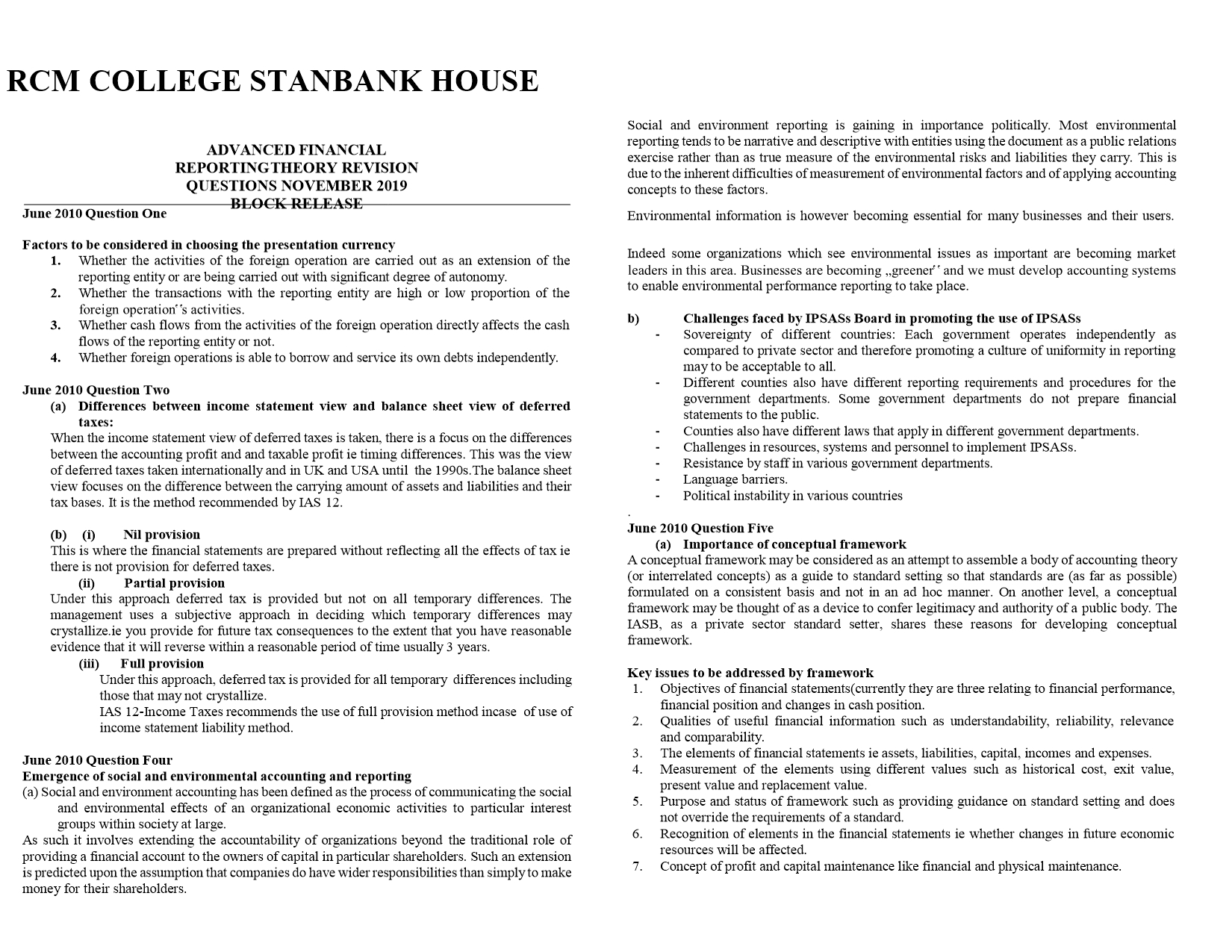
Factors to be considered in choosing the presentation currency
1. Whether the activities of the foreign operation are carried out as an extension of the
reporting entity or are being carried out with significant degree of autonomy.
2. Whether the transactions with the reporting entity are high or low proportion of the
foreign operations activities.
3. Whether cash flows from the activities of the foreign operation directly affects the cash
flows of the reporting entity or not.
4. Whether foreign operations is able to borrow and service its own debts independently.
June 2010 Question Two
(a) Differences between income statement view and balance sheet view of deferred
taxes:
When the income statement view of deferred taxes is taken, there is a focus on the differences
between the accounting profit and and taxable profit ie timing differences. This was the view
of deferred taxes taken internationally and in UK and USA until the 1990s.The balance sheet
view focuses on the difference between the carrying amount of assets and liabilities and their tax bases. It is the method recommended by IAS 12.
(b) (i) Nil provision
This is where the financial statements are prepared without reflecting all the effects of tax iethere is not provision for deferred taxes.
(ii) Partial provision
Under this approach deferred tax is provided but not on all temporary differences. The
management uses a subjective approach in deciding which temporary differences may
crystallize.ie you provide for future tax consequences to the extent that you have reasonable
evidence that it will reverse within a reasonable period of time usually 3 years.
Below is the document preview.

Altered level of consciousness
Trending!
altered level of consciousness is defined as a condition of being less responsive to and aware of environmental stimuli.
• LOC is gauged on a continuum with a normal state of alertness and full cognition(consciousness) on one end and coma on the other end.
50 Pages
3857 Views
0 Downloads
934.22 KB
NEOPLASMS ASSOCIATED WITH THE HEART AND THE MANAGEMENT
Trending!
Tumors of the heart are rare; most (75% to 88%) are benign (Braunwald et al., 2001;
Kamiya et al., 2001).
• Primary tumors occur in less than 1% of the population; metastatic tumors have been
• reported in 1.5% to 35% of oncology patients (Braunwald et al., 2001; Reynan, 1996;
Shapiro, 2001).
• Tumors may be sites for thrombus formation and therefore create a risk of embolism.
• Dysrhythmias may occur as the myocardium or conduction system is affected.
PRIMARY CARDIAC TUMOURS
BENIGN
1. Myxoma
2. Papillary fibroelastoma
3. Fibroma
4. Lipoma
5. Rhabdomyomas
1. MYXOMA
• Myxoma is a noncancerous tumor that arises from connective tissue, which is tissue that connects and supports other tissues all over the body.
• Show familial pattern of tumor development based on autosomal dominant inheritance.
• Mostly occur after trauma or even surgery i.e atrial septal defects, valve repairs.
• Present with signs of right ventricle failure
49 Pages
4053 Views
0 Downloads
899.66 KB
GIT Anatomy and Physiology
Trending!
The Digestive System Consists of ;
a) Long hollow muscular tube or canal or tract called
gastrointestinal tract or (GIT):
• it is about 5 meters long
b) Accessory glands: include:
• Salivary glands
• Liver and gall bladder
• Pancreas
57 Pages
4336 Views
0 Downloads
1.95 MB
GASTROINTESTINAL SYSTEM DISORDERS
Trending!
Disorders of the digestive system have serious consequences for the activity of the organism as a whole
congenital malformations
traumatic processes
inflammatory processes
neoplastic processes
infectious processes
Digestive system communicates with the external environment through the intake of fluids and food.
Common git disorders
• Motor dysfunction of smooth muscle of the individual parts of the digestive system
• Indigestion of food and absorption of nutrients - malabsorption syndrome
• Bleeding into the individual parts of the digestive tract
• Perforation of the wall of the digestive system with subsequent leakage of the
contents to the peritoneal cavity
• Obstruction in moving of the contents of one part of the digestive system to the next
section
• Circulation disorders in the wall of the individual parts of the digestive system
53 Pages
3888 Views
0 Downloads
1.75 MB
GASTROINTESTINAL CANCERS
Trending!
Gastric or stomach cancer is a disease in which malignant (cancer) cells form in the lining of the stomach. Gastric cancer is the fifth most frequently diagnosed cancer and the third leading cause of cancer deaths worldwide.
(Globocan 2018,Babiker,2021)
47 Pages
4556 Views
0 Downloads
1.2 MB
Shoulder dystocia
Trending!
Definition: This describes the Impaction of the anterior shoulder against the symphysis pubis after delivery of the fetal head.
Shoulder dystocia is said to have occurred when there is:
• Failure of the shoulders to rotate spontaneously into anterior, posterior diameter of the pelvis outlet after delivery of the head
• The anterior shoulder becomes trapped behind or on the symphysis pubis while the posterior shoulder may be in the hollow of the sacrum or high above the sacral promontory
36 Pages
4092 Views
0 Downloads
1.35 MB
Community Midwifery
Trending!
Domiciliary Care
It’s the care given to a pregnant woman by a midwife at her home environment, embracing prenatal, Intranatal and postpartum management.
59 Pages
5028 Views
0 Downloads
1.81 MB
PEDIATRICS - IMNCI and ETAT
Trending!
INTEGRATED MANAGEMENT OF NEWBORN AND CHILDHOOD ILLNESS
INTRODUCTION(IMNCI )
• A systematic approach with interventions that focuses on the health, growth and development of children under five years of àge
• Indicates strategies that were developed by UNICEF, WHO, and MOH to reduce preventable disability, mortality and morbidity rates in children under five years of age.
• Strategies include preventable measures on the part of families and communities as well as
curative actions to be taken by health workers and health facilities
22 Pages
4319 Views
1 Downloads
713.35 KB
AGE AND DRUG DISPOSITION
Trending!
Rational use of medications in neonates depends on an appreciation of the physiologic
immaturity and developmental maturation that influence neonatal drug disposition. Have altered body composition, weight, size and physiologic parameters.
37 Pages
3823 Views
0 Downloads
429.18 KB
Analgesics
Inflammation is mediated by prostaglandins
• The treatment of inflammation involves two
primary goals: First, the relief of symptoms and
the maintenance of function; and second, the
slowing or arrest of the tissue-damaging process.
• Salicylates and other similar agents share the
capacity to suppress the signs and symptoms of inflammation.
• They also exert antipyretic and analgesic effects.
42 Pages
1972 Views
0 Downloads
821.32 KB