ADVANCED FINANCIAL REPORTING THEORY REVISION
| Institution | University |
| Course | CERTIFIED PUBLIC ACC... |
| Year | 1st Year |
| Semester | Unknown |
| Posted By | stephen |
| File Type | |
| Pages | 17 Pages |
| File Size | 785.01 KB |
| Views | 4737 |
| Downloads | 0 |
| Price: |
Buy Now
 Buy via
whatsapp Buy via
whatsapp
|


Description
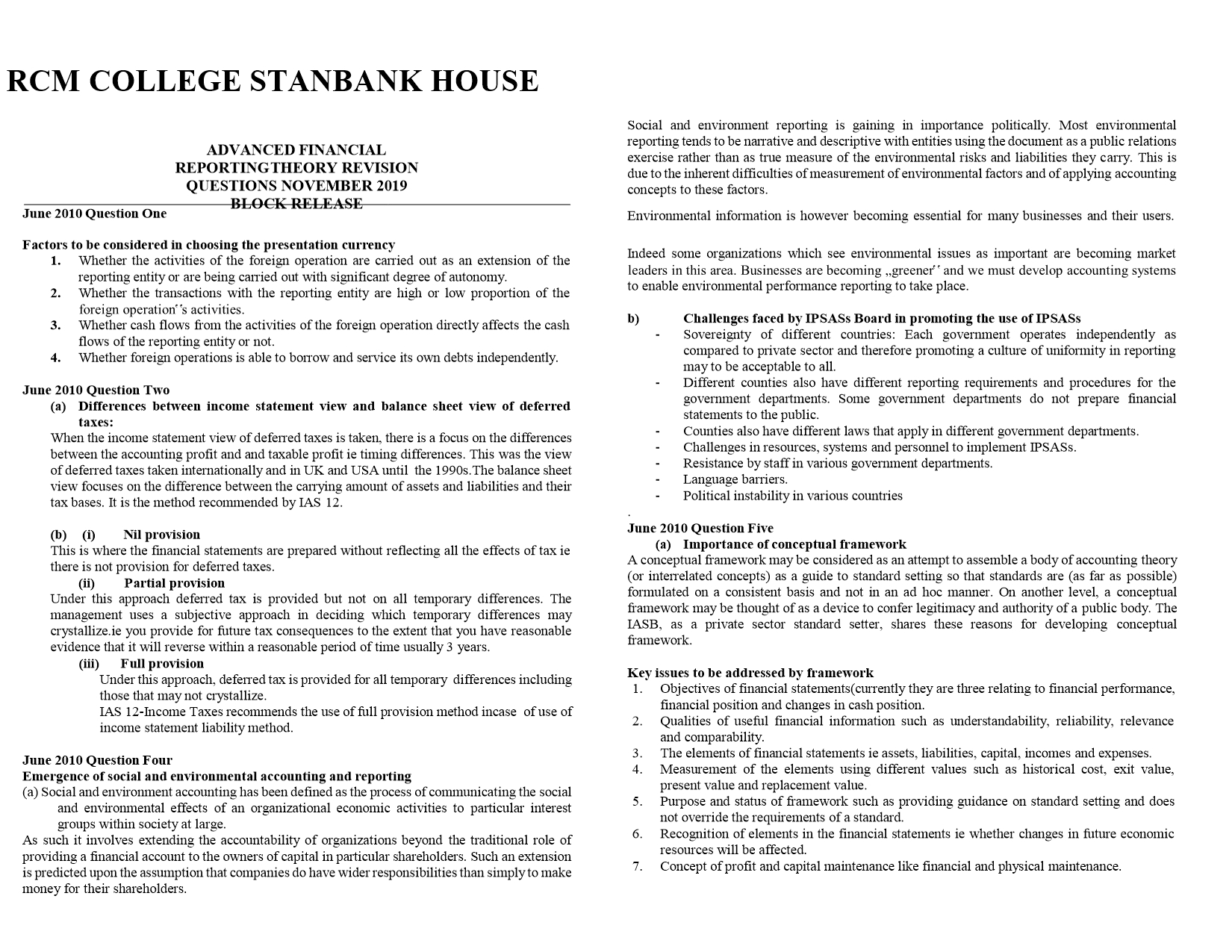
Factors to be considered in choosing the presentation currency
1. Whether the activities of the foreign operation are carried out as an extension of the
reporting entity or are being carried out with significant degree of autonomy.
2. Whether the transactions with the reporting entity are high or low proportion of the
foreign operations activities.
3. Whether cash flows from the activities of the foreign operation directly affects the cash
flows of the reporting entity or not.
4. Whether foreign operations is able to borrow and service its own debts independently.
June 2010 Question Two
(a) Differences between income statement view and balance sheet view of deferred
taxes:
When the income statement view of deferred taxes is taken, there is a focus on the differences
between the accounting profit and and taxable profit ie timing differences. This was the view
of deferred taxes taken internationally and in UK and USA until the 1990s.The balance sheet
view focuses on the difference between the carrying amount of assets and liabilities and their tax bases. It is the method recommended by IAS 12.
(b) (i) Nil provision
This is where the financial statements are prepared without reflecting all the effects of tax iethere is not provision for deferred taxes.
(ii) Partial provision
Under this approach deferred tax is provided but not on all temporary differences. The
management uses a subjective approach in deciding which temporary differences may
crystallize.ie you provide for future tax consequences to the extent that you have reasonable
evidence that it will reverse within a reasonable period of time usually 3 years.
Below is the document preview.

Anti- infective agents
Trending!
Anti-infective agents are drugs designed to target foreign organisms that have invaded and infected the body of a human host. The goal of anti-infective agents is to interfere with the normal function of the invading organism to prevent it from reproducing and to cause cell death without affecting host cells
15 Pages
3596 Views
0 Downloads
447.88 KB
Antineoplastic agents
Trending!
All cancers start with a single cell that is genetically different (mutated). This cell divides, eventually producing a tumor or neoplasm that has characteristics quite different from those of the original tissue.
• Cancer cells lose their normal function (anaplasia), develop characteristics that allow them to grow in an uninhibited way (autonomy), and have the ability to travel to other sites in the body that are conducive to their growth (metastasis).
44 Pages
4271 Views
0 Downloads
859.09 KB
Antidiabetics
Trending!
Insulin is the hormone produced by the pancreatic beta cells of the islets of Langerhans.
• The hormone is released into circulation when the levels of glucose around these cells rise
• Insulin is released from pancreatic beta cells at a low basal rate and at a much higher stimulated rate in response to a variety of stimuli, especially glucose.
• The liver and kidney are the two main organs that remove insulin from the circulation
32 Pages
4652 Views
0 Downloads
751.35 KB
Anti-Fungal Agents
Trending!
An antifungal agent is a drug that selectively eliminates fungal pathogens from a host with minimal toxicity to the host. Fungi can be found throughout the world in all kinds of environments. Most fungi don’t cause disease in people. However, some species can infect humans and cause illness. While most fungal infections affect areas such as the skin and nails, some can lead to more serious and potentially life threatening conditions like meningitis or pneumonia. There are several types of antifungal drugs available to fight fungal infections.
27 Pages
4816 Views
0 Downloads
686.84 KB
ANTI-MALARIAL DRUGS
Trending!
Malaria is transmitted by the bite of infected female anopheles mosquitoes. During feeding, mosquitoes inject sporozoites, which circulate to the liver, and rapidly infect hepatocytes, causing asymptomatic liver infection (hepatic phase)(absent in falciparum; malariae) . Merozoites released from the liver, rapidly infect erythrocytes to begin the asexual erythrocytic stage of infection that is responsible for human disease. Multiple rounds of erythrocytic development, with production of merozoites that invade additional erythrocytes, lead to large numbers of circulating parasites and clinical illness
34 Pages
4086 Views
0 Downloads
561.95 KB
ANTI-PARKINSONIAN DRUGS
Trending!
It is a common movement disorder that involves dysfunction in the basal ganglia and associated brain structures.
• It is a progressive neurological disorder of muscle
movement characterized by:
Tremors
Muscle rigidity
Bradykinesias =slowness in initiating and carrying out
voluntary movements.
Postural and gait abnormalities
33 Pages
4272 Views
0 Downloads
713.75 KB
Anti-Protozoal Drugs
Trending!
Protozoa are a diverse group of unicellular
eukaryotic organisms, many of which are
motile.
• Parasitic protozoa are transmitted by insects or by fecal-oral route.
• In human.s protozoa mainly reside in blood or
intestine .
• Protozoa of medical importance include
plasmodium, amoeba, trypanosomes
leishmania etc
68 Pages
4060 Views
1 Downloads
1.34 MB
ANTIRETROVIRAL AGENTS
Trending!
Viruses are obligate intracellular parasites; their replication depends primarily on synthetic processes of the host cell. Therefore, to be effective, antiviral agents must either block viral entry into or exit from the cell or be active inside the host cell.
44 Pages
3882 Views
0 Downloads
844.75 KB
Antianginal drugs and anticoagulants
Trending!
CAD involves changes in the coronary vessels that promote atheromas, which narrow the coronary arteries and decrease their elasticity and responsiveness to normal stimuli.
• Angina pectoris occurs when the narrowed vessels cannot accommodate the myocardial demand for oxygen.
• When a coronary vessel is completely occluded, the cells that depend on that vessel for oxygen become ischemic, then necrotic, and die (MI).
37 Pages
3638 Views
0 Downloads
798.95 KB
Antiseptics and Disinfectants
Trending!
Antiseptics and disinfectants are locally acting
antimicrobial drugs. These agents are used to reduce acquisition and transmission of infection. Drugs suitable for antisepsis and disinfection cannot be used internally because of toxicity. As a rule, agents used as disinfectants are too harsh for application to living tissue
35 Pages
3492 Views
0 Downloads
907.84 KB