ADVANCED FINANCIAL REPORTING THEORY REVISION
| Institution | University |
| Course | CERTIFIED PUBLIC ACC... |
| Year | 1st Year |
| Semester | Unknown |
| Posted By | stephen |
| File Type | |
| Pages | 17 Pages |
| File Size | 785.01 KB |
| Views | 4719 |
| Downloads | 0 |
| Price: |
Buy Now
 Buy via
whatsapp Buy via
whatsapp
|


Description
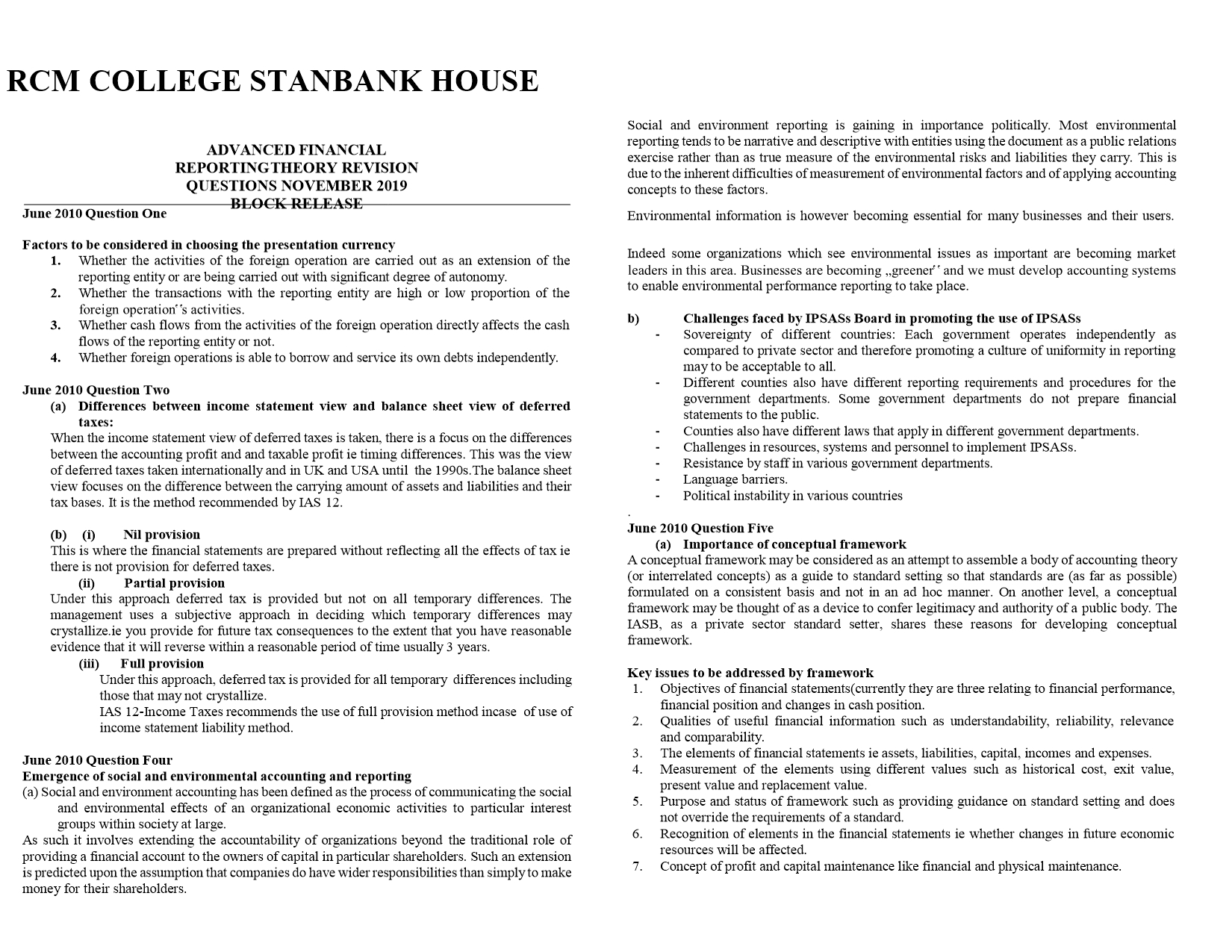
Factors to be considered in choosing the presentation currency
1. Whether the activities of the foreign operation are carried out as an extension of the
reporting entity or are being carried out with significant degree of autonomy.
2. Whether the transactions with the reporting entity are high or low proportion of the
foreign operations activities.
3. Whether cash flows from the activities of the foreign operation directly affects the cash
flows of the reporting entity or not.
4. Whether foreign operations is able to borrow and service its own debts independently.
June 2010 Question Two
(a) Differences between income statement view and balance sheet view of deferred
taxes:
When the income statement view of deferred taxes is taken, there is a focus on the differences
between the accounting profit and and taxable profit ie timing differences. This was the view
of deferred taxes taken internationally and in UK and USA until the 1990s.The balance sheet
view focuses on the difference between the carrying amount of assets and liabilities and their tax bases. It is the method recommended by IAS 12.
(b) (i) Nil provision
This is where the financial statements are prepared without reflecting all the effects of tax iethere is not provision for deferred taxes.
(ii) Partial provision
Under this approach deferred tax is provided but not on all temporary differences. The
management uses a subjective approach in deciding which temporary differences may
crystallize.ie you provide for future tax consequences to the extent that you have reasonable
evidence that it will reverse within a reasonable period of time usually 3 years.
Below is the document preview.

ANATOMY OF THE LIMBS
Trending!
The anatomy of the limbs includes bones, muscles, nerves, and joints.
Upper limbs
Shoulder: The shoulder is where the upper limb attaches to the trunk. The glenohumeral joint is formed by the humerus, scapula, and clavicle.
Radius: The radius pivots around the ulna to produce movement in the forearm.
Ulna: The ulna stabilizes the forearm.
Hand: The hand includes the carpals, metacarpals, and phalanges. The carpals are eight bones in the wrist. The metacarpals are the bones in the palm
65 Pages
5026 Views
0 Downloads
4.63 MB
INTRODUCTION TO HUMAN ANATOMY
Trending!
Anatomy: The study of the structure of the body
Physiology: The study of function of the living organism
Pathology: The study of disordered body function
43 Pages
4480 Views
0 Downloads
3.18 MB
INTRODUCTION TO ANATOMY PHYSIOLOGY
Trending!
Download full notes on INTRODUCTION TO ANATOMY PHYSIOLOGY. This notes will equip different terminologies about human anatomy and physiology ,division of human anatomy, names of the body regions and full description of hierarchal organization o the human body and lastly various organs systems and their roles .
74 Pages
4527 Views
0 Downloads
12.11 MB
CELL BIOLOGY ANATOMY & PHYSIOLOGY OF THE CELL
Trending!
The 3 Divisions of Human Anatomy:
1. Gross anatomy.
2. Developmental anatomy.
3. Microscopic anatomy.
Microscopic Anatomy:
Study of minute structures with aid of a microscope .
Histology: Study of tissues
Cytology: Study of cells
180 Pages
4731 Views
0 Downloads
11.55 MB
EXCITABLE TISSUE ORGANIZATION
Trending!
EXCITABLE TISSUES:
Can generate action
potentials (impulses)
A reserve for muscle
and nervous tissues
NON-EXCITABLE TISSUES:
Cannot generate the
electrical impulses
Refers to epithelial and
connective tissues
73 Pages
4234 Views
0 Downloads
4.7 MB
ANATOMY & PHYSIOLOGY OF THE NERVOUS SYSTEM
Trending!
Download comprehensive note on ANATOMY & PHYSIOLOGY OF THE NERVOUS SYSTEM.
SECTION I OBJECTIVES
1. State the role of the nervous system
2. Outline the divisions and subdivisions of the nervous system
3. Components of the nervous tissue
4. Types of neuroglial cells and the functions of each
5. Structure and classification of neurons
6. Differentiate between grey and white matter
130 Pages
4747 Views
0 Downloads
9.81 MB
CHEST WALL RESPIRATORY SYSTEM
Trending!
FUNCTIONS OF RESPIRATORY SYSTEM
1. Gaseous exchange
2. Acid-base balance
3. Phonation
4. Olfaction
5. Effort & evacuation
6. Endocrine functions
7. Venous return
8. Immune functions
128 Pages
4495 Views
0 Downloads
13.5 MB
SENSORY SYSTEMS
Trending!
Sensation: State of awareness of an external or internal stimulus
a) Special sensations: vision, olfaction, gustation, hearing &
equilibrium
b) General sensations: Visceral or somatic sensations
48 Pages
4443 Views
0 Downloads
5.27 MB
MALPOSITIONS OF OCCIPUT & MALPRESENTATIONS
Trending!
Malpositions & Malpresentations of the fetus present the midwife with a challenge of recognition and diagnosis both in the
antenatal period and during labor. It is therefore imperative for the learner midwives to have a thorough understanding of
the various fetal malpositions as well as malpresentations.
127 Pages
4363 Views
0 Downloads
1.53 MB
PERIOPERATIVE/THEATRE NURSING
Trending!
Theatre nursing has developed alongside the history of surgery.
• Surgery is an old form of treatment that can be traced back through the history of man.
• In the past, there were no theatres, no trained personnel, no anaesthesia and no equipment.
• Operations were performed at home.
• Problems during this time included infection, bleeding and pain.
141 Pages
4479 Views
0 Downloads
2.23 MB