ADVANCED FINANCIAL REPORTING THEORY REVISION
| Institution | University |
| Course | CERTIFIED PUBLIC ACC... |
| Year | 1st Year |
| Semester | Unknown |
| Posted By | stephen |
| File Type | |
| Pages | 17 Pages |
| File Size | 785.01 KB |
| Views | 4726 |
| Downloads | 0 |
| Price: |
Buy Now
 Buy via
whatsapp Buy via
whatsapp
|


Description
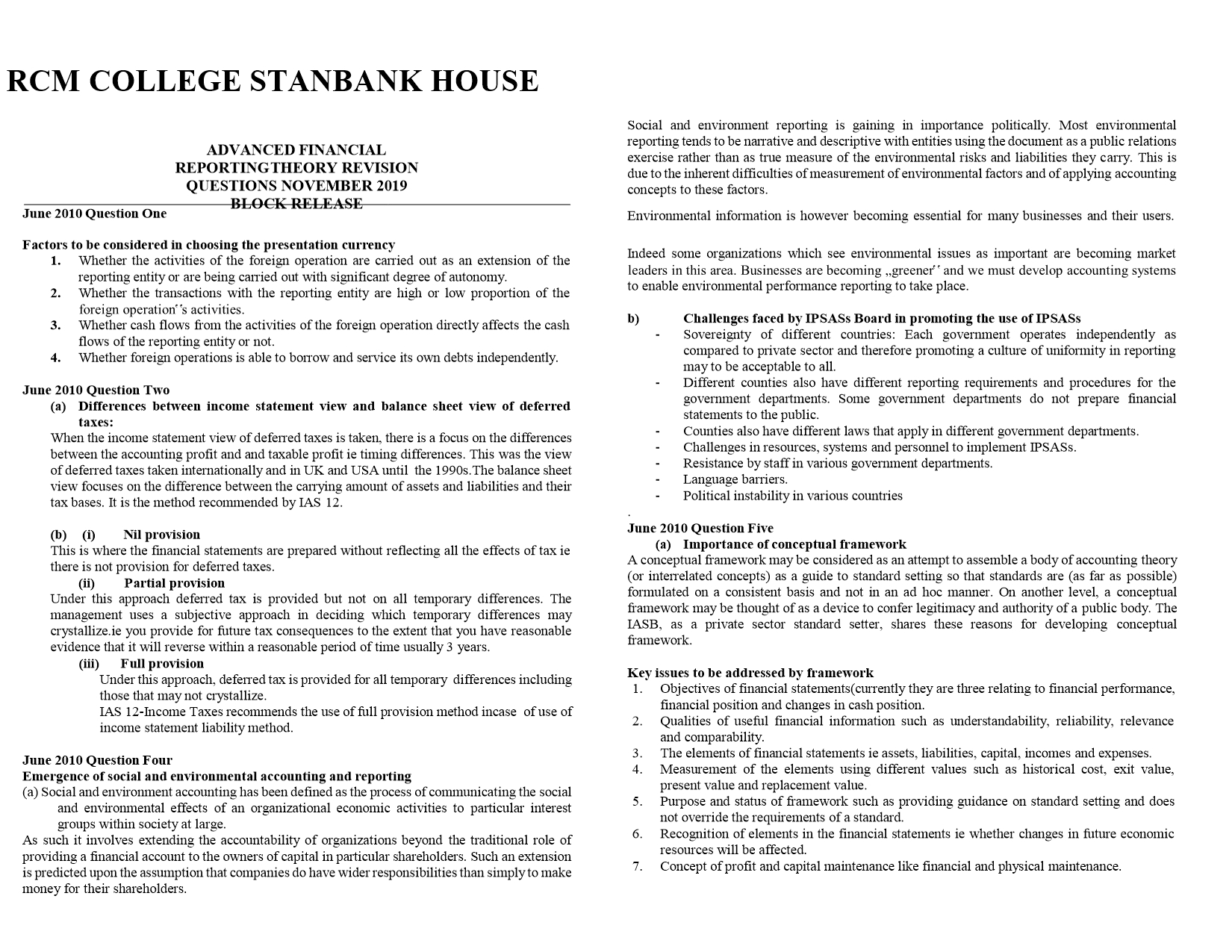
Factors to be considered in choosing the presentation currency
1. Whether the activities of the foreign operation are carried out as an extension of the
reporting entity or are being carried out with significant degree of autonomy.
2. Whether the transactions with the reporting entity are high or low proportion of the
foreign operations activities.
3. Whether cash flows from the activities of the foreign operation directly affects the cash
flows of the reporting entity or not.
4. Whether foreign operations is able to borrow and service its own debts independently.
June 2010 Question Two
(a) Differences between income statement view and balance sheet view of deferred
taxes:
When the income statement view of deferred taxes is taken, there is a focus on the differences
between the accounting profit and and taxable profit ie timing differences. This was the view
of deferred taxes taken internationally and in UK and USA until the 1990s.The balance sheet
view focuses on the difference between the carrying amount of assets and liabilities and their tax bases. It is the method recommended by IAS 12.
(b) (i) Nil provision
This is where the financial statements are prepared without reflecting all the effects of tax iethere is not provision for deferred taxes.
(ii) Partial provision
Under this approach deferred tax is provided but not on all temporary differences. The
management uses a subjective approach in deciding which temporary differences may
crystallize.ie you provide for future tax consequences to the extent that you have reasonable
evidence that it will reverse within a reasonable period of time usually 3 years.
Below is the document preview.

BCB 209: PURCHASING AND SUPPLIES MANAGEMENT
Full notes on PURCHASING AND SUPPLIES MANAGEMENT.
26 Pages
352 Views
0 Downloads
623.97 KB
BHR 2208: Conflict Management and Negotiation
Trending!
Conflict is a natural part of human interaction, and effective management is essential for maintaining productive relationships in personal, professional, and organizational settings. This course, BHR 2208: Conflict Management and Negotiation, provides students with a comprehensive understanding of conflict dynamics and equips them with practical skills for resolving disputes through negotiation and other conflict resolution techniques.
19 Pages
3025 Views
1 Downloads
312.23 KB
Inorganic Chemistry III Notes
Trending!
The document is a course module for Inorganic Chemistry III. It covers key topics such as symmetry, group theory, coordination chemistry, organometallic chemistry, and bioinorganic chemistry, emphasizing their principles and applications. The course aims to provide students with a comprehensive understanding of these concepts and their relevance in chemical reactions and properties.
79 Pages
3472 Views
0 Downloads
5.72 MB
Public Sector Accounting Lecture Notes
Trending!
This document discusses public sector accounting objectives and concepts. It explains that public sector organizations need dedicated accounting to ensure accountability to parliament and taxpayers. Key concepts covered include fund accounting, where separate accounts are created for different objectives; and different accounting techniques like budgetary, cash-based, and accrual accounting.
56 Pages
4384 Views
1 Downloads
578.29 KB
ADVOCATE TRAINING PROGRAMME PAST PAPERS
Access a compiled set of past papers with answers covering all units for revision purposes .
Civil Litigation
Criminal Litigation
Probate & Administration
Legal Writing & Drafting
Trial Advocacy
Professional Ethics
Legal Practice Management
Conveyancing
Commercial Transactions
163 Pages
751 Views
0 Downloads
24.09 MB
ATP100: CIVIL LITIGATION PAST PAPER
Trending!
CIVIL LITIGATION PAST PAPER for your revision and studies as you prepare for your final exams.
27 Pages
3451 Views
0 Downloads
611.51 KB
ATP101: CRIMINAL LITIGATION PAST PAPER
Trending!
Grab a copy CRIMINAL LITIGATION PAST PAPER where these topics appear frequently for revision purposes as you prepare for your exams.
Bail & Bond
Plea Taking
Identification Parades
Trial Procedure
Rights of the Accused
Appeals & Revision
Admissibility of Evidence
27 Pages
2949 Views
0 Downloads
608.29 KB
ATP102: PROBATE & ADMINISTRATION PAST PAPER
Trending!
Grab a copy PROBATE & ADMINISTRATION PASP PAPER which is highly practical, focusing on real-life legal scenarios for revision and study purposes.
27 Pages
3182 Views
0 Downloads
568.63 KB
ATP103: LEGAL WRITING & DRAFTING PAST PAPER
Trending!
LEGAL WRITING & DRAFTING PAST PAPER
24 Pages
3427 Views
0 Downloads
555.38 KB
ATP104: TRIAL ADVOCACY PAST PAPER
Trending!
Grab a copy of TRIAL ADVOCACY PAST PAPER for your revision and study purposes in preparation for your final exams.
24 Pages
3025 Views
0 Downloads
559.92 KB