IT and the Quality, Quantity and Organization of work
| Institution | Jomo Kenyatta University of Science and Technology |
| Course | Information Technol... |
| Year | 4th Year |
| Semester | Unknown |
| Posted By | Test |
| File Type | doc |
| Pages | |
| File Size | 39 KB |
| Views | 28308 |
| Downloads | 0 |
| Price: |
Buy Now
 Buy via
whatsapp |


Description
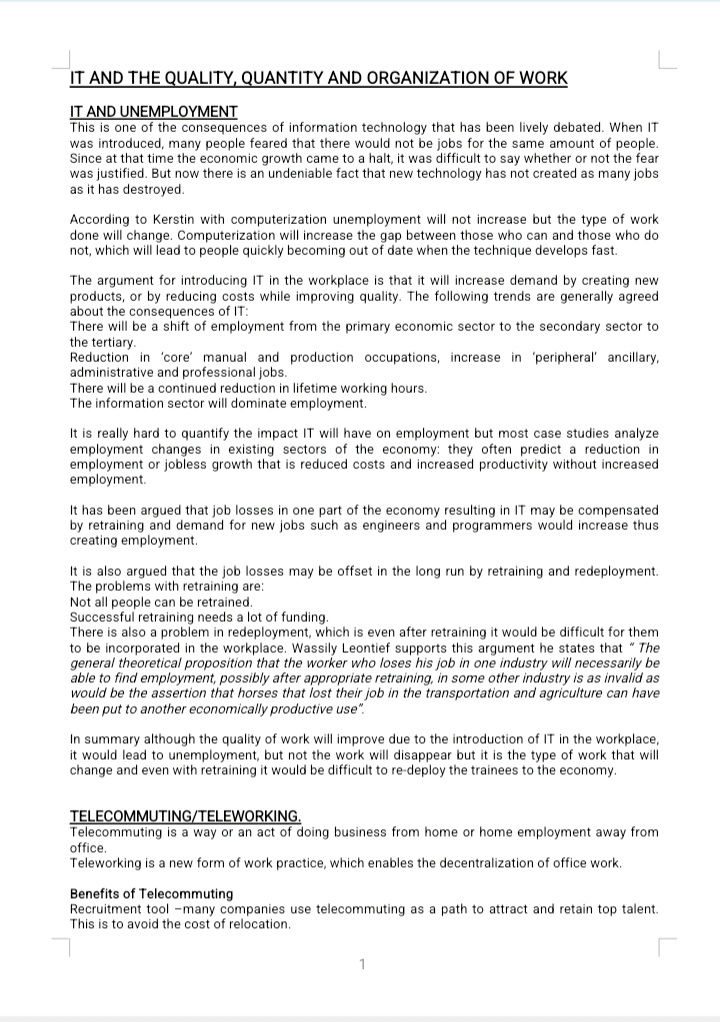
IT consistently delivers high-quality work that meets or exceeds expectations. The accuracy and attention to detail in their tasks showcase a strong understanding of the required technical skills. IT manages the quantity of work effectively, completing assignments within set deadlines without compromising on quality. Their ability to organize tasks and prioritize effectively ensures smooth workflows and efficient project completion. Overall, IT’s work is characterized by precision, reliability, and a well-organized approach to task management.
Below is the document preview.

BIT 2108: Lesson 4 Part 2 Digital Modulation
Trending!
Digital Modulation is the process of changing a digital signal into analogue form so that it can be transmitted over an analogue network. The Modulation process . At the sending end modulation occurs. At the receiving end the reverse operation known as demodulation occurs. Most data communication involves a two way transmission.
29 Pages
5556 Views
0 Downloads
294.59 KB
BIT 2108: Lesson 4 Part 1 Introduction to data communication and transmission modes 1
Trending!
Data communication is the exchange of data between two devices using some form of wired or wireless transmission medium. A communication system can be defined as the collection of hardware and software that facilitates intersystem exchange of information between different devices.
29 Pages
5624 Views
0 Downloads
282.48 KB
C Programming
C is a high-level, general-purpose programming language developed by Dennis Ritchie in 1972 at Bell Laboratories. Known for its efficiency and versatility, C has become a foundational language for system programming, including operating systems, embedded systems, and application development.
146 Pages
1875 Views
0 Downloads
1.75 MB
Introduction to C programming
Trending!
An Introduction to C Programming serves as the foundational step in learning one of the most widely used and powerful programming languages in computer science. C was developed in the early 1970s by Dennis Ritchie at Bell Labs and has become the backbone of modern programming due to its versatility and efficiency.
66 Pages
5342 Views
0 Downloads
433.24 KB
Introduction to Structured Programming
Trending!
Structured programming is a programming paradigm that emphasizes the use of a logical structure to improve clarity, quality, and development time. It is based on the idea of dividing a program into smaller, manageable sections or modules, making it easier to write, debug, and maintain.
15 Pages
5609 Views
0 Downloads
210.51 KB
Learn to program with C
Trending!
Learning to program in C is a great way to build a strong foundation in computer programming, as C is a powerful, versatile, and widely used language.
323 Pages
5376 Views
0 Downloads
3.36 MB