ADVANCED FINANCIAL REPORTING THEORY REVISION
| Institution | University |
| Course | CERTIFIED PUBLIC ACC... |
| Year | 1st Year |
| Semester | Unknown |
| Posted By | stephen |
| File Type | |
| Pages | 17 Pages |
| File Size | 785.01 KB |
| Views | 4747 |
| Downloads | 0 |
| Price: |
Buy Now
 Buy via
whatsapp Buy via
whatsapp
|


Description
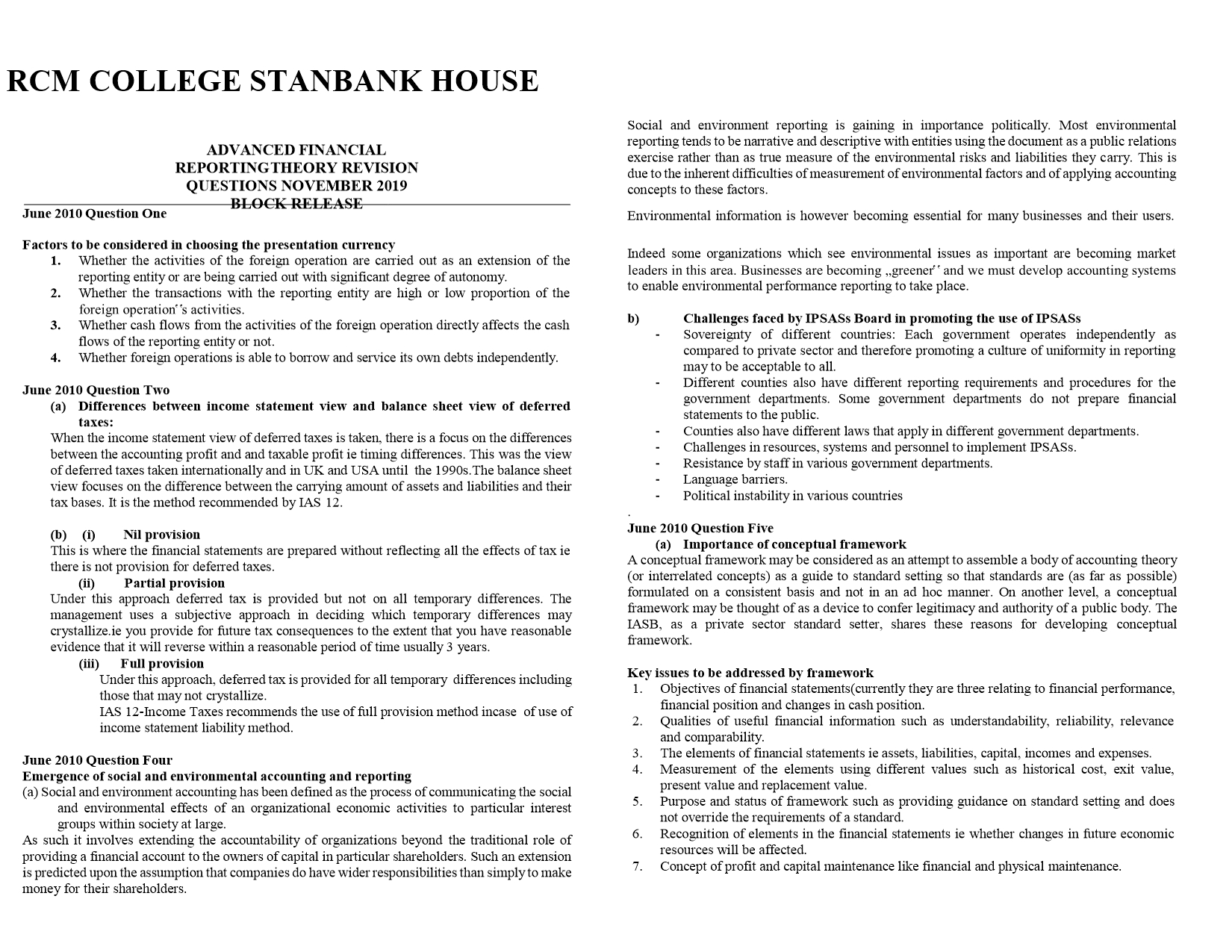
Factors to be considered in choosing the presentation currency
1. Whether the activities of the foreign operation are carried out as an extension of the
reporting entity or are being carried out with significant degree of autonomy.
2. Whether the transactions with the reporting entity are high or low proportion of the
foreign operations activities.
3. Whether cash flows from the activities of the foreign operation directly affects the cash
flows of the reporting entity or not.
4. Whether foreign operations is able to borrow and service its own debts independently.
June 2010 Question Two
(a) Differences between income statement view and balance sheet view of deferred
taxes:
When the income statement view of deferred taxes is taken, there is a focus on the differences
between the accounting profit and and taxable profit ie timing differences. This was the view
of deferred taxes taken internationally and in UK and USA until the 1990s.The balance sheet
view focuses on the difference between the carrying amount of assets and liabilities and their tax bases. It is the method recommended by IAS 12.
(b) (i) Nil provision
This is where the financial statements are prepared without reflecting all the effects of tax iethere is not provision for deferred taxes.
(ii) Partial provision
Under this approach deferred tax is provided but not on all temporary differences. The
management uses a subjective approach in deciding which temporary differences may
crystallize.ie you provide for future tax consequences to the extent that you have reasonable
evidence that it will reverse within a reasonable period of time usually 3 years.
Below is the document preview.

WIRELESS COMMUNICATIONS AND MOBILE COMPUTING
Trending!
Together with an explosive growth of the mobile applications and emerging of cloud computing concept, mobile cloud computing (MCC) has been introduced to be a potential technology for mobile services. MCC integrates the cloud computing into the mobile environment and overcomes obstacles related to the performance (e.g., battery life, storage, and bandwidth), environment (e.g., heterogeneity, scalability, and availability), and security (e.g., reliability and privacy) discussed in mobile computing. This paper gives a survey of MCC, which helps general readers have an overview of the .MCC including the definition, architecture, and applications. The issues, existing solutions, and approaches are presented. In addition, the future research directions of MCC are discussed. Copyright © 2011 John Wiley & Sons, Ltd
25 Pages
3803 Views
0 Downloads
1.57 MB
William Stallings Computer Organization and Architecture
Trending!
Hardwired systems are inflexible. General purpose hardware can do different tasks, given correct control signals. Instead of re-wiring, supply a new set of control signals
177 Pages
3952 Views
0 Downloads
17.23 MB
CMT 300 :DATA COMMUNICATIONS
Trending!
Data communication in a computer network refers to the process of transferring digital data between two or more devices connected within a network, allowing them to exchange information through a transmission medium like wires or wireless signals, essentially enabling communication between different computer systems by sending and receiving data packets across a network
266 Pages
3724 Views
0 Downloads
6.76 MB
Computer Architecture
Computer Architecture (1)
Definition
The design of integrated system which provides a useful tool to the programmer.(Baer)
The study of the structure, behaviour, and design of computers.(Hayes)
The design of the system specification at a general or subsystem level. (Abd-Alla)
The art of designing a machine that will be a pleasure to work with.(Foster)
The interface between the hardware and the lowest level software.(Hennessy and Patterson)
35 Pages
455 Views
0 Downloads
4.02 MB
Computer Architecture
Equip yourself with questions and answer to computer architectures.
6 Pages
439 Views
0 Downloads
231.27 KB
Computer Graphics
Computer Science as a disciplined has it source in mathematics. Computer graphics as course unit in Computer Science is purely mathematical. There is a need to familiarise with this maths concepts and see how the relate to graphics.
162 Pages
412 Views
0 Downloads
2.62 MB
Computer Graphics
The Graphics Pipeline
Last Class
• Application Stage
– Input from the world databases
– Collision detection
– Morphing
– Use of curves and Polygon Vertices ( Implicit curves and parametric curves)
• Geometry Stage
83 Pages
327 Views
0 Downloads
1.58 MB
2D GRAPICS USING HTML5 CANVAS
Trending!
HTML5 canvas provides methods which allow modifications directly to the transformation
matrix. The transformation matrix must initially be the identity transform. It may then be adjusted using the transformation methods.
21 Pages
3358 Views
0 Downloads
311.32 KB
INTRODUCTION TO COMPUTER NETWORKS
Exchange of information through the use of speech, signs or symbols is called
communication. When early humans started speaking, some 5,00,000 years ago,
that was the first mode of communication. Before we dive into modern
technologies that drive communication in contemporary world, we need to know
how humans developed better communication techniques to share knowledge with
each other.
31 Pages
374 Views
0 Downloads
1.06 MB
CMT 304 :DATA STRUCTURES & ALGORITHMS
Trending!
Data Structures are the programmatic way of storing data so that data can be used efficiently.
Almost every enterprise application uses various types of data structures in one or the other way.
64 Pages
3726 Views
0 Downloads
3.57 MB