ADVANCED FINANCIAL REPORTING THEORY REVISION
| Institution | University |
| Course | CERTIFIED PUBLIC ACC... |
| Year | 1st Year |
| Semester | Unknown |
| Posted By | stephen |
| File Type | |
| Pages | 17 Pages |
| File Size | 785.01 KB |
| Views | 4746 |
| Downloads | 0 |
| Price: |
Buy Now
 Buy via
whatsapp Buy via
whatsapp
|


Description
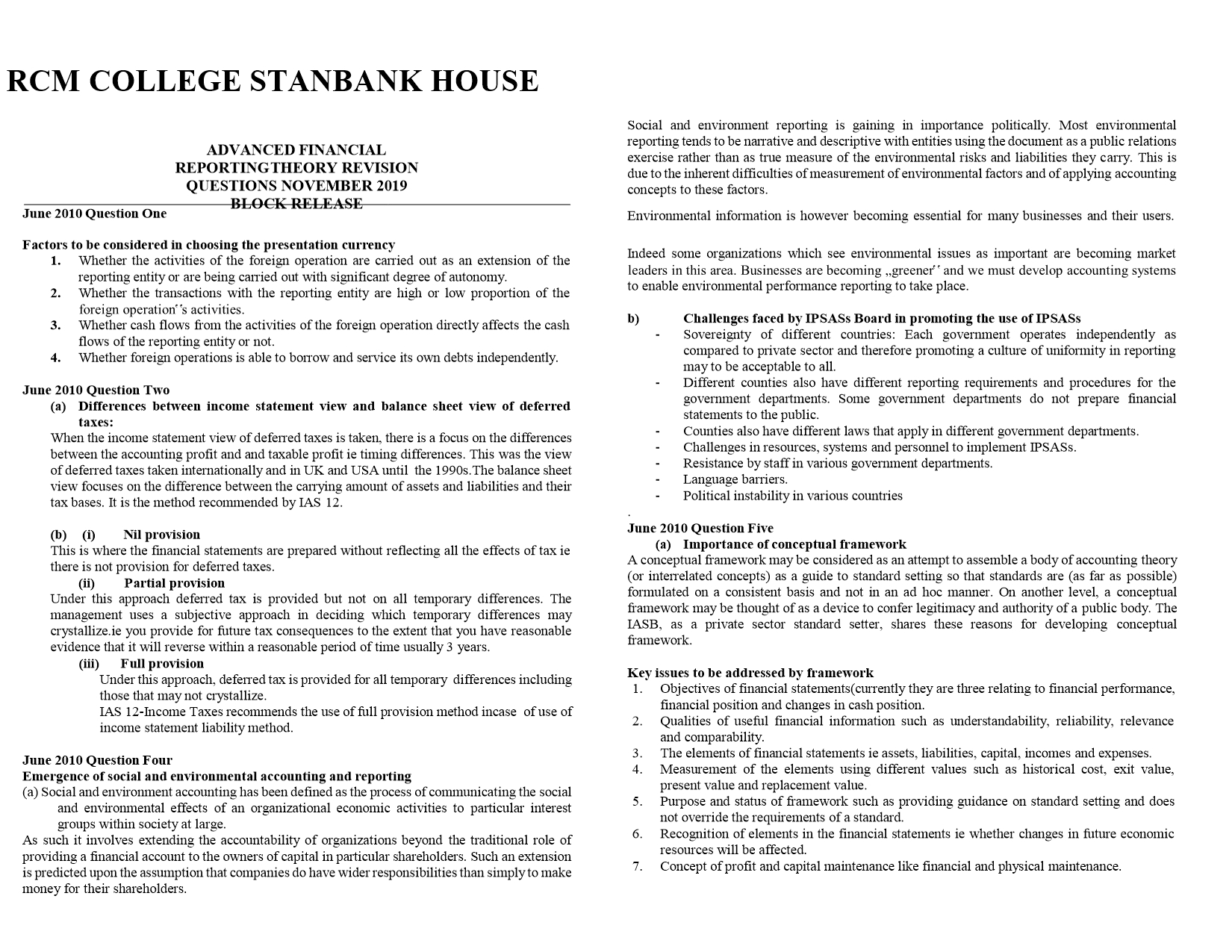
Factors to be considered in choosing the presentation currency
1. Whether the activities of the foreign operation are carried out as an extension of the
reporting entity or are being carried out with significant degree of autonomy.
2. Whether the transactions with the reporting entity are high or low proportion of the
foreign operations activities.
3. Whether cash flows from the activities of the foreign operation directly affects the cash
flows of the reporting entity or not.
4. Whether foreign operations is able to borrow and service its own debts independently.
June 2010 Question Two
(a) Differences between income statement view and balance sheet view of deferred
taxes:
When the income statement view of deferred taxes is taken, there is a focus on the differences
between the accounting profit and and taxable profit ie timing differences. This was the view
of deferred taxes taken internationally and in UK and USA until the 1990s.The balance sheet
view focuses on the difference between the carrying amount of assets and liabilities and their tax bases. It is the method recommended by IAS 12.
(b) (i) Nil provision
This is where the financial statements are prepared without reflecting all the effects of tax iethere is not provision for deferred taxes.
(ii) Partial provision
Under this approach deferred tax is provided but not on all temporary differences. The
management uses a subjective approach in deciding which temporary differences may
crystallize.ie you provide for future tax consequences to the extent that you have reasonable
evidence that it will reverse within a reasonable period of time usually 3 years.
Below is the document preview.

Amniotic Fluid.
Trending!
Protection: Amniotic fluid acts as a shock absorber hence protecting the fetus from any external trauma or sudden movement during pregnancy
2. Regulation of temperature : The Amniotic fluid is warm and of constant temperature hence it prevents fluctuation of temperature in the womb and keeps the fetus warm .
3. Provides lubrication: When body parts like the toes and fingers fuse together friction may
occur leading to some damage hence the amniotic fluid provide lubrication preventing fusing.
19 Pages
3647 Views
0 Downloads
686.9 KB
HAUTE COUTURE NOTES
Trending!
Haute Couture is a phrase that has very specific rules for qualification. Couture is a French word for dressmaking, while haute means high. These are garments created as one off pieces for a specific client. 19th century Englishman Charles Frederick Worth is considered as the father of Haute Couture and today members are selected by the Chambre Syndicale de la Haute Couture. To qualify as an official Haute Couture house, members must design made-to-order clothes for private clients, with more than one fitting, using an atelier (workshop) that employs at least fifteen fulltime staff. They must also have twenty fulltime technical workers in one of their workshops. Finally, Haute Couture houses must present a collection of not less than 50 original designs — both day and evening garments — to the public every season, in January and July
47 Pages
3874 Views
0 Downloads
766.16 KB
TRIMMING AND RENOVATION OF APPAREL
Trending!
This section is organized into two main parts, namely:
i. Trimming of apparel, and
ii. Renovation of apparel
TRIMMING OF APPAREL
Trimming refers to the decoration of a garment. It is the process of making a garment more beautiful or interesting, using accessories or garment details that are decorative as well as functional. Examples of accessories are the parts of a garment that are not part of its basic structure such as buttons, cuffs or collars. Garment details are trims that are added to the basic garment such as ribbons and appliqué. Details can either be bought ready made, or the garment maker can make them. Trimmings can be used when designing a garment, or they can be added to an old garment to improve its look. Trimming calls for one to be creative and imaginative so as to come up with an interesting look
24 Pages
3694 Views
0 Downloads
301.74 KB
CTID 323: TEXTILE TESTING LABS
Trending!
This textile testing laboratory manual is to be used with the textile testing teaching manual and any other text on textiles. The student is encouraged to read widely to supplement the information obtained from the results and be in a better position to answer the questions that follow each laboratory. Knowledge obtained will be useful to the pursuit of a successful career in apparel production, textile manufacturing, garment designing, retail buyers, choice and selection of textile products etc. This manual will be important to the students as well as the instructors.
For easy usage the manual is divided into three main parts namely:
i.Test for fibers
ii.Tests for yarns
Tests for fabrics
9 Pages
3913 Views
1 Downloads
303.38 KB
HANDLING SPECIAL FABRICS
Trending!
A special fabric may be distinguished because of:-
I. Its weight
ii. Its texture
iii. A decorative design
iv. Its purpose e.g. bridal, evening or swim wear.
A special fabric may require different handling techniques from the normal sewing practices. The special technique may include extra steps, planning unique pattern layout, omitting interfacings, topstitching hems or using special sewing equipment.
12 Pages
3503 Views
0 Downloads
355.6 KB
Exhibition display techniques
Trending!
Exhibition planning 02
First steps
Stakeholders and local connections
Exhibition proposal
Selecting the objects
Borrowing objects
Designing the layout
Assess your objects’ display requirements
20 Pages
3434 Views
0 Downloads
2.12 MB
CTID 431: Men's Wear
Trending!
We’ve said it time and time again, menswear is ruled by history and tradition. Every person in menswear (designer, stylist, editor, etc) has taken inspiration from the past at one time or another. And no era has been overlooked.
Therefore, as we continue to explore the foundations of personal style, I thought we’d take a quick look back at the last hundred-or-so years in men’s fashion. Perhaps this will provide a little insight or context as to how menswear shifts, and more importantly, how we can make informed decisions when it comes to buying clothing and developing personal style.
71 Pages
31697 Views
0 Downloads
3.24 MB
Different Types of Textile Testing Methods
Trending!
Different Types of Textile Testing Methods:
Quality Control Testing
A. Mechanical
1.Tensile Strength and Elongation
2.Breaking Strength
3.Bursting Strength
4.Tear Strength
5.Air permeability
6.Pilling Test
7.Dry and Wet Rubbing (Crock Meter)
8.Ether Soluble Matter
9.Water Absorbency
10.Lead and its compounds
11.Scouring loss
12.Flammability
17 Pages
4040 Views
0 Downloads
477.14 KB
CMT 212: CLOUD COMPUTING ESSENTIALS
Trending!
Cloud computing is a means by which computational power, storage, collaboration infrastructure, business processes and applications can be delivered as a utility, that is, a service or collection of services that meet your demands. The aspect of pay-as-you-go in the cloud is referred to as elasticity and is an extremely important concept within cloud computing.
On the whole, the cloud is basically an umbrella term that covers on-demand access to various computing resources. XaaS (Anything-as-a-Service) - This is a generic term which refers to any service which is available as cloud enabled service through internet. Some time it is also called ‘everything-as-a-service Backend-as-a-Service (BaaS) – Backend as a service (BaaS), or mobile backend as a service (mBaaS) is a model of cloud computing in which the vendor provides web and mobile application developers with tools and services to create a cloud backend for their applications. BaaS vendors typically use custom SDKs and APIs to give developers the ability to connect their applications to backend cloud storage and features such as user management, push notifications, and social network integration. Cloud Foundry – Cloud Foundry is an open-source cloud platform as a service that was originally developed as a joint venture between VMware, EMC, and General Electric, and is now owned by Pivotal Software. Cloud Management Platform (CMP) – A cloud management platform (CMP) is a product that gives the user integrated management of public, private, and hybrid cloud environments.
Cloud Marketplace - A cloud marketplace is an online marketplace, operated by a cloud service provider (CSP), where customers can browse and subscribe to software applications and developer services that are built on, integrate with, or supplement the CSP’s main offering. Amazon’s AWS . Marketplace and Microsoft’s Azure store are examples of cloud marketplaces. Cloud Washing – Cloud washing is a deceptive marketing technique used to rebrand old products by connecting them to the cloud, or at least to the term cloud. Grid computing is a group of networked computers that work together as a virtual supercomputer to perform large tasks, such as analyzing huge sets of data or weather modeling. Through the cloud, you can assemble and use vast computer grids for specific time periods and purposes, paying, if necessary, only for what you use to save both the time and expense of purchasing and deploying the necessary resources yourself. Also by splitting tasks over multiple mac
35 Pages
3880 Views
0 Downloads
1.47 MB
Data Backups and Cloud Computing
Trending!
Data backups and cloud computing can be treated as two separate subjects in one context and can be considered as complementary in another context. Data backups have been common since the inception of computers. Cloud computing, on the other hand, is a relatively recent phenomenon. The cloud infrastructure helps with effective data backups and is a low-cost disaster recovery option. Data backups help in ensuring restoration of data in case of data loss, data corruption, and data integrity issues.
26 Pages
3932 Views
0 Downloads
459.15 KB