ADVANCED FINANCIAL REPORTING THEORY REVISION
| Institution | University |
| Course | CERTIFIED PUBLIC ACC... |
| Year | 1st Year |
| Semester | Unknown |
| Posted By | stephen |
| File Type | |
| Pages | 17 Pages |
| File Size | 785.01 KB |
| Views | 4741 |
| Downloads | 0 |
| Price: |
Buy Now
 Buy via
whatsapp Buy via
whatsapp
|


Description
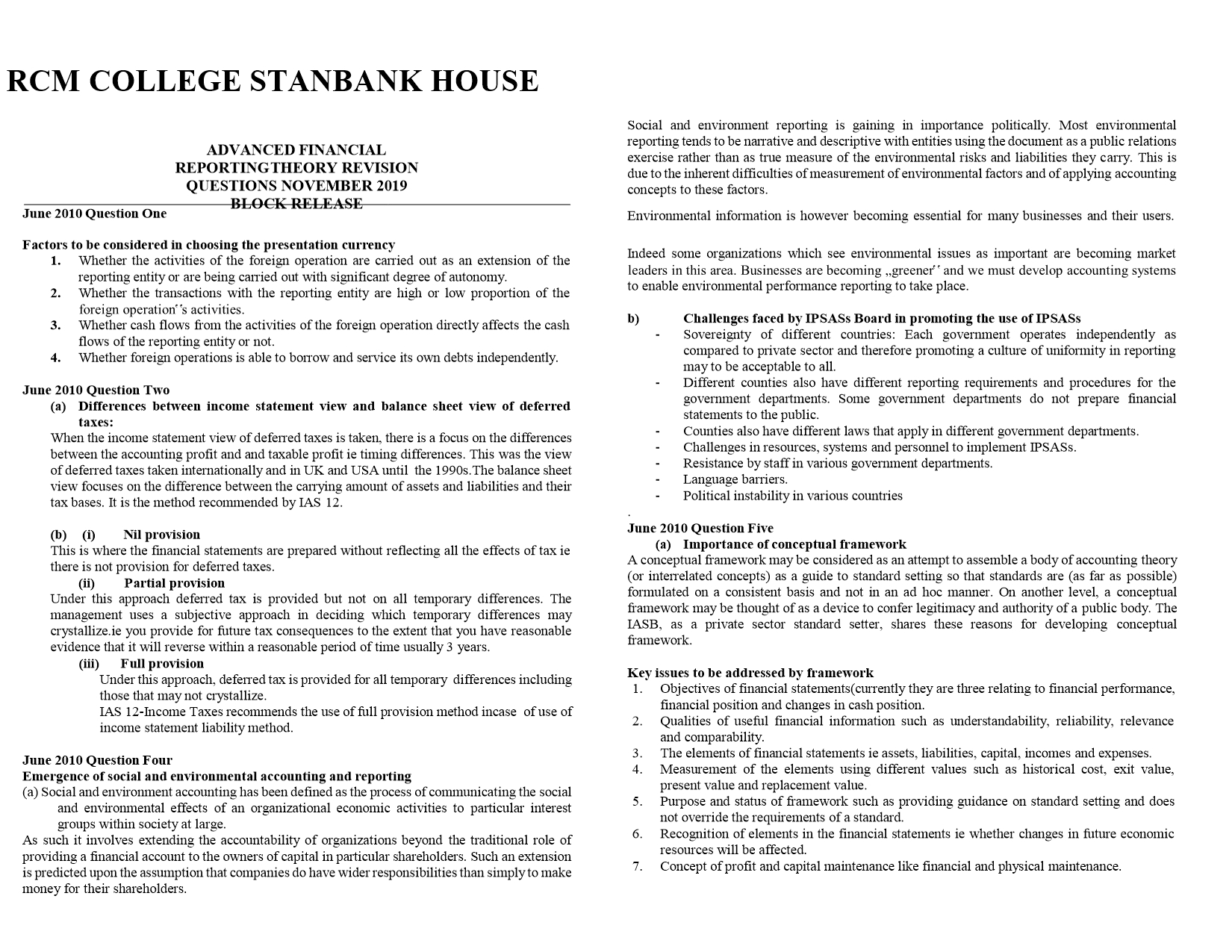
Factors to be considered in choosing the presentation currency
1. Whether the activities of the foreign operation are carried out as an extension of the
reporting entity or are being carried out with significant degree of autonomy.
2. Whether the transactions with the reporting entity are high or low proportion of the
foreign operations activities.
3. Whether cash flows from the activities of the foreign operation directly affects the cash
flows of the reporting entity or not.
4. Whether foreign operations is able to borrow and service its own debts independently.
June 2010 Question Two
(a) Differences between income statement view and balance sheet view of deferred
taxes:
When the income statement view of deferred taxes is taken, there is a focus on the differences
between the accounting profit and and taxable profit ie timing differences. This was the view
of deferred taxes taken internationally and in UK and USA until the 1990s.The balance sheet
view focuses on the difference between the carrying amount of assets and liabilities and their tax bases. It is the method recommended by IAS 12.
(b) (i) Nil provision
This is where the financial statements are prepared without reflecting all the effects of tax iethere is not provision for deferred taxes.
(ii) Partial provision
Under this approach deferred tax is provided but not on all temporary differences. The
management uses a subjective approach in deciding which temporary differences may
crystallize.ie you provide for future tax consequences to the extent that you have reasonable
evidence that it will reverse within a reasonable period of time usually 3 years.
Below is the document preview.

FETAL SKULL
Although the skull appears to be 1 large bone, there are actually several major bones that are connected together. The major bones that compose the skull of a newborn include the following:
2 frontal bones
2 parietal bones
1 occipital bone
These bony plates cover the brain and are held together by fibrous material called sutures.
Sutures allow the bones to move during the birth process. They act like an expansion joint. This allows the bone to enlarge evenly as the brain grows and the skull expands. The result is a symmetrically shaped head. Some sutures extend to the forehead, while others extend to the sides and back of the skull. One suture in the middle of the skull extends from the front of the head to the back.
26 Pages
274 Views
0 Downloads
1.08 MB
Female Genital Mutilation (FGM):
Trending!
Female Genital Mutilation (FGM): Comprises all procedures involving partial or total removal of
the female genitalia or any other injury to the female genital organs or any harmful procedure to the female genitalia, for non-medical reasons and includes clitoridectomy, excision and infibulations but does not include a sexual reassignment or a medical procedure that has a genuine therapeutic purpose.(NATIONAL ADOLESCENT SEXUAL AND REPRODUCTIVE HEALTH POLICY 2015 )
• Comprises all procedures involving partial or total removal of the external female genitalia or other injury tothe female genital organs whether for cultural or other non-therapeutic reasons.(WHO)
39 Pages
3223 Views
0 Downloads
916.92 KB
FLUID AND HYDRATION STATUS ASSESSEMENT IN CHILDREN
Trending!
Body fluids contain water and solutes, the solutes are electrolytes e.g. Na+, K+, Cl- and non electrolytes e.g. glucose and urea.
Osmolality is the concentration of solutes (electrolytes and proteins) per liter. Fluid homeostasis is present when fluid and electrolyte balance is maintained despite variation in dietary intake, metabolic rate and renal function.
41 Pages
4348 Views
0 Downloads
761.08 KB
PEDIATRIC NURSING ASTHMA AND STATUS ASTHMATICUS
Trending!
Asthma is a chronic respiratory condition where airways become inflamed
thus they narrow, swell and produce extra mucus causing difficulty in breathing, recurring episodes of wheezing , chest tightness and coughing.
27 Pages
4125 Views
0 Downloads
957.98 KB
RIGHTS OF DRUG ADMINISTRATION
Trending!
Is an act of giving a treatment, such as drug, to a patient. It includes
the way it given, the dose or how often it is given. Drugs can be administered orally as liquids, capsules tablets or chewable. Understanding the rights of drug administration can help a nurse to
provide effective and appropriate medication to a patient without any medication errors, ignoring these rights may lead to severe pain, sufferings and even death to the patients. Nurses, who primarily involved in the administration of drugs “medication”, benefit from this simplified memory aid to help them to administer medications safely with high quality.
14 Pages
3898 Views
0 Downloads
632.58 KB
Notes on Human Resource Management
Trending!
This document discusses various methods for performance appraisal in organizations. It describes traditional methods like confidential reports, ranking, and graphical rating scales. It also outlines modern methods such as management by objectives, assessment centers, and behaviorally anchored rating scales. The key steps in performance appraisal are establishing standards, communicating standards, measuring actual performance, comparing performance to standards, and taking corrective actions if needed. Performance appraisal aims to systematically evaluate employee performance and potential for development.
118 Pages
3740 Views
0 Downloads
807.66 KB
SICKLE CELL
This is name given collectively to a group of Haemoglobin S abnormalities.
• The haemoglobin S is recessive and can only be inherited from both parents, symptoms manifest in those with homozygous [HbSS], normal haemoglobin trait is [HbA]
• This is a condition arising from a mutation in the haemoglobin [HbS] leading to the red blood cells being sickle shaped and decreasing the oxygen carrying capacity. This is also hereditary, parents with the sickle cell trait have a 25% of having a child with sickle cell disease
27 Pages
943 Views
0 Downloads
419.56 KB
PAEDIATIC NURSING
Trending!
A burn is an injury to the skin or any other organ tissue, primarily caused by exposure to heat, radiation, electricity, excess friction and contact with chemicals.
• Young children especially those less than 5 years of age are at a high risk for burns and have the highest mortality rate among the paediatric population (burns are the leading cause of death from unintentional injury among children, 1- 4 years).
• Most burn related injuries in children result in death; extensive burns, however, can result in serious body deformation and disfigurement
• Carbon monoxide poisoning often occurs in conjunction with burns, children and infants being at a greater risk as compared to adults.
40 Pages
4555 Views
0 Downloads
1.41 MB
HISTORY TAKING AND HEALTH ASSESSMENT FOR A MALE
Trending!
Full Name: for proper identification of patient
Age: Certain conditions, such as prostate cancer and benign prostatic hyperplasia,
become more prevalent with advancing age
Birth date and place:
Sex: some conditions manifest differently based on sex
Religion: important for cultural competence in nursing
Occupation: Helps to identify risk factors to certain conditions (e.g people who use
motorbikes)
Marital Status: [Single/Married/Divorced]
Ethnicity/Nationality: Ethnic and national groups may experience varying health
outcomes due to socioeconomic factors, access to care, and systemic inequalities.
34 Pages
3674 Views
0 Downloads
1.08 MB
DERMATOLOGICAL CONDITIONS
Trending!
Dermatological refers to disorders or disease that affect the skin, hair and nails. This conditions manifest in different ways including rushes, itching, swelling blisters, discoloration and sores. Dermatological conditions are caused by variety of factors such as infections(bacterial, fungal or viral), autoimmune disorders, allergies, genetic predisposition, hormonal imbalance and certain medication
40 Pages
3342 Views
0 Downloads
1.11 MB