Introduction to Logic Programming using Prolog
| Institution | Jomo Kenyatta University of Science and Technology |
| Course | Information Technol... |
| Year | 3rd Year |
| Semester | Unknown |
| Posted By | Jeff Odhiambo |
| File Type | ppt |
| Pages | |
| File Size | 1.69 MB |
| Views | 4159 |
| Downloads | 0 |
| Price: |
Buy Now
 Buy via
whatsapp Buy via
whatsapp
|


Description
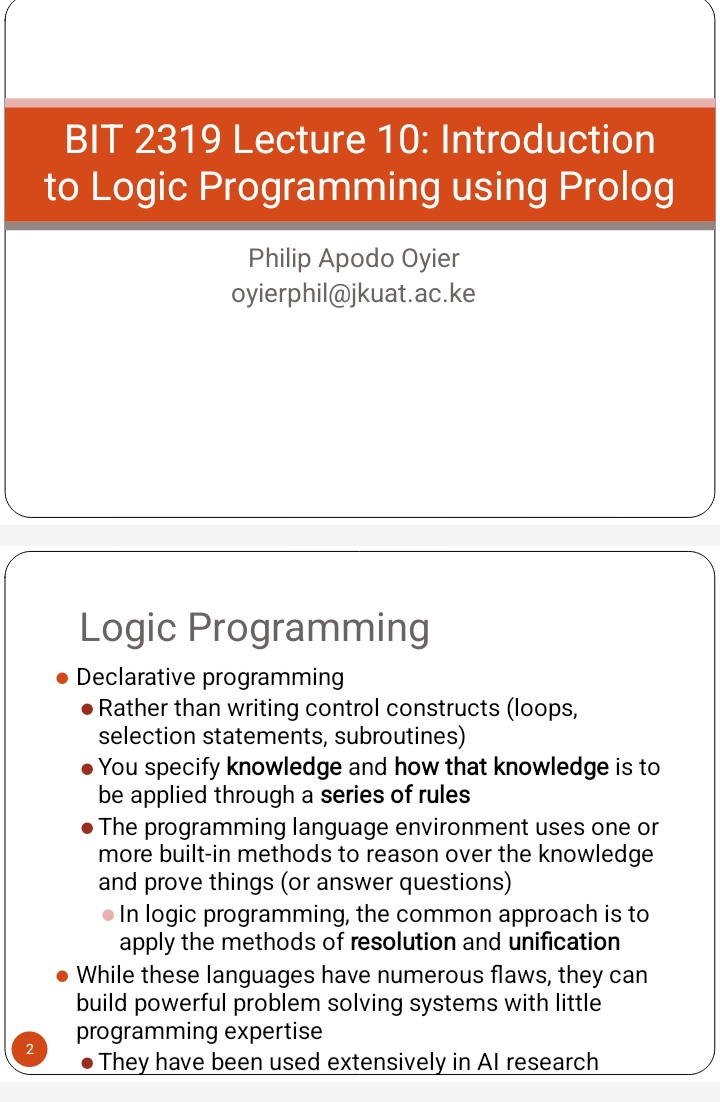
Introduction to Logic Programming using Prolog covers the fundamentals of Prolog, a declarative programming language based on formal logic. In Prolog, programs are written as a set of facts, rules, and queries, where the system attempts to answer queries by applying logical inference to the facts and rules provided. Unlike imperative programming languages, Prolog focuses on what the problem is, rather than how to solve it, making it particularly suited for tasks involving symbolic reasoning, such as artificial intelligence, natural language processing, and expert systems. The key concepts in Prolog include predicates, facts, rules, and backtracking, which allow for efficient problem-solving through logical deductions.
Below is the document preview.

Network Services and Applications
On completion of this course, you will be able to:
Understand FTP fundamentals.
Understand TFTP fundamentals.
Understand DHCP fundamentals.
Understand Telnet fundamentals.
Understand HTTP fundamentals.
Understand DNS fundamentals.
Understand NTP fundamentals.
23 Pages
325 Views
0 Downloads
811.5 KB
WAN Technologies
On completion of this course, you will be able to:
Understand the basic concepts and development history of WANs.
Understand PPP and PPPoE implementations.
Master basic PPP and PPPoE configurations.
Understand basic MPLS/SR concepts.
29 Pages
293 Views
0 Downloads
1.04 MB
Network Management and O&M
On completion of this course, you will be able to:
Understand basic concepts of network management and O&M.
Master common network management and O&M methods.
Describe basic functions of network management and O&M.
Understand the fundamentals of SNMP.
Understand Huawei iMaster NCE and related technologies.
19 Pages
351 Views
0 Downloads
646.48 KB
SDN and NFV Overview
On completion of this course, you will be able to:
Describe the development of SDN and NFV.
Understand basic principles of OpenFlow.
Understand Huawei SDN solution.
Understand the standard NFV architecture.
Understand Huawei NFV solution.
29 Pages
364 Views
0 Downloads
1.35 MB
Network Programmability and Automation
On completion of this course, you will be able to:
Describe the difficulties of conventional network O&M.
Understand the implementation of network automation.
Understand the classification of programming languages.
Describe the Python code style.
Describe the basic usage of Python telnetlib
17 Pages
316 Views
0 Downloads
471.79 KB
Typical Campus Network Architectures and Practices
Trending!
On completion of this course, you will be able to:
Understand the definition of campus networks.
Understand the typical networking architectures of campus networks.
Master the planning and design methods of small campus networks.
Master the deployment and implementation methods of small campus networks.
Understand the small campus network O&M concepts.
Understand the small campus network optimization concepts.
Independently complete a campus network project.
25 Pages
3109 Views
0 Downloads
809.84 KB
BIT 2317: COMPUTER SECURITY
Trending!
Institution: Jomo Kenyatta University of Science and Technology
Year: 2016/2017
Semester: 4th Year, 1st Semester (4.1)
SMA 2101: CALCULUS I
Trending!
To understand the word function, we consider the following scenario and definitions. For example, the growth of a sidling is an instance of a functional relation, since the growth may be affected by variations in temperature, moisture, sunlight, etc. If all these factors remain constant, then the growth is a function of time.
117 Pages
3705 Views
0 Downloads
592.87 KB
BIT 2317: COMPUTER SYSTEM SECURITY
Trending!
Institution: Jomo Kenyatta University of Science and Technology
Year: 2016/2017
Semester: 3rd Year, 1st Semester (3.1)
BIT 2317: COMPUTER SYSTEMS SECURITY
Trending!
Institution: Jomo Kenyatta University of Science and Technology
Year: 2016/2017
Semester: 4th Year, 2nd Semester (4.2)