Introduction to Logic Programming using Prolog
| Institution | Jomo Kenyatta University of Science and Technology |
| Course | Information Technol... |
| Year | 3rd Year |
| Semester | Unknown |
| Posted By | Jeff Odhiambo |
| File Type | ppt |
| Pages | |
| File Size | 1.69 MB |
| Views | 4128 |
| Downloads | 0 |
| Price: |
Buy Now
 Buy via
whatsapp Buy via
whatsapp
|


Description
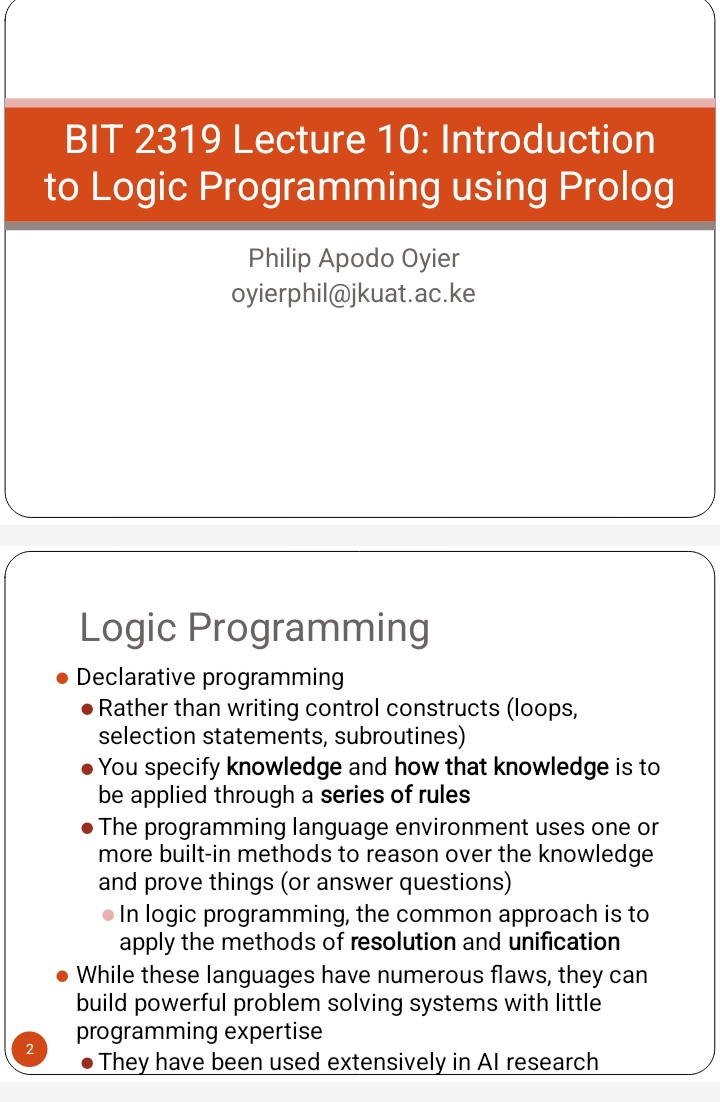
Introduction to Logic Programming using Prolog covers the fundamentals of Prolog, a declarative programming language based on formal logic. In Prolog, programs are written as a set of facts, rules, and queries, where the system attempts to answer queries by applying logical inference to the facts and rules provided. Unlike imperative programming languages, Prolog focuses on what the problem is, rather than how to solve it, making it particularly suited for tasks involving symbolic reasoning, such as artificial intelligence, natural language processing, and expert systems. The key concepts in Prolog include predicates, facts, rules, and backtracking, which allow for efficient problem-solving through logical deductions.
Below is the document preview.

BIT 2108: Lesson 4 Part 2 Digital Modulation
Trending!
Digital Modulation is the process of changing a digital signal into analogue form so that it can be transmitted over an analogue network. The Modulation process . At the sending end modulation occurs. At the receiving end the reverse operation known as demodulation occurs. Most data communication involves a two way transmission.
29 Pages
5109 Views
0 Downloads
294.59 KB
BIT 2108: Lesson 4 Part 1 Introduction to data communication and transmission modes 1
Trending!
Data communication is the exchange of data between two devices using some form of wired or wireless transmission medium. A communication system can be defined as the collection of hardware and software that facilitates intersystem exchange of information between different devices.
29 Pages
5152 Views
0 Downloads
282.48 KB
C Programming
C is a high-level, general-purpose programming language developed by Dennis Ritchie in 1972 at Bell Laboratories. Known for its efficiency and versatility, C has become a foundational language for system programming, including operating systems, embedded systems, and application development.
146 Pages
1721 Views
0 Downloads
1.75 MB
Introduction to C programming
Trending!
An Introduction to C Programming serves as the foundational step in learning one of the most widely used and powerful programming languages in computer science. C was developed in the early 1970s by Dennis Ritchie at Bell Labs and has become the backbone of modern programming due to its versatility and efficiency.
66 Pages
4770 Views
0 Downloads
433.24 KB
Introduction to Structured Programming
Trending!
Structured programming is a programming paradigm that emphasizes the use of a logical structure to improve clarity, quality, and development time. It is based on the idea of dividing a program into smaller, manageable sections or modules, making it easier to write, debug, and maintain.
15 Pages
5017 Views
0 Downloads
210.51 KB
Learn to program with C
Trending!
Learning to program in C is a great way to build a strong foundation in computer programming, as C is a powerful, versatile, and widely used language.
323 Pages
4944 Views
0 Downloads
3.36 MB
IT Certification Roadmap
Trending!
IT certification roadmap outlines the steps to achieve certifications that validate skills in various areas of Information Technology. These certifications are grouped based on categories such as foundational, intermediate, and advanced levels, as well as specialization fields like networking, cybersecurity, cloud computing, data science, and more.
2 Pages
5400 Views
0 Downloads
183.05 KB
Deadlock
Trending!
Deadlocks can occur in a variety of different situations besides requesting dedicated I/O devices.
Mostly, deadlocks involve resources when processes have been granted exclusive access to
devices, data records, files, and so forth. Such objects are referred to resources. A computer system
will normally have different resources that can be acquired.
8 Pages
4928 Views
0 Downloads
173.61 KB
File Management
Trending!
File management refers to the process of organizing, storing, accessing, and maintaining files on a computer or storage device. It involves the systematic handling of data to ensure it is easy to locate, secure, and update. Efficient file management is critical for productivity and data integrity.
5 Pages
4811 Views
0 Downloads
236.57 KB
Introduction to Operating Systems
Trending!
An Operating System (OS) is a crucial software layer that serves as the interface between computer hardware and users or application programs. It manages and coordinates hardware resources such as the CPU, memory, storage, and input/output devices, ensuring efficient and effective utilization.
9 Pages
5303 Views
0 Downloads
260.19 KB