Introduction to Logic Programming using Prolog
| Institution | Jomo Kenyatta University of Science and Technology |
| Course | Information Technol... |
| Year | 3rd Year |
| Semester | Unknown |
| Posted By | Jeff Odhiambo |
| File Type | ppt |
| Pages | |
| File Size | 1.69 MB |
| Views | 4134 |
| Downloads | 0 |
| Price: |
Buy Now
 Buy via
whatsapp Buy via
whatsapp
|


Description
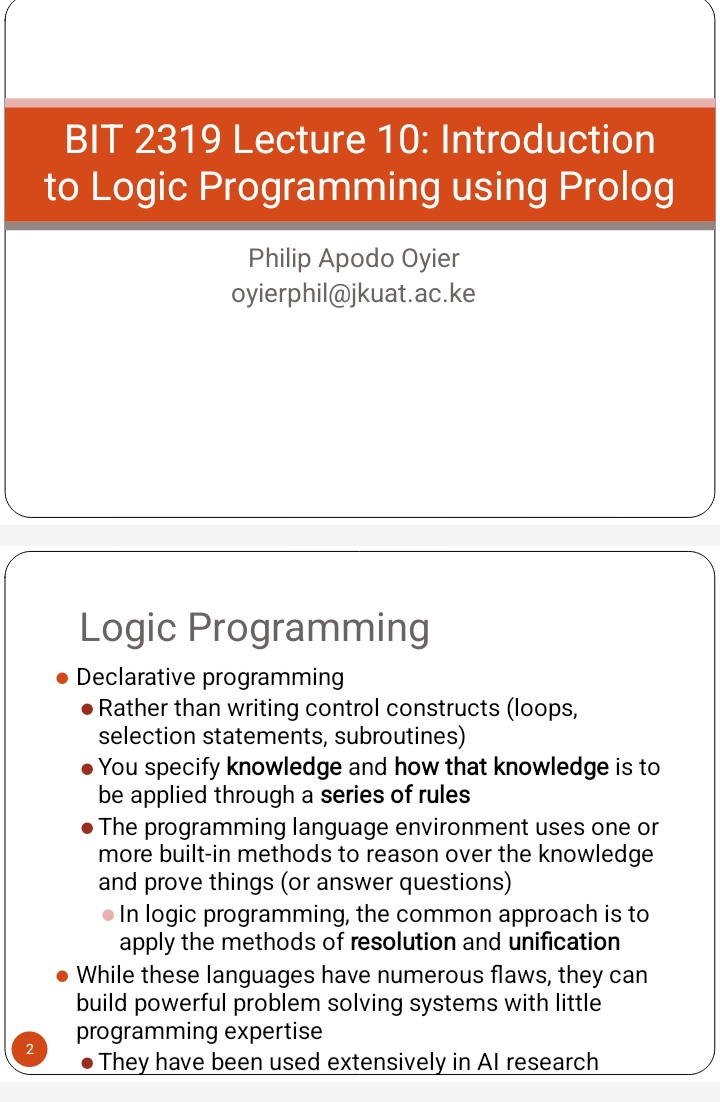
Introduction to Logic Programming using Prolog covers the fundamentals of Prolog, a declarative programming language based on formal logic. In Prolog, programs are written as a set of facts, rules, and queries, where the system attempts to answer queries by applying logical inference to the facts and rules provided. Unlike imperative programming languages, Prolog focuses on what the problem is, rather than how to solve it, making it particularly suited for tasks involving symbolic reasoning, such as artificial intelligence, natural language processing, and expert systems. The key concepts in Prolog include predicates, facts, rules, and backtracking, which allow for efficient problem-solving through logical deductions.
Below is the document preview.

IO Device Management
Trending!
I/O (Input/Output) device management refers to the process of controlling and coordinating the operations of input and output devices within a computer system. This is typically handled by the operating system to ensure that data is transferred efficiently between the CPU, memory, and I/O devices.
3 Pages
4518 Views
0 Downloads
287.72 KB
Memory Management
Trending!
Memory management refers to the process of efficiently allocating, organizing, and using computer memory in a system to ensure optimal performance and stability. It is a critical function of an operating system (OS) and is essential for executing programs and processing data.
6 Pages
4277 Views
0 Downloads
240.33 KB
Operating Systems Design and Implementation
Trending!
Systems Design refers to the process of defining the architecture, components, modules, interfaces, and data for a system to meet specified requirements. It is the blueprint for how the system will operate and interact with other systems or users. This phase follows the analysis phase in the systems development life cycle (SDLC).
Systems Implementation is the phase where the designed system is developed, tested, and deployed. It involves translating the plans into an operational system that meets user needs. Implementation often includes installation, configuration, training, and ongoing support.
1106 Pages
4311 Views
0 Downloads
21.97 MB
Operating System Exercise Questions
Trending!
Components of a thread which are not shared
Components of a thread which are shared
Benefits of threaded execution
Models of threads and for each explain advantages and disadvantages
4420 Views
0 Downloads
10.29 KB
ICS 2202: Internal and design Principles
Trending!
Internal principles define the core components, structures, and processes that ensure an IT system operates efficiently, reliably, and securely.Design principles focus on creating systems that are usable, maintainable, and aligned with business needs.
3475 Pages
4266 Views
0 Downloads
31.24 MB
ICS 2202: Process Co-ordination
Trending!
When a process is being executed, the operating system must store information about a
process in a PCB. When scheduler switches CPU from executing one process to another, context
switcher saves the contents of all processor registers in process descriptor. That is, the context of
a process is represented in a PCB of a process.
5 Pages
4351 Views
0 Downloads
251.41 KB
ICS 2202: Process Management
Trending!
Process Management refers to the planning, monitoring, and controlling of activities involved in achieving specific goals or outputs within an organization or system. It ensures that processes are executed efficiently and effectively, using available resources while maintaining quality, consistency, and alignment with organizational objectives.
5 Pages
4352 Views
0 Downloads
248.85 KB
ICS 2202: Processor
Trending!
A processor, also known as a central processing unit (CPU), is the primary component of a computer that performs most of the processing inside the system. It acts as the "brain" of the computer, interpreting and executing instructions from software programs.
2 Pages
4075 Views
0 Downloads
123.84 KB
ICS 2202: Protection and security
Trending!
Protection and security are critical aspects of an operating system (OS) that ensure the integrity, confidentiality, and availability of data and system resources.
5 Pages
4120 Views
0 Downloads
173.71 KB
ICS 2202: Secondary Storage Management
Trending!
Secondary storage management in an operating system refers to the processes and techniques used to manage data stored on non-volatile storage devices, such as hard drives, solid-state drives (SSDs), and other storage media. This management is crucial as secondary storage typically holds the majority of an OS's data, including user files, applications, and system data.
9 Pages
4166 Views
0 Downloads
357.18 KB