 Join Our WhatsApp Channel for Updates!
MICROSOFT ACCESS NOTES
| Institution | Maseno University |
| Course | UCI |
| Year | 1st Year |
| Semester | Unknown |
| Posted By | Mwalimu Evans Okoyo. |
| File Type | doc |
| Pages | |
| File Size | 292 KB |
| Views | 6561 |
| Downloads | 0 |
| Price: |
Buy Now
 Buy via
whatsapp Buy via
whatsapp
|


Description
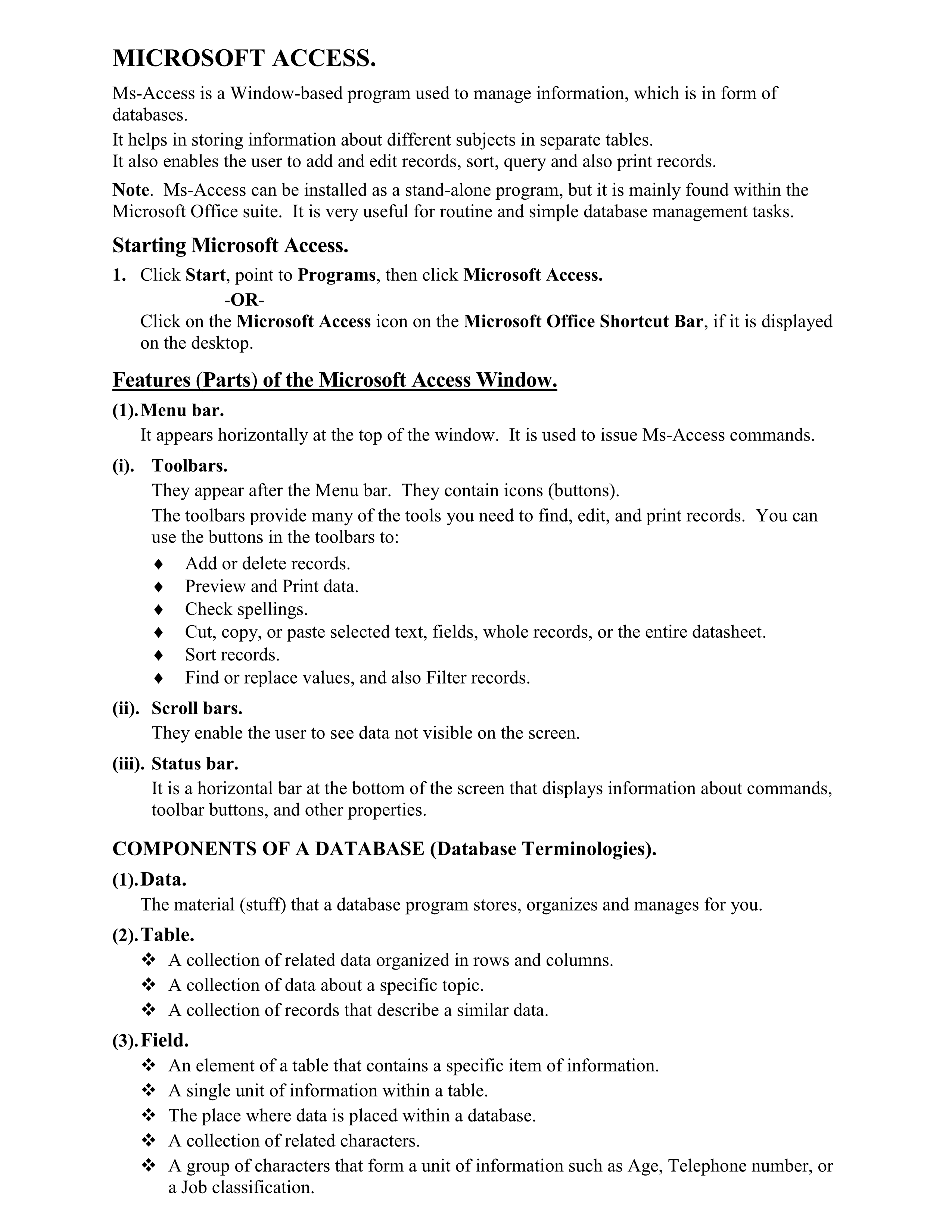
Ms-Access is a Window-based program used to manage information, which is in form of databases. It helps in storing information about different subjects in separate tables. It also enables the user to add and edit records, sort, query and also print records.
Below is the document preview.

21. Network Programmability and Automation
Trending!
New protocols, technologies, and delivery and O&M modes are emerging in the
network engineering field. Conventional networks face challenges from new
connection requirements, such as requirements for cloud computing and artificial
intelligence (AI). Enterprises are also pursuing service agility, flexibility, and elasticity. Against this backdrop, network automation becomes increasingly important.
Network programmability and automation is to simplify network configuration,
management, monitoring, and operations for engineers and improve deployment
and O&M efficiency. This course is to help network engineers understand Python
programming and implement network automation.
17 Pages
4349 Views
0 Downloads
471.79 KB
22. Typical Campus Network Architectures and Practices
Trending!
A broad range of places, such as campuses, office spaces, and shopping malls, are
covered by networks. You can access internal resources of your school, access
internal printers of your company to print documents, or access the Internet to
browse news through the networks. These networks belong to campus networks and are generally constructed by
enterprises or organizations. Campus networks not only improve the operational
efficiency of enterprises, but also provide network access services for external
users.This chapter describes the basic architecture of a campus network and details how to build a campus network.
25 Pages
3770 Views
0 Downloads
809.84 KB
SZL 2111: HIV/AIDs Year 1 Examminations
Trending!
SZL 211: HIV/AIDS JOMO KENYATTA UNIVERSITY OF AGRICULTURE AND TECHNOLOGY revision past paper YEAR ONE EXAMINATION FOR DISTANCE LEARNING STUDENTS
1 Pages
4206 Views
0 Downloads
147.5 KB
SZL 2111: HIV/AIDs - Full Notes
Trending!
General introduction: Public health and hygiene, human reproductive system, sex and sexuality. History of sexually transmitted diseases (STDs); History of Human Immunode
ciency virus/ Acquired Immune deficiency Syndrome(HIV/AIDS), Comparative information on trends, global and local distribution, Justification of importance of course. Biology of HIV/AIDS; Overview of immune system, natural immunity to HIV/AIDS. The AIDS virus and its life cycle, disease progression, transmission and diagnosis.
Discordant couples. Treatment and Management; nutrition, prevention and control; Abstain, Be faithful, Condom use, Destigmatize HIV/AIDS (ABCD) methods and an-tiretroviral drugs and vaccines. Pregnancy and AIDS. Management of HIV/AIDS patients. Social and cultural practices: Religion and AIDS. Social stigma on HIV/AIDS. Behavioral change. Voluntary Counseling and Testing Services. Gender and HIV/AIDS. Drug and alcohol abuse and HIV/AIDS. Poverty and AIDS. Families and AIDS orphans. Government policies: Global policies of AIDS. Legal rights of AIDS patients. AIDS Impact: Family /society setup, population, agriculture, education, health, industry, development, economy and other sectors.
153 Pages
4306 Views
0 Downloads
934.29 KB
SZL 2111: HIV/AIDs - Lesson 1
General introduction: Public health and hygiene, human reproductive system, sex and sexuality. History of sexually transmitted diseases (STDs); History of Human Immunodeficiency virus/Acquired Immune deficiency Syndrome (HIV/AIDS), Comparative information on trends, global and local distribution, Justification of importance of course. Biology of HIV/AIDS; Overview of immune system, natural immunity to HIV/AIDS. The AIDS virus and its life cycle, disease progression, transmission and diagnosis. Discordant couples. Treatment and Management; nutrition, prevention and control; Abstain, Be faithful, Condom use, Destigmatize HIV/AIDS (ABCD) methods
56 Pages
399 Views
0 Downloads
477.39 KB
SZL2111: HIV/AIDs - Sex education and Human sexuality
Trending!
Sex education, also called sexuality education or sex and relationships education.
It's the process of acquiring information and forming attitudes and beliefs about sex, sexual identity, relationships and intimacy. It is also about developing young people's skills so that they make informed choices about their behavior, and feel confident and competent about acting on these choices. It is widely accepted that young people have a right to sex education, partly because it is a means by which they are helped to protect themselves against abuse, exploitation, unintended pregnancies, sexually transmitted diseases and HIV/AIDS.
68 Pages
4054 Views
0 Downloads
1.5 MB
SZL2111: HIV/AIDs - The Immune system
Trending!
Immune system is a system of biological structures and processes within an organism that protects against diseases by identifying and killing pathogens and tumor cells. The immune system is made up of organs that are involved in fighting invasion by foreign bodies.
24 Pages
3878 Views
0 Downloads
289.22 KB
SZL 2111: HIV/AIDs - Biology of HIV
Trending!
HIV can’t grow or reproduce on its own. It requires cell of living organisms to infect & reproduce. HIV is specific to CD4+ cells in the human body i.e. cells with surface molecule called Cluster of Differentiation 4. Cells carrying this molecule are called CD4+ cells. Therefore HIV cant survive in the animal blood, because its only human blood that contains CD4+cells. HIV is a lentivirus. Like all viruses in this group it attacks the immune system. Lentiviruses are in turn part of a larger group of viruses called retroviruses. The term ”retrovirus” stems from the fact that these kinds of viruses are capable of copying RNA into DNA. The name lentivirus means slow virus. This is because they take such a longtime to produce any adverse effects in the body.
24 Pages
3615 Views
0 Downloads
293.16 KB
SZL 2111: HIV/AIDs - Disease progression and symptoms
Trending!
HIV infects cells of the immune system and the central nervous system. The main cell HIV infects is T helper cell which is a crucial part of the immune system, because it co-ordinates the actions of other cells of the immune system. A large reduction in the number of T helper cells seriously weakens the immune system.
37 Pages
3570 Views
0 Downloads
327.7 KB
SZL 2111: HIV/AIDs - Lesson 6
Trending!
General introduction: Public health and hygiene, human reproductive system, sex and sexuality. History of sexually transmitted diseases (STDs); History of Human Immunodeficiency virus/Acquired Immune de
ciency Syndrome (HIV/AIDS), Compara-
tive information on trends, global and local distribution, Justification of importance of course. Biology of HIV/AIDS; Overview of immune system, natural immunity to HIV/AIDS. The AIDS virus and its life cycle, disease progression, transmission and
diagnosis.
48 Pages
4438 Views
0 Downloads
401.01 KB