 Join Our WhatsApp Channel for Updates!
MICROSOFT ACCESS NOTES
| Institution | Maseno University |
| Course | UCI |
| Year | 1st Year |
| Semester | Unknown |
| Posted By | Mwalimu Evans Okoyo. |
| File Type | doc |
| Pages | |
| File Size | 292 KB |
| Views | 6562 |
| Downloads | 0 |
| Price: |
Buy Now
 Buy via
whatsapp Buy via
whatsapp
|


Description
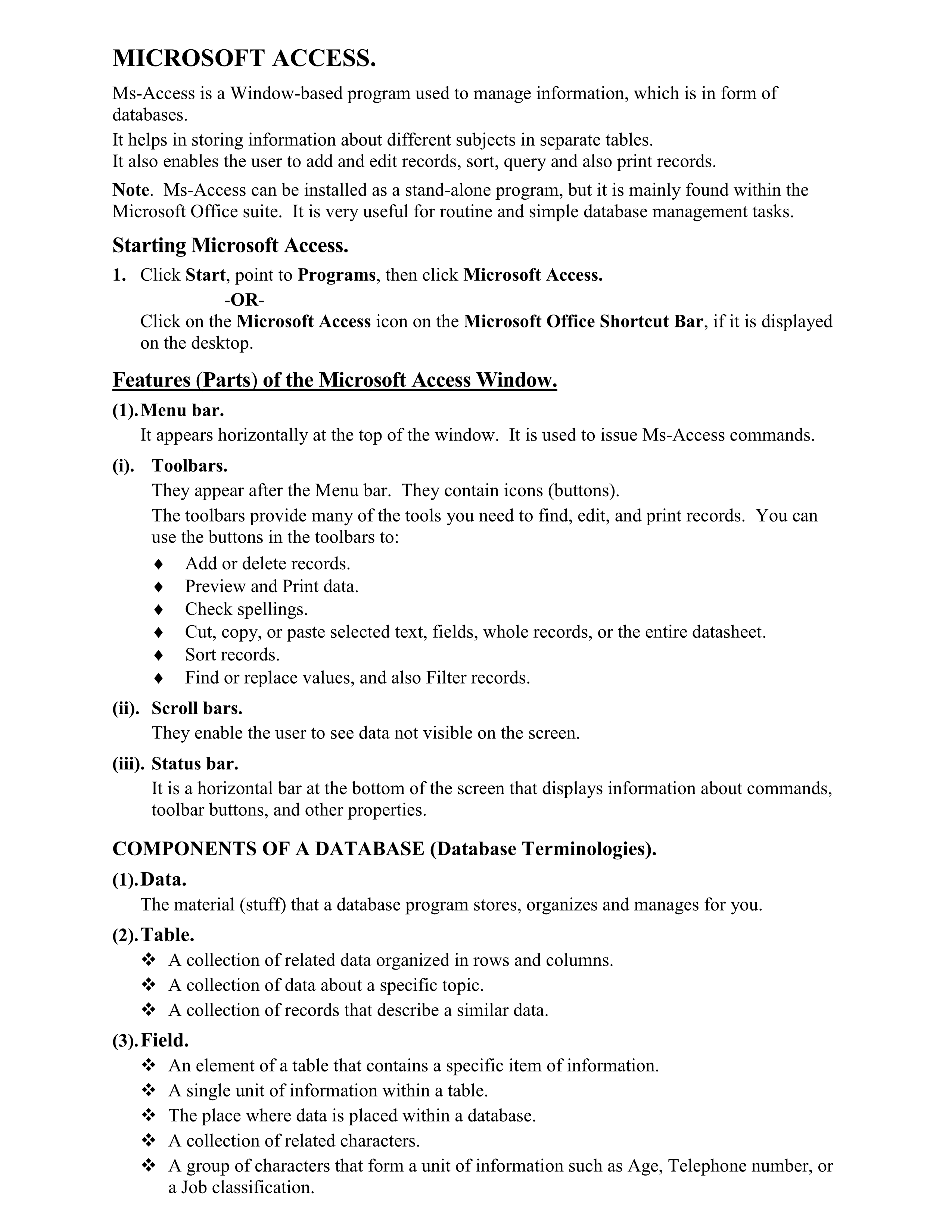
Ms-Access is a Window-based program used to manage information, which is in form of databases. It helps in storing information about different subjects in separate tables. It also enables the user to add and edit records, sort, query and also print records.
Below is the document preview.

13. AAA Principles and Configuration
Trending!
User management is one of the most basic security management requirements for
any network. Authentication, authorization, and accounting (AAA) is a management framework that provides a security mechanism for authorizing some users to access specified resources and recording the operations of these users. AAA is widely used because of its good scalability and easy implementation of centralized management of user information. AAA can be implemented through multiple protocols. In actual applications, the Remote Authentication Dial-In User Service (RADIUS) protocol is the most commonly used to implement AAA.
This course describes the basic concepts, implementation, basic configurations, and
typical application scenarios of AAA.
21 Pages
3748 Views
0 Downloads
869.21 KB
14 Network Address Translation
Trending!
With the development of the Internet and the increase of network applications,
limited public IPv4 addresses have become the bottleneck of network
development. To solve this problem, Network Address Translation (NAT) was
introduced.
NAT enables hosts on an internal network to access an external network. It not
only helps alleviate IPv4 address shortage but also improves the security of the
internal network as NAT prevents devices on the external network from directly
communicating with hosts on the internal network that uses private addresses.
This course describes the motivation behind NAT, and implementations and
application scenarios of different types of NAT.
32 Pages
3944 Views
0 Downloads
1.17 MB
15. Network Services and Applications
Trending!
The Internet has become an integral part of our lives, with a wide range of
applications such as file transfer, email sending, online video, web browsing, and
online gaming. Because of the layered network model, common users can use
various services provided by the application layer, without knowing technical
details such as communication technology implementations.
In previous courses, we have learned technologies related to the data link layer,
network layer, and transport layer. This chapter will describe common network
services and applications such as FTP, DHCP, and HTTP.
50 Pages
4396 Views
0 Downloads
1.7 MB
UCU110.Communication and collaboration skills
Trending!
These notes are summarizes in a manner that make your studies more simple and efficient
115 Pages
3285 Views
0 Downloads
981.5 KB
16 WLAN Overview
Trending!
Wired LANs are expensive and lack mobility. The increasing demand for portability
and mobility requires wireless local area network (WLAN) technologies. WLAN is now the most cost-efficient and convenient network access mode. This course introduces the development of WLAN in different phases, concepts related to WLAN technologies, implementation and basic configurations of common WLAN networking architectures, and WLAN development trends.
73 Pages
3700 Views
0 Downloads
1.99 MB
SBC 120 : Introduction to genetics
Trending!
This is an affordable access to some questions to expect In your exams
2 Pages
4156 Views
0 Downloads
61.09 KB
17. WAN Technologies
Trending!
As economic globalization and digital transformation accelerate, enterprises keep expanding their scales. More and more branches locate in different regions, with each branch network being considered as a local area network (LAN). The headquarters and branches need to cross geographical locations to communicate with each other. To better carry out services, an enterprise needs to connect these geographically dispersed branches through a wide area network (WAN).
The development of the WAN technologies is accompanied by the continuously increased bandwidth.In the early stage, X.25 provided only the bandwidth of 64 kbit/s. Later, the digital data network (DDN) and Frame Relay (FR) increased the bandwidth to 2 Mbit/s. Synchronous digital hierarchy (SDH) and asynchronous transfer mode (ATM) further increased the bandwidth to 10 Gbit/s. Now, the current IP-based WANs provide 10 Gbit/s or even higher bandwidth.
This course describes the development history of WAN technologies, especially the implementations and configurations of Point-to-Point Protocol (PPP) and Point-to-Point Protocol over Ethernet (PPPoE).
55 Pages
4581 Views
0 Downloads
1.44 MB
18 Network Management and O&M
Trending!
The ever expanding network and increasing network devices present a significant
challenge in managing networks effectively and providing high-quality network
services.
There are many network management and O&M methods, of which this course
describes some of the most common.
37 Pages
3412 Views
0 Downloads
1.21 MB
19. IPv6 Basics
Trending!
In the 1980s, the Internet Engineering Task Force (IETF) released RFC 791 –
Internet Protocol, which marks the standardization of IPv4. In the following decades, IPv4 has become one of the most popular protocols. Numerous people have developed various applications based on IPv4 and made various supplements and enhancements to IPv4, enabling the Internet to flourish.
However, with the expansion of the Internet and the development of new
technologies such as 5G and Internet of Things (IoT), IPv4 faces more and more
challenges. It is imperative to replace IPv4 with IPv6. This course describes the reasons for IPv4-to-IPv6 transition and basic IPv6 knowledge.
38 Pages
3351 Views
0 Downloads
1.36 MB
20. SDN and NFV Overview
Trending!
The open ecosystem of the computing industry brings booming development of
multiple fields, such as Commercial Off-the-Shelf (COTS), operating system,
virtualization, middleware, cloud computing, and software applications. The network industry is also seeking transformation and development. Software. Defined Networking (SDN) and Network Functions Virtualization (NFV) are mainly used.
This course aims to help engineers understand the development of SDN and NFV
and introduce Huawei SDN and NFV solutions.
51 Pages
4217 Views
0 Downloads
2.92 MB