Nanoparticles: synthesis and applications
| Institution | UNIVERSITY |
| Course | BACHELOR OF SCIENCE... |
| Year | 4th Year |
| Semester | Unknown |
| Posted By | stephen oyake rabilo |
| File Type | |
| Pages | 30 Pages |
| File Size | 1.73 MB |
| Views | 5303 |
| Downloads | 0 |
| Price: |
Buy Now
 Buy via
whatsapp Buy via
whatsapp
|


Description
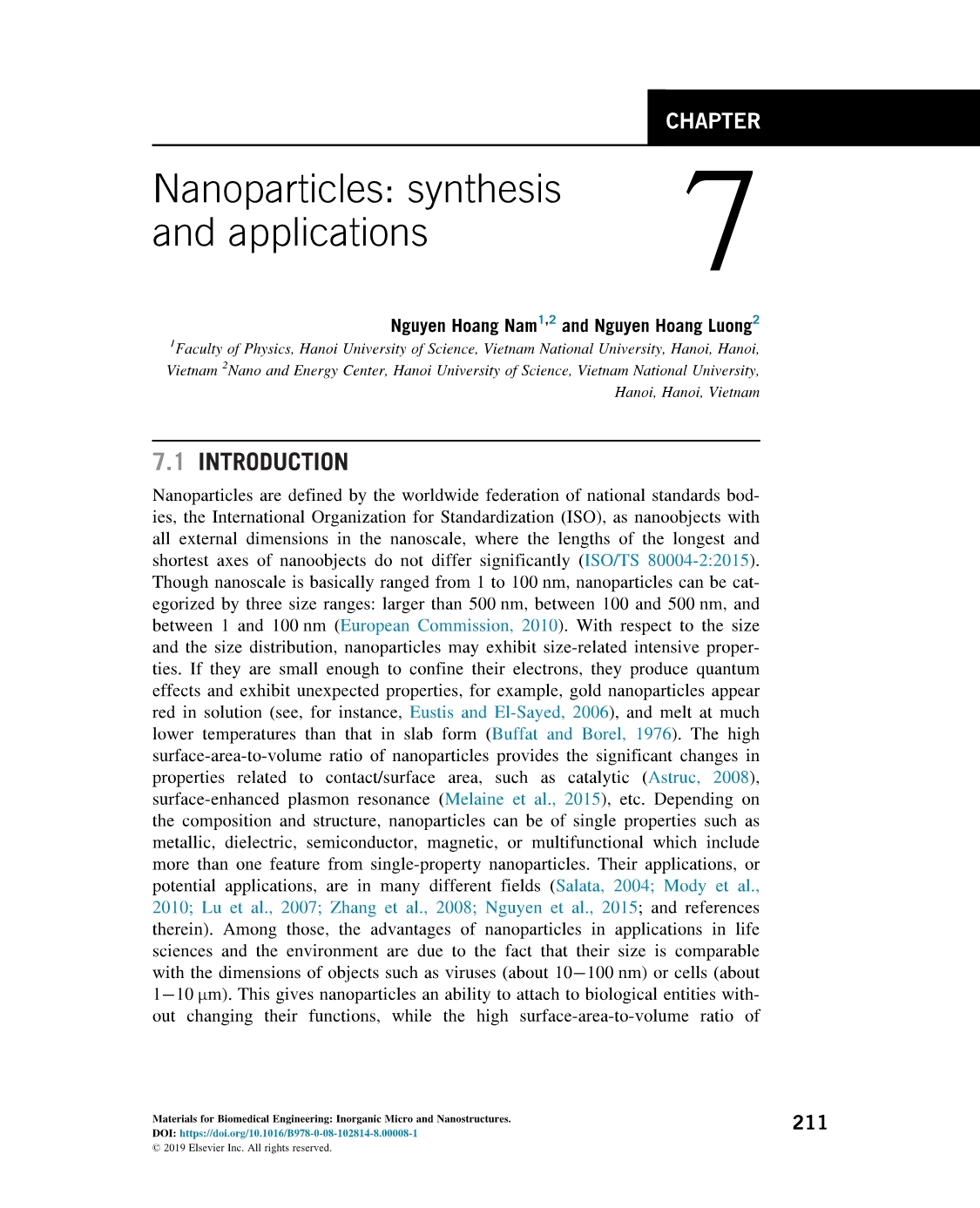
Nanoparticles are defined by the worldwide federation of national standards bodies, the International Organization for Standardization (ISO), as nanoobjects with
all external dimensions in the nanoscale, where the lengths of the longest andshortest axes of nanoobjects do not differ significantly . Though nanoscale is basically ranged from 1 to 100 nm, nanoparticles can be categorized by three size ranges: larger than 500 nm, between 100 and 500 nm, and
between 1 and 100 nm (European Commission, 2010). With respect to the size and the size distribution, nanoparticles may exhibit size-related intensive properties. If they are small enough to confine their electrons, they produce quantum effects and exhibit unexpected properties, for example, gold nanoparticles appear red in solution (see, for instance, Eustis and El-Sayed, 2006), and melt at much lower temperatures than that in slab form (Buffat and Borel, 1976). The high surface-area-to-volume ratio of nanoparticles provides the significant changes in properties related to contact/surface area, such as catalytic (Astruc, 2008),surface-enhanced plasmon resonance (Melaine et al., 2015), etc.
Below is the document preview.

FLEXIBLE MANUFACTURING SYSTEM
Trending!
Globalization, fickling market requirements and modern lifestyle trends have put up
tremendous challenge to manufacturing industries. In the current business scenario the
competitiveness of any manufacturing industry is determined by its ability to respond
quickly to the rapidly changing market and to produce high quality products at low costs.
60 Pages
6492 Views
0 Downloads
510.5 KB
Introduction to Curriculum
This course introduces curriculum and states different meanings and definition of terms under curriculum
24 Pages
1992 Views
0 Downloads
849.5 KB
COMPETENCE-BASED CURRICULUM
Trending!
A curriculum usually contains a statement of objectives and specific objectives; it indicates some selection and organization of content; it either implies or manifests certain patterns of learning and teaching, whether because of their objectives or because the content organization requires them.
71 Pages
2135 Views
0 Downloads
721.09 KB
Gauging and Gauge Design
Trending!
Updated notes on Gauging and gauge design
7 Pages
7715 Views
0 Downloads
1.05 MB
The Origin of HIV/AIDS
This module states detailed notes on the origin of HIV/AIDS
236 Pages
226 Views
0 Downloads
10.09 MB
Respiratory Physiology
Trending!
Updated notes on respiratory physiology
7140 Views
0 Downloads
5.1 MB
KFI 201: CONSUMER THEORY
Trending!
Latest detailed notes on consumer theory
32 Pages
5825 Views
0 Downloads
1.1 MB
Cnidaria and Ctenophore
Trending!
Updated notes on Cnidaria and Ctenophore
7565 Views
0 Downloads
4.75 MB
NERVOUS TISSUE
Trending!
This course provides detailed notes on nervous system
68 Pages
6920 Views
0 Downloads
1.53 MB