Nanoparticles: synthesis and applications
| Institution | UNIVERSITY |
| Course | BACHELOR OF SCIENCE... |
| Year | 4th Year |
| Semester | Unknown |
| Posted By | stephen oyake rabilo |
| File Type | |
| Pages | 30 Pages |
| File Size | 1.73 MB |
| Views | 1712 |
| Downloads | 0 |
| Price: |
Buy Now

|
Description
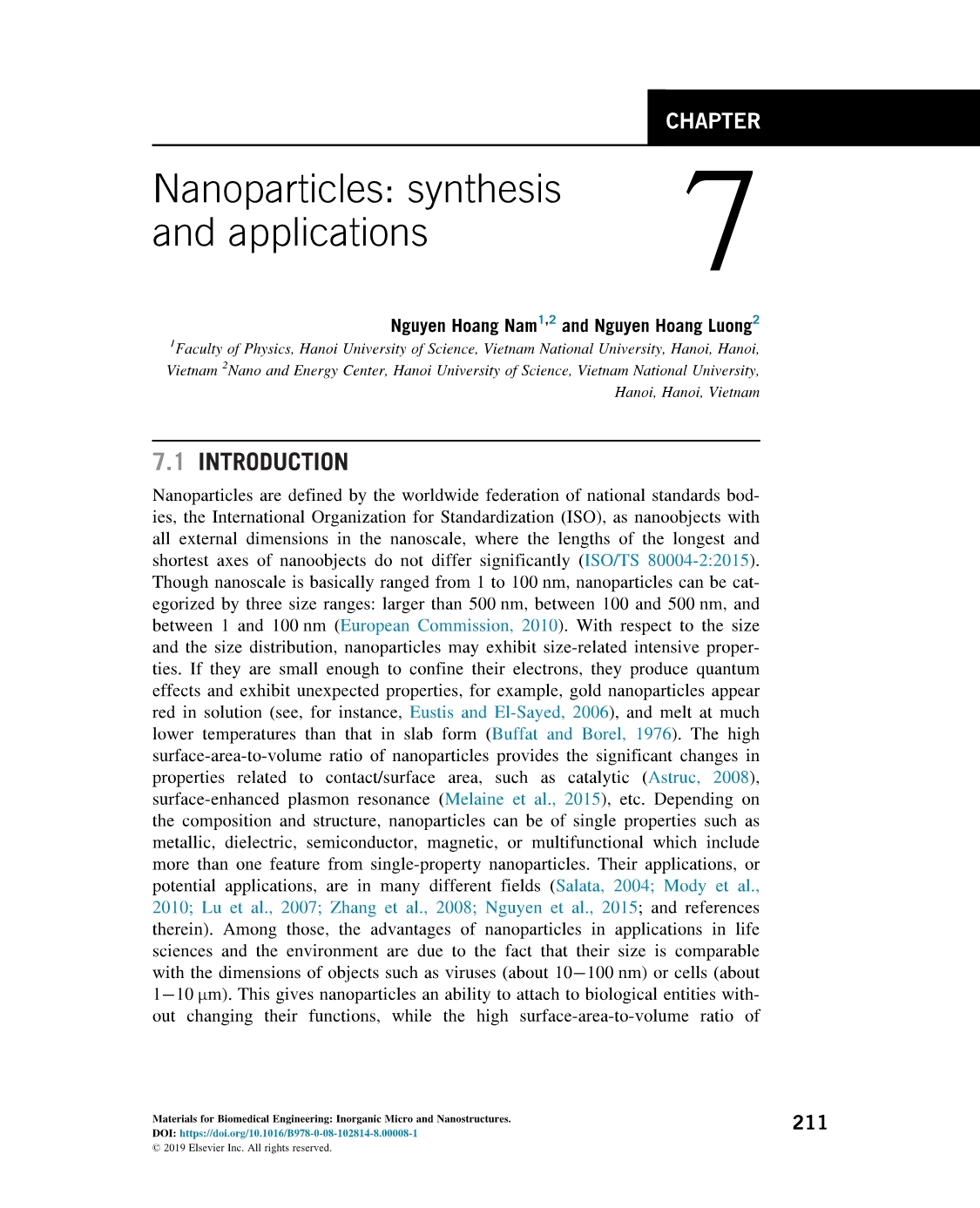
Nanoparticles are defined by the worldwide federation of national standards bodies, the International Organization for Standardization (ISO), as nanoobjects with
all external dimensions in the nanoscale, where the lengths of the longest andshortest axes of nanoobjects do not differ significantly . Though nanoscale is basically ranged from 1 to 100 nm, nanoparticles can be categorized by three size ranges: larger than 500 nm, between 100 and 500 nm, and
between 1 and 100 nm (European Commission, 2010). With respect to the size and the size distribution, nanoparticles may exhibit size-related intensive properties. If they are small enough to confine their electrons, they produce quantum effects and exhibit unexpected properties, for example, gold nanoparticles appear red in solution (see, for instance, Eustis and El-Sayed, 2006), and melt at much lower temperatures than that in slab form (Buffat and Borel, 1976). The high surface-area-to-volume ratio of nanoparticles provides the significant changes in properties related to contact/surface area, such as catalytic (Astruc, 2008),surface-enhanced plasmon resonance (Melaine et al., 2015), etc.
Below is the document preview.
INTRODUCTION TO LEADERSHIP AND MANAGEMENT
Trending!
Health, according to the WHO, is "a state of complete physical, mental and social wellbeing and not merely the absence of disease and infirmity.
• A health management system, also sometimes referred to as health care system is an organization of people, institutions, and resources that deliver health care services to meet the health needs of target populations.
• Leader, an individual who is able to influence and inspire a group or organisational members to help the group or organisation achieve its goals
• Leadership is a process whereby an individual influences a group of individuals to achieve a common goal. Leadership is a function of knowing yourself, having a vision that is well communicated, building trust among colleagues and taking effective action to realise your own leadership potential.
• Health systems cannot be strengthened without good management and leadership. Leadership and management skills are therefore essential at all levels of the health system. Health managers should also embrace leadership and management practices that will lead to improved health outcomes.
• Administration-mainly involves interpreting and implementing narrow rules or specific rules regulation and policies of an organisation.
132 Pages
3317 Views
1 Downloads
2.75 MB
Endocrine disorders
Trending!
It is an Autosomal recessive inborn error of metabolism found
on the twelfth chromosome
Causing an inherited metabolic disease that passes through
families. It is rare condition characterized by the deficiency in the
enzyme (Phenylalanine Hydroxylase).
Normally: phenylalanine tyrosine by liver enzyme phenylalanine
hydroxylase (PAH)
33 Pages
2859 Views
0 Downloads
499.39 KB
Health system management
Trending!
Download full notes on health management system for your course .
ADMINISTRATION: It is a combination of labour in the form of
clerical duties with the capital for environment, equipment in proper proportion which if properly controlled achieves the purpose intended in the most efficient way.
STRATEGY: This is a plan of action designed to achieve a particular goal. Tactics.
ETHICS: Ethics also known as moral philosophy is a branch of
philosophy which seeks to address questions about morality; that is about such concepts as good and bad, right and wrong, justice and virtue. Major branches of ethics include: Meta-ethics, about theoretical meaning and reference of moral
propositions and how their truth value [if any] may be determined; Normative ethics, about the practical means of determining a moral course of action;
Applied ethics, about how moral out-comes can be achieved in
specific situations; Moral Psychology, about how moral capacity or moral agency
develops and what its nature is; and
Descriptive ethics, about what moral values people actually abide with. Within each of these branches are many different schools of thought and still further sub-fields of study.
168 Pages
2925 Views
0 Downloads
1.88 MB
PHP 308: PRINCIPLES AND PRACTICE OF HEALTH PROMOTION 1
Trending!
UNIT 1.0 CONCEPTS AND PRINCIPLES OF HEALTH PROMOTION
1.1 Introduction
In this section, we shall examine the concept and principles of health promotion to serve as a foundation to what follows in the course. Principally, we shall review the historical background of
health promotion, define terms related to health promotion and discuss the aims and core values of health promotion.
1.2 Objectives of the Unit
At the end of this topic, you should be able to:
a) Define terms related to health promotion
b) State the Aims and core values of Health promotion
c) Discuss the historical background of health promotion
1.3 Introduction to Health Promotion
The term health promotion (HP) refers to a broad social and political process that includes both actions intended to improve people's abilities and skills and actions intended to alter social,
environmental, and economic conditions in order to lessen their negative effects on both public and individual health. The purpose of HP practice is to create and sustain environments that enable individuals to make healthy decisions and promote social contexts that support healthy behaviors.
77 Pages
2876 Views
1 Downloads
2.22 MB
STRESS AND STRESS MANAGEMENT DURING EMERGENCIES
Trending!
The reaction people may have when presented with demands and pressures that are not matched to their knowledge and abilities and which challenge their ability to cope. (WHO).How we react when we feel under pressure or threatened
52 Pages
2128 Views
0 Downloads
1.58 MB
BIOCHEMISTRY FULLNOTES
Trending!
ACE YOUR EXAMS WITH CONFIDENCE
86 Pages
3504 Views
0 Downloads
2.22 MB
LEVEL 6: Manage Perioperative Theatre Resources
Trending!
Management is the process of getting things done through others with the help of some basic activities like planning, organizing, directing, coordinating, and controlling to achieve the desired goals and objectives. It is the basis for every organization.
79 Pages
3133 Views
1 Downloads
805.32 KB
Form 1 physics notes
Trending!
This notes covers the whole form one syllabus, worked examples and revision questions
136 Pages
2995 Views
1 Downloads
2.82 MB
Form 3 physics notes
Trending!
This notes covers the whole form one syllabus, worked examples and revision questions
158 Pages
2972 Views
1 Downloads
3.12 MB
Form 4 physics notes
This notes covers the whole form one syllabus, worked examples and revision questions
88 Pages
306 Views
2 Downloads
2.19 MB