Nanoparticles: synthesis and applications
| Institution | UNIVERSITY |
| Course | BACHELOR OF SCIENCE... |
| Year | 4th Year |
| Semester | Unknown |
| Posted By | stephen oyake rabilo |
| File Type | |
| Pages | 30 Pages |
| File Size | 1.73 MB |
| Views | 5602 |
| Downloads | 0 |
| Price: |
Buy Now
 Buy via
whatsapp Buy via
whatsapp
|


Description
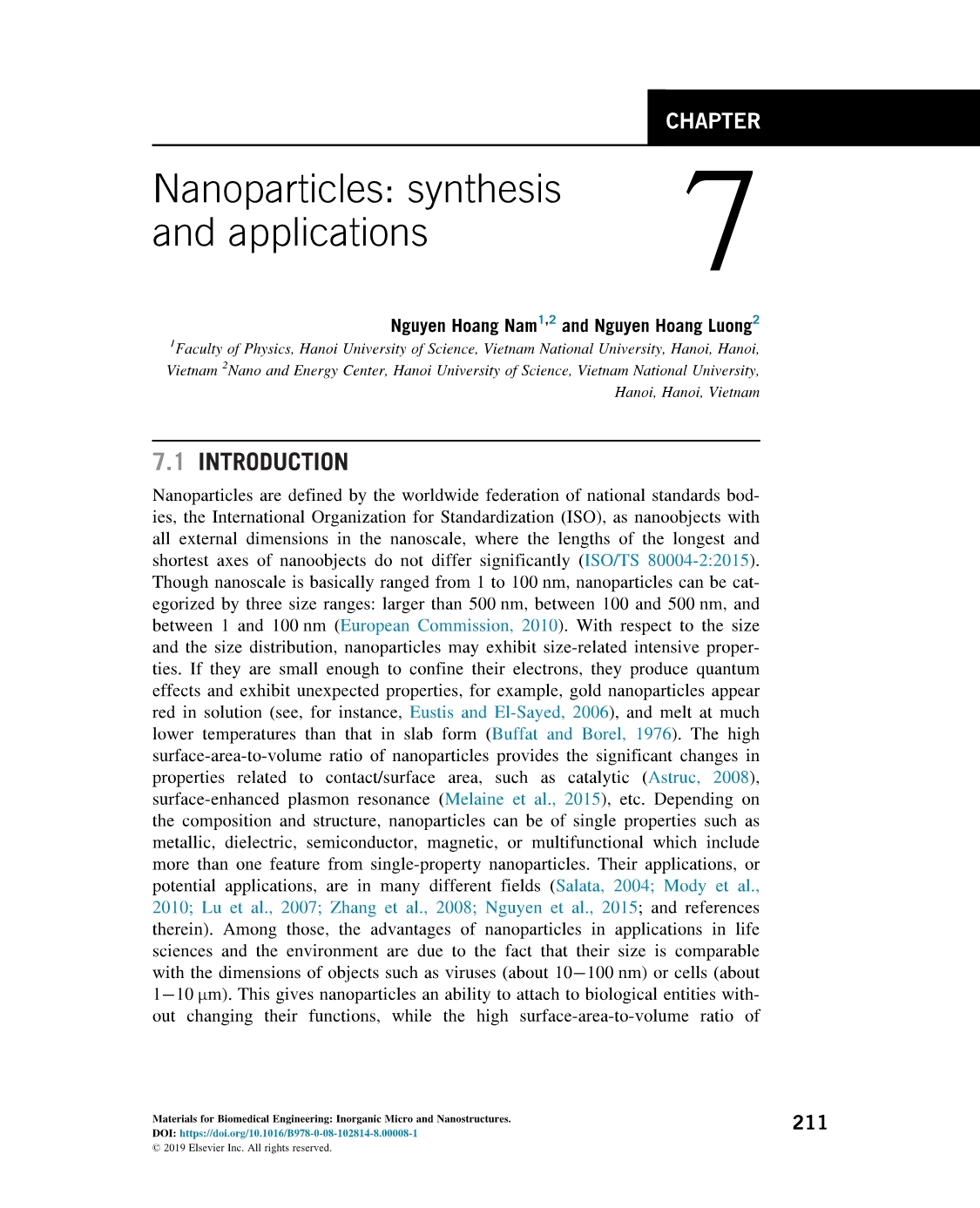
Nanoparticles are defined by the worldwide federation of national standards bodies, the International Organization for Standardization (ISO), as nanoobjects with
all external dimensions in the nanoscale, where the lengths of the longest andshortest axes of nanoobjects do not differ significantly . Though nanoscale is basically ranged from 1 to 100 nm, nanoparticles can be categorized by three size ranges: larger than 500 nm, between 100 and 500 nm, and
between 1 and 100 nm (European Commission, 2010). With respect to the size and the size distribution, nanoparticles may exhibit size-related intensive properties. If they are small enough to confine their electrons, they produce quantum effects and exhibit unexpected properties, for example, gold nanoparticles appear red in solution (see, for instance, Eustis and El-Sayed, 2006), and melt at much lower temperatures than that in slab form (Buffat and Borel, 1976). The high surface-area-to-volume ratio of nanoparticles provides the significant changes in properties related to contact/surface area, such as catalytic (Astruc, 2008),surface-enhanced plasmon resonance (Melaine et al., 2015), etc.
Below is the document preview.

ASC 327: SOCIOLOGY OF HEALTH AND ILLNESS
Trending!
Sociology as a discipline is studies society and the social life and how people in group interact. These interactions influence how people behavior in everyday life including their health behaviour.
84 Pages
7720 Views
9 Downloads
1.13 MB
ASC 100: INTRODUCTION TO SOCIOLOGY
Sociology is the scientific study of the human interaction. It is the systematic study of social behavior and human groups. It focuses primarily on the influence of social relationships on people's attitudes and behavior and on how societies are established and change. [e.g., Tattoo, piercing]
77 Pages
1702 Views
1 Downloads
1.19 MB
LIFE NUTRITION CYCLE
Trending!
Nutrition and Longevity
• Good nutrition and regular physical activity
can increase life expectancy, support good
health, prevent or prolong the onset of
disease, and improve the quality of life.
• There are many healthy habits that can
increase life span.
• A person’s physiological age and
chronological age may be different.
• The benefits of energy restriction in
humans in the later years are being
studied.
42 Pages
5037 Views
0 Downloads
663.04 KB
APS 307: COUNSELING THEORIES NOTES
Trending!
A theory is a set of assumptions, principles, propositions, or accepted facts that attempts to provide a plausible or rational explanation of cause-and-effect (causal) relationships among a group of observed phenomenon.
55 Pages
5281 Views
1 Downloads
1.14 MB
APS 427: ADULT DEVELOPMENT AND AGING
Trending!
In this first lesson, we lay the foundation for the entire course by defining the concept adult development and aging. Of importance are the differences between gerontology and geriatrics and the general lifespan development which takes place in adult life. The knowledge acquired in this lesson will make you learn how to handle the elderly in a way that they deserve.
87 Pages
5372 Views
0 Downloads
1.54 MB
APP 306: MEDIA AND PUBLIC POLICY
Trending!
The fundamental purpose of this module is to provide an understanding of the role media in public policy. The public policy trends will be highlighted as they are, both historical and current interaction. In addition the course will find out how public policy is deliberated and analyzed by the media, as well as the advantages and challenges that come along with digital media and the 24/7 news cycle.
63 Pages
5533 Views
2 Downloads
1.39 MB
INTRODUCTION TO ECONOMICS
Economics is a social science which studies allocation of scarce resources which have
alternative uses among competing and limitless wants of the consumer in the society. It
therefore concerns the way people apply knowledge, skills and effort to satisfy human
wants or provide for material well being.
Human wants – Refer to peoples’ desire for goods and services and circumstances that
enhance material well being.
Economics resources – These are ingredients available for providing goods and services.
They are also called factors of production which include land, labour, capital and
entrepreneurship. A resource must be scarce and have money value. Resources are
categorized as either natural or manmade
i. Natural resources – Refer to anything given by nature example soils, lakes and
mountains.
ii. Man-made resources – Refer to anything created by man to assist in production
of goods and services example tools, equipment and building.
Scarcity and Choice
Scarcity - Resources are scarce if their availability is not enough to produce goods and
services to satisfy all wants. Resources are therefore said to be limited and hence choices
have to be made.
Choice is the decision to satisfy one want out of many alternatives. This means others have
to be forgone.
Opportunity cost
Refer to the value of benefit expected from the best second alternative forgone. Since
resources are scarce and have competing alternative uses, choice to satisfy one means
another is forgone
Economic and Non Economic goods
Economic goods – These are goods produced with scarce resources e.g. clothes and
therefore a price has to be paid to obtain them.
Non – Economic goods – are free goods hence no price has to be paid for them e.g.
sunshine, ai
36 Pages
395 Views
0 Downloads
828.33 KB
APP 205: INTRODUCTION TO ADMINISTRATIVE THEORY
Trending!
This module will introduce you to various administrative theories that are helpful to the study of public administration. In addition it's an interactive instructional module that uses both action and collaborative learning styles that provide you with diverse online learning experiences and effective learning processes.
71 Pages
6252 Views
0 Downloads
1.55 MB
AGRICULTURAL MARKETING
Agricultural marketing can be defined as the performance of all business activities
involved in the flow of goods and services from the initial point of production
until they are in the hands of the ultimate consumer.
Marketing consists of all strategies and tactics used to identify, create and maintain
satisfying relationships, with customers that results in value for both consumers and
marketer.
87 Pages
1532 Views
0 Downloads
1.07 MB
APA STYLE REFERENCING SIMPLIFIED
Trending!
Acknowledging a source in your work is somehow a play with your understanding of the information that you are passing across, though the approach is similar. One can begin by first acknowledging the source of the information (author of the information you are using) then follow with the text that contains the information you are presenting: e.g Jones (1998) notes that following instructions in any examination is as important as passing the examination itself.
6 Pages
5561 Views
0 Downloads
690.92 KB