Expanding Social Horizons: Socioemotional Development in Middle Childhood
| Institution | Keiser University |
| Course | Pschology |
| Year | 4th Year |
| Semester | Unknown |
| Posted By | Faith Kagwi |
| File Type | |
| Pages | 34 Pages |
| File Size | 174.87 KB |
| Views | 6712 |
| Downloads | 0 |
| Price: |
Buy Now
 Buy via
whatsapp Buy via
whatsapp
|


Description
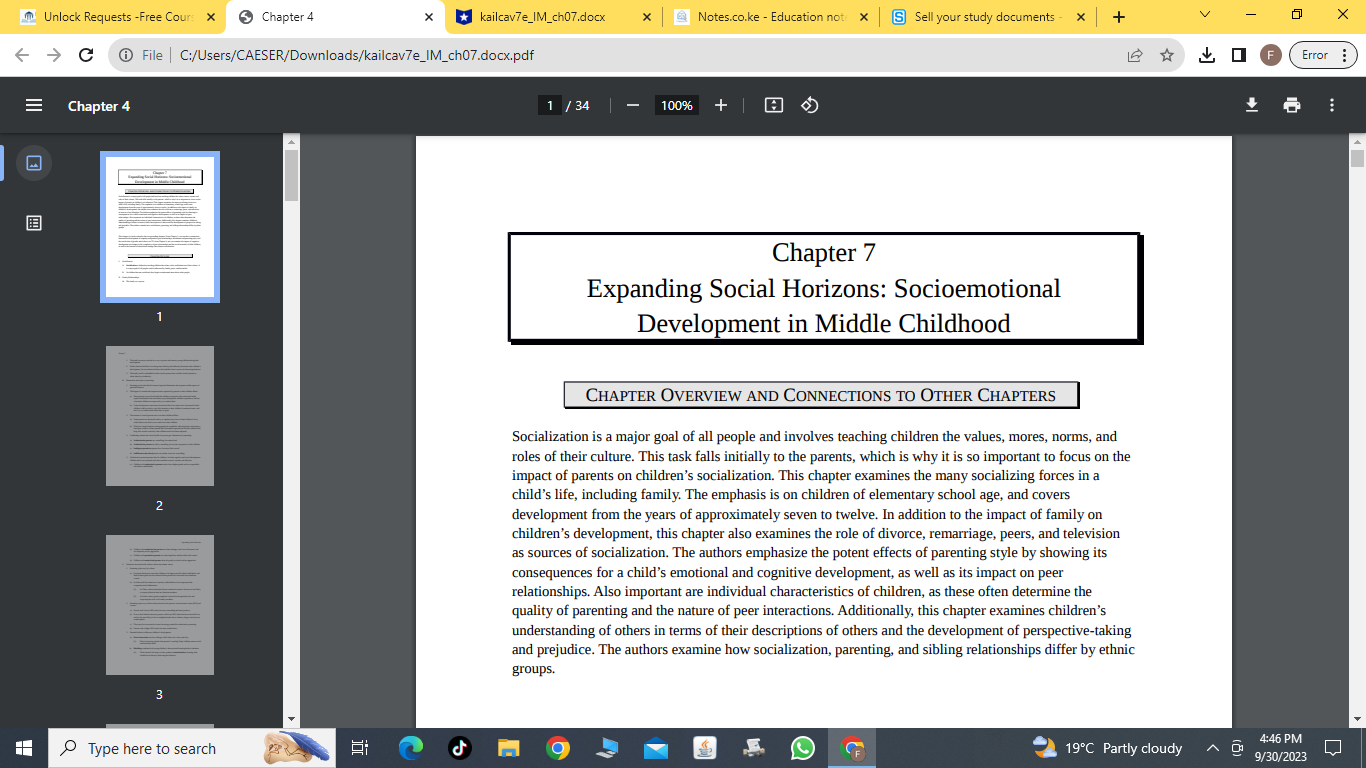
CHAPTER OVERVIEW AND CONNECTIONS TO OTHER CHAPTERS
Socialization is a major goal of all people and involves teaching children the values, mores, norms, and
roles of their culture. This task falls initially to the parents, which is why it is so important to focus on the
impact of parents on children’s socialization. This chapter examines the many socializing forces in a
child’s life, including family. The emphasis is on children of elementary school age, and covers
development from the years of approximately seven to twelve. In addition to the impact of family on
children’s development, this chapter also examines the role of divorce, remarriage, peers, and television
as sources of socialization. The authors emphasize the potent effects of parenting style by showing its
consequences for a child’s emotional and cognitive development, as well as its impact on peer
relationships. Also important are individual characteristics of children, as these often determine the
quality of parenting and the nature of peer interactions. Additionally, this chapter examines children’s
understanding of others in terms of their descriptions of others and the development of perspective-taking
and prejudice. The authors examine how socialization, parenting, and sibling relationships differ by ethnic
groups.
This chapter is closely related to the two preceding chapters. From Chapter 5, you can draw connections
between the development of empathy and positive peer relationships, attachment and parenting style, and
the social roles of gender and violence on TV; from Chapter 6, you can examine the impact of cognitive
development on changes in the complexity of peer relationships and the social networks of older children,
as well as the features of educational settings that enhance socialization.
Below is the document preview.

OFFICE MANAGEMENT AND OFFICE ADMINISTRATION
Trending!
Management can therefore be defined as principally a task of planning, coordinating,
and motivating the efforts of others towards the specific objectives. In brief,
management is the task of unifying efforts efficiently to achieve well defined objectives. The resources available to an organization remain idle till they are directed by the dynamic human effort. Management therefore aims at seeing that the job gets done efficiently.
50 Pages
8465 Views
1 Downloads
537.65 KB
WORKSHOP PRACTICE
Trending!
Engineering workshop services include engineering design, fabrication and machining. This involves the selection and use of workshop tools as well as machines. As such, an understanding of workshop practice will ensure effective and safe use of tools and machines while also ensuring the safety of other workshop users.
17 Pages
2077 Views
0 Downloads
1.14 MB
WORKSHOP PRACTICES FULL NOTES
Trending!
To impart knowledge and practical skills on the use and maintenance of workshop tools and equipment.
56 Pages
10092 Views
0 Downloads
1.84 MB
RESEARCH PROJECT FORMAT
Trending!
Abstract; It provides the title summary of research objectives, the methodology i.e. sampling procedure, target population and data collection methods. It should also contain summary of finding and recommendation (should be in block, one (1) page and should not be divided into paragraphs).
4 Pages
8257 Views
1 Downloads
312.94 KB
DBA; BUSINESS FINANCE NOTES
Trending!
The purpose of this unit or module is to equip the trainee or student with knowledge and skills on accounting basics and information. These Business Finance notes can also be used in courses such as certificate in Business Administration,certificate in Accountancy, certificate in BM Module 2 and Diploma in Accountancy that share the common units.
329 Pages
9221 Views
3 Downloads
2.72 MB
DBA; HUMAN RESOURCE MANAGEMENT NOTES
Trending!
The purpose of this unit is to equip the trainee or student with knowledge and skills to apply human resource management techniques in his or her organisation as a human resource manager and management as a whole.These notes can also be used in KNEC courses such as Diploma in Business Administration, Diploma in Personnel Management, Diploma in Human Resource Management Module 2, Diploma in Business Management Module 2,Higher Diploma in Human Resource Management, Higher Diploma in Entrepreneurship Development that share this common unit.
37 Pages
10855 Views
1 Downloads
986.6 KB
DBA; ORGANIZATION THEORY AND BEHAVIOUR QUESTIONS AND ANSWERS
Trending!
The purpose of this module or unit questions and answers is to help the trainee or student on how to answer examination questions relating to Organization theory and Behaviour
7 Pages
10296 Views
1 Downloads
166.71 KB
WRITING OF A BUSINESS PLAN
Trending!
The time of writing a business plan depends on the experience and knowledge of the writer (entrepreneur) as well as the purpose it intends to serve. It should be comprehensive enough to give any potential investor a complete picture and understanding of the new venture.
4 Pages
10066 Views
0 Downloads
663.25 KB
FOOD AND BEVERAGE CONTROL
Food and beverage control may be defined as the guidance and regulation of the costs and revenue of operating the catering activity in a food and beverage establishment.
168 Pages
1829 Views
1 Downloads
2 MB
TENDERING
Trending!
Potential bidders should be aware that there are various procedures before they can supply building works, roads and housing. The Ministry of Public Works vets all building contractors through the National Registration Committee (NRC), which is chaired by the Chief Architect.
10 Pages
2295 Views
0 Downloads
554.19 KB