Expanding Social Horizons: Socioemotional Development in Middle Childhood
| Institution | Keiser University |
| Course | Pschology |
| Year | 4th Year |
| Semester | Unknown |
| Posted By | Faith Kagwi |
| File Type | |
| Pages | 34 Pages |
| File Size | 174.87 KB |
| Views | 6710 |
| Downloads | 0 |
| Price: |
Buy Now
 Buy via
whatsapp Buy via
whatsapp
|


Description
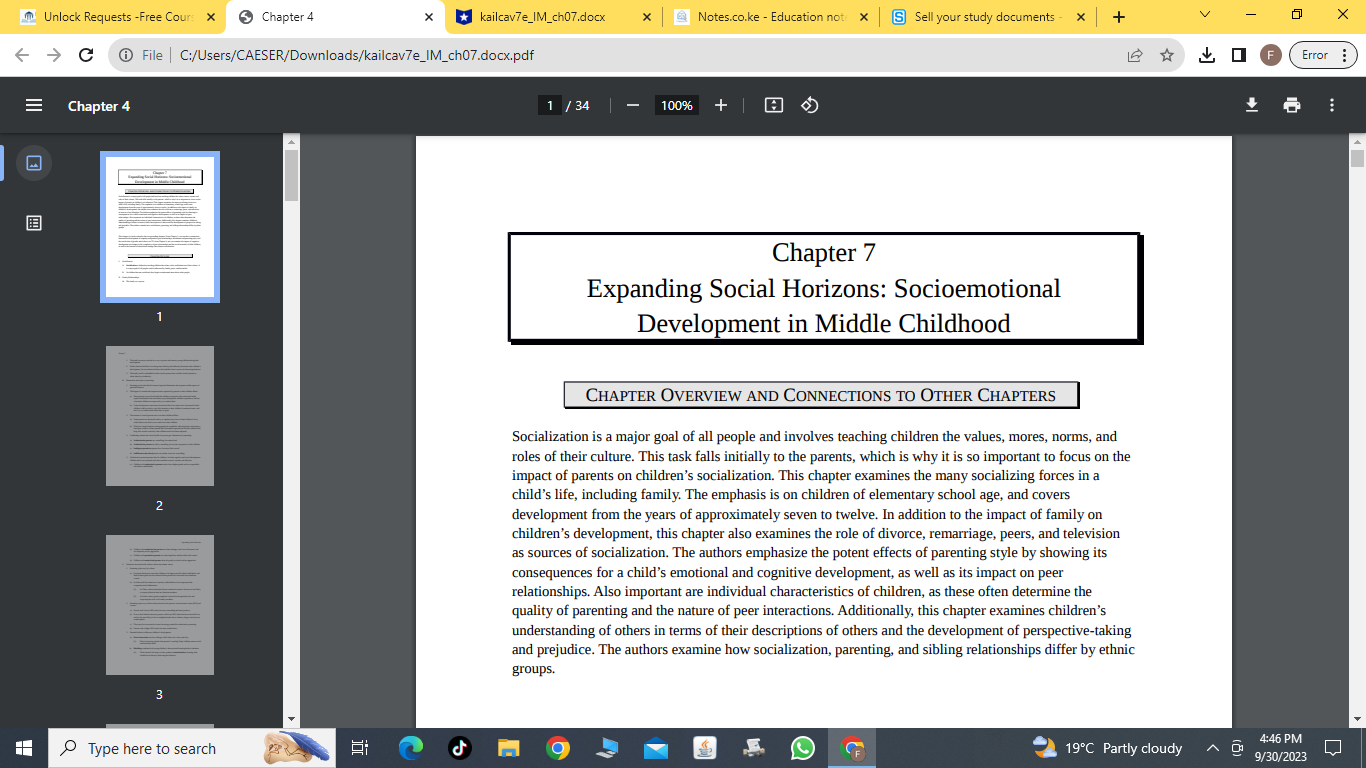
CHAPTER OVERVIEW AND CONNECTIONS TO OTHER CHAPTERS
Socialization is a major goal of all people and involves teaching children the values, mores, norms, and
roles of their culture. This task falls initially to the parents, which is why it is so important to focus on the
impact of parents on children’s socialization. This chapter examines the many socializing forces in a
child’s life, including family. The emphasis is on children of elementary school age, and covers
development from the years of approximately seven to twelve. In addition to the impact of family on
children’s development, this chapter also examines the role of divorce, remarriage, peers, and television
as sources of socialization. The authors emphasize the potent effects of parenting style by showing its
consequences for a child’s emotional and cognitive development, as well as its impact on peer
relationships. Also important are individual characteristics of children, as these often determine the
quality of parenting and the nature of peer interactions. Additionally, this chapter examines children’s
understanding of others in terms of their descriptions of others and the development of perspective-taking
and prejudice. The authors examine how socialization, parenting, and sibling relationships differ by ethnic
groups.
This chapter is closely related to the two preceding chapters. From Chapter 5, you can draw connections
between the development of empathy and positive peer relationships, attachment and parenting style, and
the social roles of gender and violence on TV; from Chapter 6, you can examine the impact of cognitive
development on changes in the complexity of peer relationships and the social networks of older children,
as well as the features of educational settings that enhance socialization.
Below is the document preview.

MANAGEMENT AND ORGANISATION DEVELOPMENT
Trending!
Management is the art of getting things done through people". From this definition we see that managers achieve organizational goals by arranging for others the necessary tasks to be performed to achieve the goals of the organization, hence they do not do the work themselves.
187 Pages
8856 Views
0 Downloads
1.08 MB
ANAEMIA
The word anaemia is a Latin word meaning "no blood." It describes a condition where there is lack of heam in the blood. Heam is the oxygen carrying and iron-containing molecule. This is attached to a protein called globin to form haemoglobin (Hb), which is contained in the red blood cells. This haemoglobin is responsible for the red colour of the blood.
6 Pages
1342 Views
0 Downloads
141.19 KB
FOOD AND BEVERAGE PRODUCTION THEORY
Trending!
Before a kitchen is planned, the management must know its goals and objectives in relation to the market strategy. The menu will then determine the type of equipment you will require in order to produce the products that you know from the market research that the customer is going to buy. You also need to know the target numbers that you intend to service.
179 Pages
2105 Views
4 Downloads
3.14 MB
FOOD AND BEVERAGE CONTROL NOTES
Trending!
Food and beverage control is the guidance and regulation of all operating costs and revenues in the catering establishment with the aim of making a profit. Food and beverage control as is currently practiced in hotel and catering industry is in many respects different from the old concept of cost control which had its origin in the predominantly cost related manufacturing industry.
89 Pages
9575 Views
4 Downloads
838.97 KB
EMPLOYEE PERFORMANCE APPRAISAL
Trending!
Performance appraised also referred to us employee assessment is a process of systematically evaluating performance adjustment can be made, performance appraisal can also be said to be the process of evaluating performance & qualifications of the employee in terms of the requirements of the job for which he/she is employed.
56 Pages
8581 Views
0 Downloads
777.39 KB
SPH 302 LESSON 1: THERMODYNAMICS
Trending!
Applications of the kinetic theory of gases are countless. Automobile engineers are concerned with the combustion of vaporized fuel (a gas) in the automobile engines. Food engineers are concerned with the production rate of the fermentation gas that causes bread to rise as it bakes. Beverage engineers are concerned with how gas can produce the head in a glass of beer or shoot a cork from a champagne bottle. Medical engineers and physiologists are concerned with calculating how long a scuba diver must pause during ascent to eliminate nitrogen gas from the bloodstream (to avoid the bends).
11 Pages
7925 Views
1 Downloads
311.84 KB
SMA 2231: PROBABILITY AND STATISTICS III
Trending!
Let X and Y be discrete random variables, denoted by x a realizable value of X and by y a
realizable value of Y. let the probability that X takes values x and Y takes values y be
denoted by
P( ) X = x,Y = y
Then the function f ( ) ( ) x, y = P X = x,Y = y is said to be the joint probability function of X
and Y if it satisfies the following two conditions
89 Pages
11153 Views
7 Downloads
377.52 KB
CLC 113: COMPUTER APPLICATIONS FOR INFORMATION COMMUNICATION
Trending!
In this lecture, we are going to get an overview of computers, their component parts and how
they work. We will also learn how computer components are connected as well as theprocedures of starting and shutting down a computer. Moreover, we will go over the subject of computer applications and why it is becoming increasingly important that you become computer literate. Some of these topics will be discussed in more detail in later lectures.
51 Pages
8001 Views
0 Downloads
508.45 KB
EMBROLOGY.
Trending!
ANAPHASE. Each chromosome undergoes a
longitudinal division of the centromere and give rise to
two daughter chromosomes. The daughter
chromosomes begins to migrate towards the opposite
poles of the cell
196 Pages
7782 Views
0 Downloads
3.35 MB
CARDIOVASCULAR PHYSIOLOGY
Trending!
The cardiovascular system (cardio- heart; vascular blood vessels) consists of three interrelated components: blood, the heart, and blood vessels. In the embryo, the heart begins to beat at 4 weeks of age, even before its nerve supply has been established The heart pumps blood through blood vessels to all body tissues. the heart beats about 100,000 times every day When sleeping, the heart pumps 30 times its own weight (5 L) each minute, which amounts to more than 14,000 liters of blood in a day and 10 million liters in a year
47 Pages
8134 Views
0 Downloads
858.17 KB