Effectiveness of internal control systems on fraud detection and prevention Among Small and Medium-Sized Enterprises in Nairobi Kenya- business research project
| Institution | Kimathi Institute of Technology |
| Course | Business , hrm |
| Year | 3rd Year |
| Semester | Unknown |
| Posted By | MAKORI KERECHA |
| File Type | docx |
| Pages | |
| File Size | 2.78 MB |
| Views | 1471 |
| Downloads | 0 |
| Price: |
Buy Now
 Buy via
whatsapp Buy via
whatsapp
|


Description
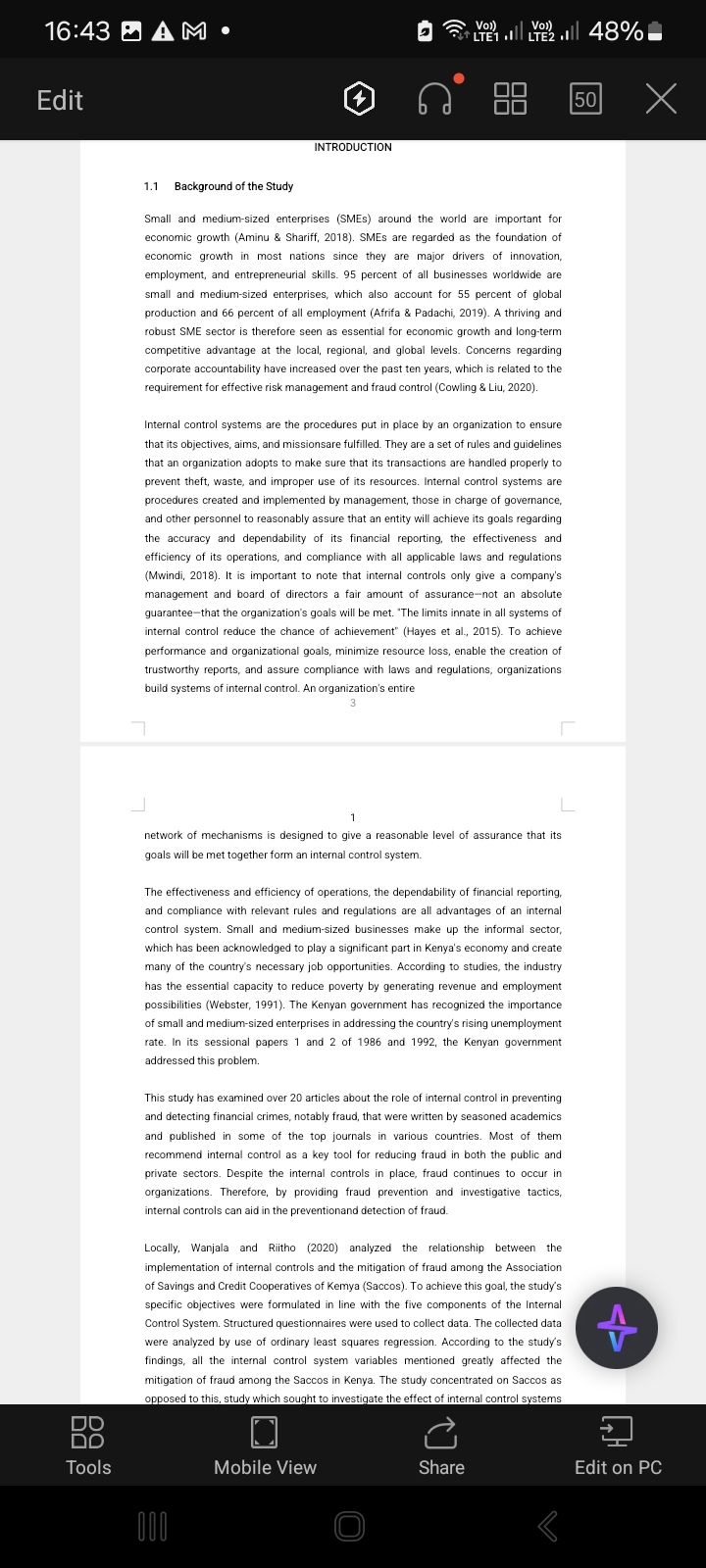
Despite the government's commitment to the ease of doing business, there has been debate over why small and medium-sized enterprises are experiencing a downward trend in business survival. Statistics from the Economic Survey of 2021 show that small and medium-sized enterprises have grown significantly in Kenya during the past 10 years, accounting for around 96 percent of all business enterprises in the country. However, 90% of new businesses fail to survive past their third anniversary. The main objective of this study, therefore, was to investigate the effect of internal control systems on fraud detection and prevention among SMEs in Nairobi, Kenya; specifically to establish the effect of the control environment on fraud detection and prevention among SMEs in Nairobi, Kenya; to establish the effect of risk assessment mechanisms in fraud detection and prevention among SMEs in Nairobi Kenya; and, to establish the effect of monitoring in fraud detection and prevention among the SMEs in Nairobi Kenya. The study was anchored on Reliability and Fraud Diamond Theories. The study adopted an explanatory research design, also known as an experimental design. The group of interest was all the SMEs in the Nairobi Central Business District registered with Nairobi City County. According to the Nairobi City County License Register of 2021, there are 993 business enterprises in the Nairobi Central Business District with between 10 and 99 employees. Therefore, the target population of this study was 993 managers/owners of business enterprises in the Nairobi Central Business District. Yamane's (1967) formula was utilized to determine the sample size for the study in this circumstance. 400owners/managers from the target population served as the respondents for the study. Primary data was used in the study, and semistructured questionnaires were used to gather it. To evaluate the accuracy and dependability of the research instrument, a pilot test was carried out for the study. To assess this data, various data analysis techniques were used. Additionally, descriptive statistics, as well as inferential statistics, were used to examine the quantitativedata. SPSS version 28 was used to complete the data analysis task. The inferential statistics used were factor analysis and ordinal (ordered) logistic regression. The results were that there was a positive correlation between risk assessment and monitoring and fraud detection and prevention among SMEs in Nairobi Kenya. However, there was a weak correlation between the control environment and fraud detection and prevention among SMEs in Nairobi, Kenya. This study contributes to theory by building on the theoretical framework such as the Fraud Diamond theory and improving on the understanding of internal control systems, and the possible effect ICS could have on fraud detection and prevention. Empirically, the study guides management practices by giving insights on how to close the gaps in accounting requirements and other laws that SMEs employ to manipulate profits and deceive investors. The findings of this study were limited to the ICS components of the COSO framework. The study was also limited to data collected using an explanatory research design yet fraud detection and prevention may be affected by technological advancements and unprecedented occurrences which may affect how business is carried out in organizations.
Below is the document preview.

Effect of employee motivation on engagement at work in restaurants in Nairobi.- hospitality and tourism research project
In any organization, employee engagement is most significant as it forms the foundation where an employee works in an organization in the best interest as he or she has the desire to do so. Employees need to be motivated to be engaged and it may be through the employees ‘sense of achievement, recognition, enjoyment of the job, promotion opportunities, responsibility, and the chance for personal growth. Employee motivation and engagement are tied directly to the style of management that is applied. Employee engagement is the level of commitment and involvement and employee has towards his or her organization and its values. The engaged employee goes an added mile, they are aware of the business context, and works with colleagues to improve performance within the job for the benefit of the organization. The research focuses on how employee engagement at worksa forerunner of job involvement is. The main objective of the study was to determine the effect of employee motivation on engagement at work in restaurants in Nairobi. A descriptive research survey design was used in this study. The sample size consisted of 60 respondents working in different restaurants within the proximity of Nairobi CBD. The tool used to collect the data was a questionnaire. From this research it is evident that employee at the restaurant is committed with their work as long as they are motivated.
1755 Views
0 Downloads
158.03 KB
EFFECT OF FOOD SAFETY AND FOOD QUALITY ON CUSTOMER CHOICE OF DINING DESTINATIONS IN KENYA- HOSPITALITY AND TOURISM RESEARCH PROJECT
The effect of Food safety (FS) and Food Quality (FQ) on customer’s destination choice (DC) remains controversial. A number of empirical studies conducted in Kenya failed to seek the manner in which consumers themselves perceived FS and FQ in order to choose their destination of choice. Owing to this contradiction, this study was to determine the effects of FS and FQ on customer choice of dining destinations in Kenya. The objectives of the study were; to assess the relationship between food quality and customer choice on the dining destinations in Kenya, to determine the relationship between food safety assurance and customer choice on dining destinations in Kenya, to determine the relationship between food monitoring and surveillance systems and customer choice of dining destinations in Kenya, to assess the moderating effect of top management commitment on the relationship between food safety and quality and customer choice of dining destinations in Kenya and to assess the moderating effect of customer-based factors on the relationship between food safety and quality and customer choice of dining destinations in Kenya. A cross-sectional survey design was adopted in this study where1058 guests were sampled based on 49% average bed occupancy statistics. Additionally, 54 hotel staff (managers and Sous chefs) were purposively selected from 4-star and 5-star hotels in Kenya. Self-administered questionnaires and structured interview schedules were employed to collect data from respondents. Qualitative data collected through interview schedules was analyzed thematically while quantitative data was analyzed using multiple regression analysis. The study found out that there was positive significant relationship between FQ, FS and FSM in determining customer’s choice of dining destinations (pvalues 0.015, 0.005 and 0.044). The study also found out that there was a moderating effect of top management commitment on the relationship between FQ, FS and choice of customer’s dining destination (p-value = 0.004). While there was a general agreement that top management are committed in affirming food safety and quality, it was also revealed that for every positive improvement in top management commitment, there would be a corresponding positive rate of influence on dining destination choice. The output of the models with and without interaction confirmed that the moderation effect of customer-based factors was found not to be significant but presented itself as an explanatory variable (P=0.25). Although the study presented unique insights into food safety, quality, monitoring as well as surveillance; there were a number of limitations based on the empirical as well as conceptual settings. The study failed to investigate the physical, chemical as well as microbial contaminations that can cause unsafe food. This therefore could be a prime area for future research.
1582 Views
0 Downloads
1.16 MB
Effect of institutional factors on public procurement performance in commercial and manufacturing state corporations in Kenya- business research project
Empirical studies have shown that there is considerable evidence that public procurement performance in the country is deficient, as evidenced by poor allocation of resources, inefficiency in the process, gross negligence, non-adherence to procedures, untimely deliveries, unqualified personnel and incompetence of public administrators in Kenyan corporations. This study sought to examine how institutional factors influence procurement performance in parastatals. The study examined the impact of structure, management style, systems and staff on public procurement performance. The study was anchored on the Higgins model and institutional theory. The study was based on a positivist research philosophy with a descriptive research design. The population for the study was the 33 commercial and manufacturing state corporations in Kenya. The unit of observation was 165 respondents drawn from the strategy managers, finance managers, IT managers, human resource managers and procurement managers of each of the institutions. The study used a census survey of all respondents. The study used a structured research questionnaire. The research data was collected using physical questionnaires and Google forms. The research data collected was analysed using quantitative approaches such as descriptive and inferential analysis. The analysed research data was presented using graphs and tables. The findings revealed that there was a response rate of 95% (n= 114) between April and June 2022.Most of the respondents were procurement managers (26%) and finance managers (23%) in the companies.
The results indicate that there was a statistically significant weak and positive association between structure, leadership style, staff and procurement performance within the state corporations. The correlation also showed a statistically significant moderate and positive association between system and procurement performance within state corporations. The results of the regression showed an R2 = .531 which indicates that at least 53.1% of the changes in the dependent variable (procurement performance) are determined by staff, leadership style, system, structure. The study also concluded that structure, system and staff of state owned commercial and manufacturing enterprises have a significant and positive effect on public procurement performance. The study further revealed that leadership style has a positive but insignificant effect on public procurement performance. Therefore, the results of the study indicate that institutional factors are key determinants of public procurement performance. Accordingly, a major focus should be placed on internal issues based on the factors examined in this study. However, more explanation is needed to further identify the specific issues in each organisation and possible structural patterns of problems.
1560 Views
0 Downloads
2.01 MB
effect of integrated marketing communication (IMC) on sales performance by Taking Keronche Brewery Nairobi- business research project
The main target of the research was to measure and determine the effect of integrated marketing communication (IMC) on sales performance by Taking Keronche Brewery Nairobi plant as a case study and its branch office situated in Nairobi. Basically, integrated marketing communication is all about synchronizing or coordinating the five marketing communication tools for the best of marketing output. The five tools of IMC are, advertisement, sales promotion, personal selling, direct marketing and public relation. All the sales and marketing department staffs of the company are considered as target populations (census was taken), which were 240 in number out of which around 193 questionnaires were appropriately filled the rest 47 were not filled hence excluded from consideration. The collected data were processed through statistical package for social science (SPSS). Data obtained were analyzed by using multiple regression analysis to find out the magnitude and direction of each of the IMC tool in affecting sales performance. Based on the output of the multiple regression all the five elements of IMC, namely Advertisement, sales promotion, personal selling, direct marketing and public relation have positive and significant effect on the sales performance of Keronche Brewery Share Company. When it comes to the magnitude or the strength of the effect of the IMC tools on the sales performance of the firm the highest significance value is recorded by direct marketing and the lowest is for advertisement. Advertisement’s low significance value is found to be due to the government ban on advertising any alcoholic beverages through two of the most important broadcast advertisement means (TV and radio) and also through open air banners, which come in to effect in 2019. Therefore, it is recommended that the firm expected to find and engage in other contemporary advertising mediums such as social media advertisement not to lose its market positioning. The firm also doing its best to fulfil its corporate social responsibilities as a public relation activity but there is a gap in letting the public know about the firm’s public relation efforts so the company needs an extensive promotion of its public relation activities. The firm needs to maintain the effects of direct marketing and sales promotion since its effect on sales performance found to be significant and also needs to incorporate other tools to boost its sales promotion and direct marketing activities. Personal selling also has a significant effect on sales performance of the firm but still it needs much effort to improve its level of significance.
1381 Views
0 Downloads
187.71 KB
effect of Organizational Citizenship Behaviors on Job Satisfaction of Equity Bank S.C- Business research project
The objective of the study is to examine the effect of Organizational Citizenship Behaviors on Job Satisfaction of Equity Bank S.C. In addition, the study consider independent variables which are Altruism, Consciousness, Sportsmanship, Courtesy and Civic virtue and dependent variable Job Satisfaction to determine whether a relationship exist between the variables. In order to attest the study objectives the researcher uses both descriptive & explanatory survey design. A total of 160 questionnaires were distributed to Equity Bank staff out of which 125 was used. The respondents were selected using proportionate stratified sampling technique. The questionnaire was tested for its reliability and found to be reliable enough to study the research questions. The data collected from the survey was analyzed using SPSS software and presented in the form of descriptive data analysis, correlations and logistic Regression Analysis. The finding of the study indicates that there is significant positive relation between the dependent and independent variables. The researcher proved that the entire hypotheses weren’t supported except one. The researcher concluded that that all predictors except one have insignificant effect on JS. Altruism, civic virtue, courtesy, sportsmanship and conciseness respectively. The study recommended some basic points such as; holding regular training programs, cultivating a good working relationship, devising policies that contribute to staff well beings and encouraging voluntary activities that go beyond the formal obligations of employees.
1294 Views
0 Downloads
220.33 KB
Effect of remote working on employee wellness among Non-Governmental Organizations in Nairobi City County, Kenya- business research project
Trending!
focus has over time been on competitiveness and productivity. Remote working has also been adopted to allow employees work from home. In such arrangement, workforce welfare is neglected and various health problems are reported, causing less employee engagement, morale, and dissatisfaction and suboptimal outputs. Consequently, even the adoption of technology turns out counterproductive in firms. This study sought to determine the effect of remote working on employee wellness by analyzing employees in non-governmental organizations in Nairobi City County, Kenya. The study's specific objectives were to determine the effect of job-related factors, organizational factors, and work-life balance on employee wellness. The study followed a positivist research paradigm and applied a crosssectional descriptive research design to quantitatively describe the relationships between the study variables. From the total population of 80,229 employees in the registered nongovernmental organizations in Kenya, a sample of 398 was targeted. To achieve adequate response rate, the study targeted 7 respondents, which is 1 senior-level, 3 mid-level and 3 junior-level employees from each of the 60 international and national non-governmental organizations based in Nairobi County. Therefore, stratified random sampling was employed for an even representation of the 60 organizations. A convenient sampling technique was applied to choose participants based on availability. A pilot study targeting 40 employees from 6 organizations in Kiambu County was conducted. The firms used for pilot testing were not considered during the actual research. Adequate research quality concerning validity and reliability was achieved through Cronbach’s alpha. Data was analysed through SPSS. Regression analysis results indicated a weak relationship between the independent variables: job-related factors, organizational factors and work-life balance and the employee wellness. Based on coefficients, both Job-related and organizational factors were significant at 0.05 significant level. Similarly, work-life balance had a positive, statistically significant influence on employee wellness. The study concludes that job-related factors, organizational factors, and work-life balance have a weak joint effect on employee wellness. Work-life balance has a positive, statistically significant correlation with employee wellness while job-related and organizational factors have significant influence on employee wellness. Organizations should enhance job-related and organizational factors to enhance employee work-life balance which in turn improves employee wellness. Further research can be implemented to test the mediational role of work-life balance in the relationship between job-related and organizational factors and employee wellness.
2136 Views
0 Downloads
1.34 MB
EFFECT OF SKILLS DEVELOPMENT ON POST COVID-19 PANDEMIC EMPLOYEE PERFORMANCE IN COMMUNITY BASED ORGANIZATIONS IN LAIKIPIA COUNTY, KENYA- HRM RESEARCH PROJECT
Employee performance is a critical component of the success and effectiveness of community-based organizations in Laikipia County, Kenya. However, there are several challenges that hinder optimal performance in these organizations. One significant issue affecting employee performance is the limited access to training and development opportunities. Hence the need to conduct a study on the effect of skills development on post covid-19 pandemic employee performance in community based non-governmental organizations in Laikipia County, Kenya. Specifically, the study sought to assess the effect of upskilling, cross skilling, reskilling and retooling on employee performance in community based organizations in Laikipia County, Kenya. This study was informed by human capital theory, cognitive theory of multimedia learning and technology acceptance model. This study adopted an exploratory research design. The unit of analysis was six community-based organizations in Laikipia County. The unit of observation was 151 employees working with the six community-based organizations in Laikipia County. The sample size was 110 respondents drawn from the six organizations calculated using the formula developed by Taro Yamane. Data was collected using questionnaires. A pilot study was conducted to test the data collection instruments for their reliability while validity was tested through subjecting it to subject matter experts. From the findings the Cronbach Alpha was between 0.706 and 0.838 implying that the research instrument was reliable. The collected data was analyzed using descriptive statistics including frequencies, percentages and means, and inferential statistics including correlation and regression analysis using SPSS. The findings revealed that there is a moderate positive and statistically significant correlation between upskilling and employee performance in community-based organizations in Laikipia County, (r = 0.543; p < 0.05). In addition, the findings revealed that there is a moderate positive and statistically significant correlation between cross skilling and employee performance in community-based organizations in Laikipia County, (r = 0.643; p < 0.05). Furthermore, the findings revealed that there is a moderate positive and statistically significant correlation between reskilling and employee performance in community-based organizations in Laikipia County, (r = 0.443; p < 0.05). Finally, the findings indicated that there was a moderate positive and statistically significant correlation between retooling and employee performance in community-based organizations in Laikipia County, (r = 0.654; p < 0.05). The study also concluded that as a result of being provided with an opportunity for retraining employees are more committed to the organization. The study also concluded that as a result of being provided with an opportunity for reskilling employees are more committed to the organization. The study also concluded that new technologies and working processes reduced errors at work. From the findings, the study recommended that training programs should address specific challenges faced by these organizations. Moreover, community-based organizations should design comprehensive training programs that expose employees to various aspects of community-based work. Finally, the study recommended that organizations should emphasize digital literacy and technology-driven skills to align with the evolving landscape of community development. The findings are significant to policy makers, practitioners and stakeholders in adjusting workforce development and capacity building initiatives.
1362 Views
0 Downloads
136.05 KB
EFFECT OF TRADE FINANCE OPERATION ON FINANCIAL PERFORMANCE OF COMMERCIAL BANK -ACCOUNTING, BANKING AND FINANCE
The purpose of this study was to determine the impact of trade finance operation on the financial performance of Equity Bank as representative of the commercial banking industry. Its objectives were to describe the trade finance revenue streams of the Bank and establish the relationship between the dependent variable i.e. return on asset and the independent variables,Fees and commission, interest income, Foreign exchange trading income and capital adequacy as moderating variable. Descriptive and explanatory research designs were used and the target population comprised on Commercial Bank of Ethiopia. Data was collected from reports of the EB spans from 2006 to 2021 for sixteen years of the Bank’s operations. The data was analyzed using the Statistical Package for Social Sciences (SPSS) version22. Descriptive and inferential methods helped incoming up with statistical results from the quantitative data. The findings revealed that interest income, non-interest income and foreign exchange trading income had been increasing over the years although there were slight fluctuations. The total Capital and the total assets had also been increasing over the years although there have been slight fluctuations. There was a strong, positive and statistically significant relationship between fees and commission, interest income, foreign exchange trading income with return on asset of Commercial Bank of Ethiopia. It was concluded that income sources of trade finance, that is, foreign exchange gain were key in enhancing the financial performance of EB. The study recommends that trade finance operation shall give further attention to SME and micro customer to further leverage the performance of the Bank.
1956 Views
0 Downloads
313.83 KB
effect on employee intrapreneurial orientation and small enterprise performance.- business research project
Researchers and practitioners continue to explore the drivers of firm performance. One relevant emerging research domain is the influence of employee intrapreneurial orientation on firm performance which has hitherto focused mainly on large enterprises in developed countries. Considering the critical role of small enterprises in national development and the numerous challenges that hinder their performance, this study sought to examine the effects of innovativeness, pro-activeness, risk taking propensity, autonomy, and competitive aggressiveness of employees on small enterprise performance in the Sunyani Municipality, Ghana and the possible moderating effect of employee commitment. The study adopted a quantitative research approach and a predictive research design. The convenience sampling technique was employed. Data were obtained through the administration of questionnaires using a sample size of 320 employees of small enterprises in the Sunyani Municipality. The results of structural equation modelling revealed that proactiveness, risk-taking propensity, autonomy and competitive aggressiveness of employees had significant effects on the performance of small enterprises. Furthermore, employee commitment as a moderating variable has a significant effects on the relationship between pro-activeness and competitive aggressiveness of employees and small enterprise performance respectively. As a recommendation, small enterprise owners should reorganise their employees’ activities to include more intrapreneurial activities and further focus on various aspects of commitment among employees as it has a significant effect on employee intrapreneurial orientation and small enterprise performance.
1488 Views
0 Downloads
1.3 MB
EFFECTIVE INTERNAL CONTROL FOR CREDIT UNIONS IN KISII COUNTY.- BUSINESS RESEARCH PROJECT
The purpose of the study was to assess the effectiveness of internal controls in credit unions in Kisii County. The study used cross-sectional descriptive survey. It was conducted in Kisii County for the staff/workers, management and the clients of Shama Co-operative Credit Union and Work place credit union. Simple random was employed to select 102 workers each from the various credit unions, however, purposive sampling was used to select 2 management officials each from various credit unions to form part of the study, thus, 208 respondents in all. Questionnaire and structured interviews were the main data collection instruments. The questionnaires were analyzed and interpreted using descriptive statistics such as frequency and percentages, however, the recordings of the interviews were transcribed verbatim, organised, presented in themes based on the research objectives. It was found out that respondents were negligence on the one responsible for setting up the internal control system in the credit unions. Also, there was no procurement policy and procurement committee in the credit unions in the metropolis. However, the major challenges in the implementation of internal controls in the various credit unions include; resistance to change, human factor and lack of independence, inadequate resources and wrongful application of findings by management of credit unions. On the other hand, possible solutions for sound and effective implementation of internal controls included; adequate training on internal controls for workers and management, effective monitoring and evaluations intermittently and given out operational policies and manuals to members in order to ensure effective implementation of internal controls.
1391 Views
0 Downloads
109.88 KB