Effectiveness of internal control systems on fraud detection and prevention Among Small and Medium-Sized Enterprises in Nairobi Kenya- business research project
| Institution | Kimathi Institute of Technology |
| Course | Business , hrm |
| Year | 3rd Year |
| Semester | Unknown |
| Posted By | MAKORI KERECHA |
| File Type | docx |
| Pages | |
| File Size | 2.78 MB |
| Views | 1473 |
| Downloads | 0 |
| Price: |
Buy Now
 Buy via
whatsapp Buy via
whatsapp
|


Description
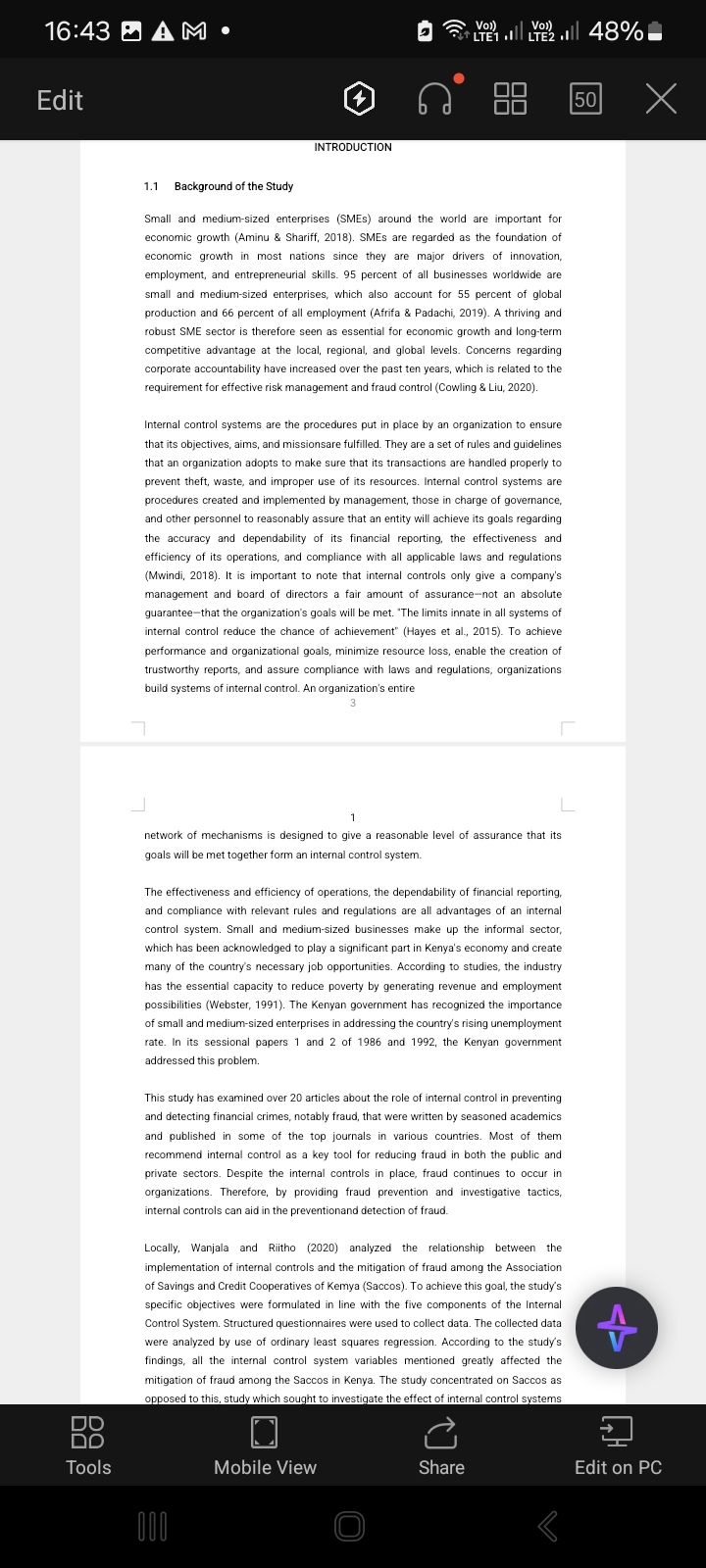
Despite the government's commitment to the ease of doing business, there has been debate over why small and medium-sized enterprises are experiencing a downward trend in business survival. Statistics from the Economic Survey of 2021 show that small and medium-sized enterprises have grown significantly in Kenya during the past 10 years, accounting for around 96 percent of all business enterprises in the country. However, 90% of new businesses fail to survive past their third anniversary. The main objective of this study, therefore, was to investigate the effect of internal control systems on fraud detection and prevention among SMEs in Nairobi, Kenya; specifically to establish the effect of the control environment on fraud detection and prevention among SMEs in Nairobi, Kenya; to establish the effect of risk assessment mechanisms in fraud detection and prevention among SMEs in Nairobi Kenya; and, to establish the effect of monitoring in fraud detection and prevention among the SMEs in Nairobi Kenya. The study was anchored on Reliability and Fraud Diamond Theories. The study adopted an explanatory research design, also known as an experimental design. The group of interest was all the SMEs in the Nairobi Central Business District registered with Nairobi City County. According to the Nairobi City County License Register of 2021, there are 993 business enterprises in the Nairobi Central Business District with between 10 and 99 employees. Therefore, the target population of this study was 993 managers/owners of business enterprises in the Nairobi Central Business District. Yamane's (1967) formula was utilized to determine the sample size for the study in this circumstance. 400owners/managers from the target population served as the respondents for the study. Primary data was used in the study, and semistructured questionnaires were used to gather it. To evaluate the accuracy and dependability of the research instrument, a pilot test was carried out for the study. To assess this data, various data analysis techniques were used. Additionally, descriptive statistics, as well as inferential statistics, were used to examine the quantitativedata. SPSS version 28 was used to complete the data analysis task. The inferential statistics used were factor analysis and ordinal (ordered) logistic regression. The results were that there was a positive correlation between risk assessment and monitoring and fraud detection and prevention among SMEs in Nairobi Kenya. However, there was a weak correlation between the control environment and fraud detection and prevention among SMEs in Nairobi, Kenya. This study contributes to theory by building on the theoretical framework such as the Fraud Diamond theory and improving on the understanding of internal control systems, and the possible effect ICS could have on fraud detection and prevention. Empirically, the study guides management practices by giving insights on how to close the gaps in accounting requirements and other laws that SMEs employ to manipulate profits and deceive investors. The findings of this study were limited to the ICS components of the COSO framework. The study was also limited to data collected using an explanatory research design yet fraud detection and prevention may be affected by technological advancements and unprecedented occurrences which may affect how business is carried out in organizations.
Below is the document preview.

employee participation in decision making and its impact on the organizational performance- business research project
aim of the study was to examine the employee participation in decision making and its impact on the organizational performance of SCIK. Informative, consultative, administrative, associative, and decisive participation levels; and formal and informal participation of employees in decision making, participative decision making, and representative participation of employees in decision making were identified as an independent variable in this study. The research has followed quantitative research approach, survey as a strategy, and structured questionnaire adopted from previous related works as data collection instrument. The research used descriptive and explanatory research design. The data was collected from the employees of SCIK across the existing occupational levels working at the head office, Nairobi, Kenya . Proportionate stratified sampling method along with random sampling techniques was applied to identify respondents proportionately across the occupational levels. Both primary and secondary data sources were used to gather data. The study has utilized a statistical tool called SPSS V.25 for doing the analysis. Descriptive statistics were used for summarizing and presenting the data. In addition to this, inferential statistical tools such as correlation, and regression analysis were utilized for examining the relationship between dependent and independent variables. The study revealed that associative and informative participations; and representative participation are the most practiced levels and types of employee participation in SCIK. The study found that there is a positive and statistically significant relationship between all independent variables and dependent variable; and all independent variables have a significant impact on the organizational performance of SCIK. The study concludes that, among the identified independent variables, there is strongest relationship between informative participation level and organizational performance of SCIK followed by participative decision making and formal and informal participation of employees in decision making respectively. In contrary, consultative, and associative participation levels have the least impact on the organizational performance of SCIK. The study recommends that SCIK should focus on implementing all dimensions of types of employee participation in decision making to enhance the performance of the organization.
1486 Views
0 Downloads
240.55 KB
factor influencing profitability of micro & small scale leather products manufacturing enterprises in Kisii County
Micro and Small (MSSEs) play an important economic role in many countries. In Kenya, for example the MSSE sector contributes over 50 percent of new jobs created but despite their significance. The purpose of this study will be to explain in detail factors influencing on the profitability of Micro and Small scales leather products manufacturing Enterprises in Kisii Town, Ogembo, and Yeka Sub counties Kisii County Administration, Kenya. The study uses explanatory research design. The study targeted Leather Manufacturing MSSEs that were based in Kisii County, Kenya. Census was usd for sample determining strategy because the total population is small, primary data was collected from the study respondents using survey and questionnaires which was self-administered and others researcher administering. Data was analyzed descriptively and presenting through figures, tables, percentages.
When doing regression analysis we determine whether or not there is a relationship between the independent variable and the dependent variable by examining the significance of the regression F statistic for the regression analysis less than the level of significance of 0.05. We reject the null hypothesis because there is positively and significantly strong relationship between the independent the capital and the dependent variable of profitability. Generally, in order to increase the profitability of leather products manufacturing in MSSEs level should need more attention. Also enterprises should improve managing time, money, decrease material wastage I recommended that firms have to improve their financial status, and technological capability on their side. On the other hand, the government has to support them by giving special incentives that promote the manufacturing industry in terms of financial accessibility, promotional support and acess of raw materials easily with comfortabl price for enterprises.
421 Views
0 Downloads
224.36 KB
Impact of Application of Information and Communication Technology (ICT) On Office Managers’ Performance- office management research project
The topic of this study is Application of Information and Communication Technology (ICT) On Office Managers’ Performance (A Case Study of University of Ibadan).The instrument used in gathering data for this study is questionnaire. The scope of the study covered tenunits in the University of Ibadan. The sample size used by the researcher was 50;the data gathered were analyzed using Analysis of variance (ANOVA) and table presentations. The research findings reveal that information and communication technology motivates the job performance of office manager’s and makes work easier and faster. Again, that lack of maintenance will reduce the effectiveness of these machines and bring slowdown in processing.From the summary of the findings, the researcher therefore concludes that information and communication technology should be provided to office manager’s so as to attain their job performance. The researcher recommends that the role of office technology in the development of office manager profession should be encouraged and office managers should have the required skills needed in operating thisequipment.
1388 Views
0 Downloads
139.82 KB
IMPACT OF ECONOMIC ENVIRONMENT ON SCHOOL ATTENDANCE IN NYAMACHE SUB- COUNTY OF KISII COUNTY- SOCIAL WORK AND COMMUNITY HEALTH RESEARCH PROJECT
The study was undertaken to find out the effects of the economic environment in Nyamache Sub- County of Kisii County and its impact on school attendance and the possible mechanisms that could be put in place to improve regular school attendance. The sample of the study consisted of students who obtained less than 30% of attendance, parents of such children and teachers and head teachers in the selected school.
Two principal research instruments were used. These were interview schedule for students and their parents, and questionnaire for the teachers and head teachers.
The study brought to light these major findings: Children who engaged in the economic activities especially the craft activities recorded low school attendance. Surprisingly, the study revealed that a substantial proportion of children stayed with their mothers only, hence the ease with which they play truant at school.
It was also noticed that, boys out numbered the girls in the case of absenteeism, because most of the economic activities they engage in are the crafts which in most cases are the preserve of men or boys. Poverty was also a hindrance to regular school attendance, as most of the children use the money they got from their engagement in the economic activities to supplement their family income.
To improve attendance the under listed strategies could adopt: Adaption of craft activities as an integral part of the curriculum counselors to move round and talk to parents on the importance of formal education.
302 Views
0 Downloads
138.38 KB
impact of small credit finance to poverty alleviation in the urban society of Nyamache Kisii County
main purpose of this study was to assess the impact of small credit finance to poverty alleviation in the urban society of Nyamache Kisii County. It explores the benefits gained from using micro-financing as a mechanism to reduce poverty. The study was conducted in Waumini Credit and Saving Institutes specifically in Nyamache Branch. The data gathering was done by using questionnaire as primary source of data. In addition, interview and other secondary data sources were used. Mixed approach was used and the researcher employed cross-sectional survey design. Descriptive statistical analysis and Propensity Score Matching (PSM) analysis technique was used with respondents coming from clients to test the differences of benefit from the credit scheme who were compared with those in the waiting lists. Purposive Sampling was used to recruit 384 respondents for this study. The findings of the study revealed that customers are getting advantage from the institute for the business startup and growth or expansion. However, close support system in financial management and utilization of the money they borrowed has gaps. The empowerment and psycho-social development of female clients have problems in the borrowing decision, spending of the loan money, and usage of the profit. Findings from new clients indicated that group formation and lack of entrepreneurship implementation is demanding. High interest and unwillingness to accept group responsibility are problems. Therefore, it is important to give training and support systems should be provided in order to strengthen usage of the credit and saving institutes for economic beneficence and development or positive change. The induction and orientation should be from getting loan up to the returning the money borrowed.
369 Views
0 Downloads
204.17 KB
IMPACT OF STAFF MOTIVATION ON ORGANIZATIONAL PRODUCTIVITY A CASE STUDY OF TAC LIMITED NAIROBI COUNTY
Adopting staff motivation practices in a business by the management, boosts the organizational productivity since the employees are encouraged and motivated to work harder in order to boost production .This research investigated the impact of staff motivation practices on organizational productivity, with a focus on identifying the key factors that drove employee performance and subsequently the overall productivity of a firm. This was a case study of TACC Stores, a store which deals with home interiors and sanitaryware. The study specifically examined the effect of monetary incentives; recognition and rewards and career development opportunities on the organizational productivity. Over the recent years, various organizations have adopted the policy of motivating their employees in order to boost their production. They have significantly adopted various techniques and practices of staff motivation, ranging from recognition, empowerment, career development, and many more other practices. Based on this, this research seeks to investigate the impact of staff motivation practices on organizational productivity. Various studies that have been done indicate that factors like empowerment and recognition have a positive effect on employee motivation. Recognition and empowerment play an essential part in enhancing employee motivation towards organizational task (Manzoor, 2011). Other studies that have been done indicate that 66% of organizational productivity is explained by staff motivation practices. Most researches that have been done only study the effect of employee motivation on employee performance not focusing on the organizational productivity. This study used a qualitative approach of data collection. The data was collected through administering questionnaires to the employees of TACC Stores. A target population of 40 employees was used. The sample size for this study was 12 employees. Primary data was collected and the data analyzed qualitatively.
409 Views
0 Downloads
176.29 KB
impact of women entrepreneurship development project (WEDP) loans on the socio- economic development of women entrepreneurs- business research project
Women are becoming increasingly important in the socio-economic development of both developed and developing economies. Female entrepreneurship represents a vast untapped source of innovation, job creation and economic growth in the developing world. Women’s Entrepreneurship Development Project (WEDP) is a $50 million IDA investment lending operation designed to address the key constraints for growth-oriented women entrepreneurs in Nairobi. Its objective is to increase the earnings and employment of micro and small enterprises owned or partly owned by women entrepreneurs in Nairobi. It targets growth oriented women entrepreneurs, providing credit as well as entrepreneurship training/business development services. The purpose of the study is to investigate the impact of women entrepreneurship development project (WEDP) loans on the socio- economic development of women entrepreneurs in the case study of Vision Fund Micro Finance Institution, Nairobibranch. The study was used two groups of samples namely, experimental or treatment group and control group. A total of 220 samples are selected. 100 samples are used as treatment group from the total population size 419 and 120 are used as control group. Documentation, survey /Questionnaires, Focus Group Discussion (FGD), and Key Informants Interviews was used as a data collecting tools. Descriptive statistics and econometric model were applied for analyzing quantitative data. The contribution of WEDP is analyzed based on income, saving, expenditure for health, expenditure for children school, asset accumulation, decision making power, business management skills along with the strength and weakness of the project. The finding indicates that Vision Fund Microfinance WEDP has made positive contributions to the wellbeing of its client. However, all of Vision Fund Microfinance WEDP clients have already been involved in a business activity that can generate income for the repayment of the loan. The study revealed that the aim of WEDP to reach out the any growth oriented women entrepreneurs has not been achieved due to target problems. It was, again, uncovered that, microfinance try as much as possible to reduce the risk involved in giving out unsecured loans. One of their ways of trying to achieve this is by group lending which automatically sideline the poorest since the groups are formed based on the income level of the individual.
1453 Views
0 Downloads
301.89 KB
Influence of change management strategies on employee engagement in multinational companies in Kenya- business research project
The business environment has become more uncertain due to macroeconomic headwinds, shifting political climates and evolving consumer needs triggering organizational change in response to disruption. Manufacturing firms have more recently led the stage in organizational changes due to their vulnerability to the rising cost of goods threatening their margins. However, multiple organizational change initiatives have been known to flop by either not meeting their objectives or resulting in a worse position than before the change. Various change management strategies can be employed to mitigate the negative effects of uncertainty which leads to decreased employee engagement during change. There are limited empirical studies investigating change management strategies’ influence on employee engagement within the context of multinational companies in Kenya within the consumer goods industry. This study investigated the link between change management strategies and employee engagement in multinational companies in the consumer goods industry in Kenya. The study was anchored on Kurt Lewin’s change theory and Kotter’s eight-step change model. The study used a descriptive cross-sectional research design where the unit analysis was the 25 multinational consumer goods companies in Kenya. The representative of each of the 25 multinational companies in the consumer goods manufacturing industry was the chief executive officer (CEO) and chief human resources officer because they hold the requisite information on employee matters and relations, bringing the total number of respondents to 50. The research instrument for primary data collection was structured closed-ended questionnaires. The findings were analyzed through descriptive and inferential statistics and the statistical package for social science (SPSS) was the key analysis tool. The study found that the influence of change management strategies on employee engagement bears different magnitudes depending on the industry. Employee involvement strategy had the most significant positive influence on employee engagement while internal communication, training and coaching were positively associated with employee engagement but only to a moderate magnitude contrary to similar past studies in other sectors where all the key change management variables strongly influenced employee engagement. Recommendations from the study are that organizations should not single out a strategy but employ a combined approach for a stronger effect on employee engagement. It is also vital to foster an environment of trust between employees and leadership as it is a measure of engagement. The study acknowledges it was limited in that being quantitative and anonymous, was constrained in accounting for the experiences of the respondents as the researcher could not probe for further explanations of some responses. The study narrowed down on three change management strategies: internal communication, employee involvement and training and coaching and their influence on employee engagement while there could be other strategies that also strongly influence employee engagement. The study is also based on the perceptions of executive leadership which introduces bias.
1462 Views
0 Downloads
3.97 MB
Influence of supply chain management on the performance of distributors of fast-moving consumer goods companies in Kenya - a case of select key distributors'- business research project
The aim of this study was to investigate factors influencing consumer buying decision towards selected fast moving consumer goods (FMCG) in Nairobi. Quantitative approach along with explanatory research design was applied. The study was conducted on consumer of laundry detergent in Nairobi. A sample of 385 respondents was taken through convenience no probability sampling method, of which a total of 288 valid responses were obtained and used for the analysis. Structured self-administered questionnaire was used to collect the primary data and using SPSS 20.0, both descriptive and inferential analyses were conducted for correlation and multiple linear regression analysis to attain the intended objectives. The Finding indicates that product quality, price, availability, advertisement and brand awareness significantly influence buying decision of consumers in Nairobi, but, product quality, price and availability were the most significant and the demographic profile of shoppers indicates that the market is highly dominated by the purchasing decisions of females within the households in Nairobi plus Retailer's recommendation, friend and family as well as exposure to brands in shops have been identified as the most important sources of information. An important implication for marketers is the development of marketing strategies based on the right knowledge of the decision maker and shopper. Results also give direction for companies and marketers of such products to give attention to consumer’s behavior to be successful.
1371 Views
0 Downloads
1.86 MB
Influence of workforce diversity on employee retention among manufacturing based industries in Multinational Corporations (MNCs) in Kenya- business research project
global workplace is rapidly evolving due to technological advancements, economic expansion, and unprecedented events, leading to increased concerns about employee turnover in multinational corporations (MNCs).
This study examined the impact of age, gender, and ethnic diversity on employee retention intention within manufacturing-based MNCs in Kenya, aiming to address gaps in existing research and provide insights for enhancing retention strategies. The primary objectives included examining the age diversity's effects on staff retention intention within multinational corporations in Kenya, examining the impact of ethnic diversity on employee retention intention among multinational firms in Kenya, as well as the role of gender diversity on employee retention intention in these corporations. Sample survey research design was the type of research design used.
The study's population consisted of 38 manufacturing-based MNCs in Kenya. The research distributed questionnaires and the analysis used descriptive and multiple regression This study was guided by the Reasoned Action Theory and the Social Identity Theory. One hundred and seventy workers were given questionnaires for the survey, and SPSS version 22 was used to do multiple regression analysis. The overall significance of the regression model was determined, as anticipated.
Findings revealed positive perceptions of age diversity, with significant correlations between age diversity and retention intention, emphasizing the importance of inclusive practices for retaining employees. Similarly, positive perceptions of gender diversity and its strong correlation with retention intention highlight the need for gender-inclusive policies and decision-making processes. Ethnic diversity also positively influences retention intention, despite challenges related to cultural conflicts and disparities in career opportunities based on ethnicity.
Effective diversity management is crucial for enhancing employee retention within multinationalcorporations in Kenya. Strategiessuch as ensuring balanced age distribution, promoting gender equality, and addressing cultural conflicts can strengthen retention efforts and contribute to organizational success. The study underscores the importance of fostering inclusive environments that value age, gender, and ethnic diversity for long-term growth and sustainability.
Policymakers should develop comprehensive diversity and inclusion programs addressing age and ethnicity disparities, while management should foster gender equality and communication to create inclusive cultures. Continued research on workplace diversity and employee retention is recommended to explore additional insights and strategies for enhancing organizational performance and employee satisfaction.
1398 Views
0 Downloads
1.12 MB