DESIGN AND IMPLEMENTATION OF A SINGLE INVERTER
| Institution | Kisii National Polytechnic |
| Course | Electrical and elect... |
| Year | 3rd Year |
| Semester | Unknown |
| Posted By | MAKORI KERECHA |
| File Type | docx |
| Pages | |
| File Size | 696.23 KB |
| Views | 3931 |
| Downloads | 0 |
| Price: |
Buy Now
 Buy via
whatsapp Buy via
whatsapp
|


Description
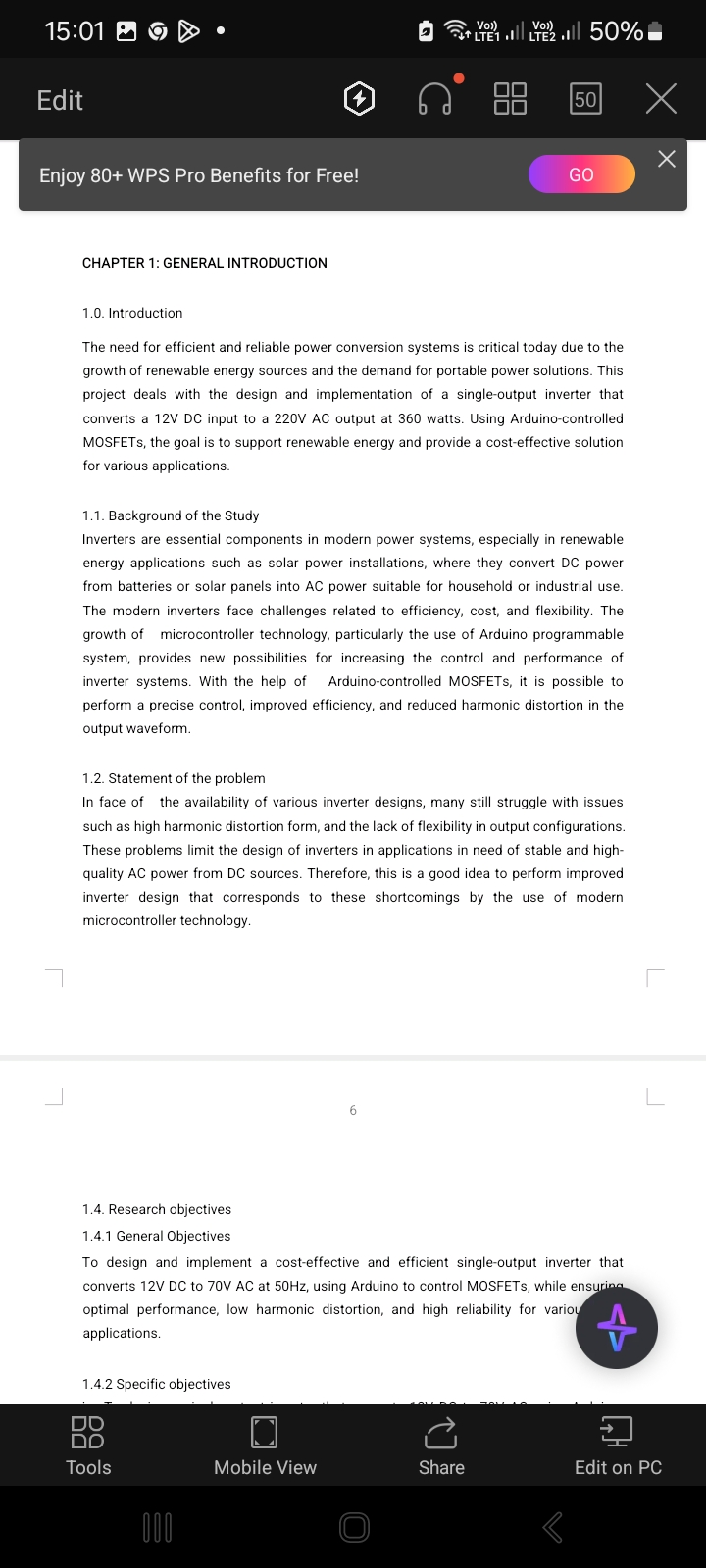
project report covers the design and implementation of a single-output inverter. It converts a single 12V DC input to a 70V AC output at 7watts using Arduino-controlled MOSFETs. This setup is cost- efficient because one inverter can supply different loads, saving money and space, especially in renewable energy systems. The goal is to develop an inverter that provides multiple AC outputs from one DC source for various uses, including renewable energy and portable power supplies.
The core of the system is an Arduino microcontroller. It generates precise pulse-width modulation (PWM) signals to control the MOSFET switches, ensuring efficient conversion and stable output. The design process involves choosing the right MOSFETs and developing protective circuits to prevent overvoltage, under voltage, and short-circuits.
Experimental results show that the inverter can produce a stable 70V AC output with low harmonic distortion, maintaining performance under different load conditions. The system's efficiency, output quality, and response to changing loads are thoroughly analyzed. This project demonstrates the effective combination of Arduino control with power electronics, providing a high-performance solution for converting DC to AC power.
Below is the document preview.

Hotel management system - Ict/computer science research report
Trending!
Get your editable report
This project examines the aspect of the hospitality industry which is Hotel management. In the 21st century the use of the internet, computers and other electronic devices have made handling different jobs and aspects of management very easy. This project is the design and implementation of an electronic hotel management system that provides proper management of data and transactions in a centralized and organized manner and also provides a user friendly interface with which the user can interact easily with the just little or elementary knowledge of operating computers. This project is designed to create a platform that allows booth the user and administrator to keep track of transactions like room reservations, room booking, financial administration of the hotel, staff record keeping, online reservation and other day to day activities involved in the running and management of a hotel. The implementation is based on the requirements for a hotel management system. The project work is divided into five major categories which are; Front Desk, Accommodation, Catering, Finance & Account and Personnel Staff Record (Human resource management). This project accomplished the task of building a system that ensures accurate record maintenance which was done through proper identification of customers and the proper designation of user functions with most of the processes being done automatically. An electronic hotel management information system is required to assist management of data in the hospitality industry and also to make the entire hotel management process easier. The project was designed with the use of Microsoft visual Studio which is an integrated development environment made by Microsoft. It can be used to develop console and graphical user interface applications along with windows form application websites. The database system was created using Microsoft SQL server (MSSQL).
For source code contact 0723316663
2302 Views
0 Downloads
1.22 MB
Effects of soft skills on customer service in hotel food establishments in kisii town - hospitality and tourism research project
Trending!
Get your editable research project
The influence of Service Quality on Customer Satisfaction and Customer Loyalty in 4-star hotels in Nairobi County, Kenya has been a major importance in the hospitality industry. Service quality as seen is a major factor that contributes to customer satisfaction in the hotel industry since excellent service quality will bring about the satisfaction of their guests thus the brand of the hotel will be improved by the satisfaction of their guests. Service quality is also a major factor to which contributes to the loyalty of a guest since the customer will be satisfied and will definitely visit the hotel occasionally since the service quality of the hotel is good and professional thus the customers will talk to other to other potential customers about the quality of service of the hotel and they were treated as well as how they enjoyed their experience in the hotel. This then will improve the appearance of the hotel and increase the brand status of the hotel. We see the relationship of service quality on customer satisfaction and customer loyalty and the various theories as well as the different models that display the relationship between service quality, customer satisfaction and customer loyalty
2216 Views
0 Downloads
344.62 KB
Structural and architectural design of modern clinic - building and civil engineering project
Trending!
This Project titled “Architectural and Structural Design of Three-storey Clinic in Kisii District: addresses the pressing need for modern infrastructure in Kisii, particularly in meeting the growing demands of the hospitality industry. Given Kisii’s socio-economic landscape, where the tourism and hospitality sectors are pivotal for economic growth, this study aims to evaluate and create a sustainable architectural framework and structural design for a hotel that integrates modern design principles and sustainability. Problem Statement: As Kisii advances towards its vision for sustainable development, there is a critical requirement for infrastructures, such as hotels, that cater to the influx of tourists while promoting local economic growth. This study seeks to address the gap in architectural and structural frameworks within the hospitality sector, particularly in densely populated regions like Kisii District. Objectives: The primary objective of this study is to design a comprehensive architectural model and structural configuration for a three-storey Clinic, aiming for efficiency, safety, and aesthetic appeal. The specific objectives include:
This study adopted a case study methodology focusing on Kisii District. Data was collected through site observations and analysis of the existing infrastructure. Architectural designs were rendered using ARCHICAD, while structural designs—including slabs, beams, columns, and foundations—were analyzed using PROKON software. Reinforcement specifications were calculated for each structural element to ensure safety and durability. The architectural design emphasized the integration of modern aesthetics with functional spaces, including reception areas, guest accommodations, and service rooms. The structural analysis revealed that the designed building could effectively support anticipated live and dead loads while maintaining safety standards. Recommendation: It is recommended that further research focuses on environmental impacts and how to incorporate renewable energy practices into clinic designs. Additionally, policymakers should facilitate training programs for civil engineering students to enhance competencies in using modern design software, which is crucial for sustainable infrastructure development in Kisii.
3736 Views
0 Downloads
1.64 MB
Determinants of customer satisfaction on banquet services in hotels in kisii town - hospitality and tourism research project
Trending!
Get your editable research project
This study sought to analyse determinants of customer satisfaction of banquet services in Kisii Town, Kenya. The drop in influx of foreign and domestic tourists seeking for hospitality services in Kisii State has forced hoteliers into competing for banquet events as a means of remaining in business. Customers are the focus of every successful service operations; it is important that banquet managers know what customers want in banquet service operations in order to stop them from switching to other providers and remaining loyal to a provider. The objectives of the study were: to determine the relationship between socio-economic background of customers and their satisfaction of banquet services offered in Kisii Town, to examine the impact of hotel location on customer satisfaction of the banquet service, to assess the effect of price on customer satisfaction, and to investigate the effect of service quality on customer satisfaction of banquet services offered in hotels in Kisii Town. The study adopted descriptive research survey design. Quantitative methods were used to collect primary data. Fisher’s formula was used to select a sample population of this study. The study targeted a population of 391, which comprised of the clients that sponsored the banquet functions and attendees of banquet services in hotels in Kisii Town. The study sampled 50% of the hotels whereby purposive sampling technique was employed to select 17 hotels representing three types of hotel classifications; ranging from ‘A’ to ‘C’ category. In addition purposive sampling method was used to select clients who booked for banquet events, while probability sampling techniques were used to select the attendees who participated in the study. The study used structured questionnaires to collect primary data from the respondents. Descriptive statistical analysis such as standard deviation, mean ranking was applied to describe the study variables in line with the study objectives. Gap analysis using the service quality measurement instrument (SERVQUAL) developed by Parasuraman, Zeithml and Berry (1988) was used to determine the customer satisfaction in relation to quality of service rendered. Spearman Rank Order Correlation (rho) and multiple regression analysis were used to assess the relationship between banquet service quality and customer satisfaction. The analysed data was presented in tables and charts to represent quantitative findings. The study findings were summarised and conclusion made in an attempt to describe the research objectives. The study, in summary, found that the demographic characteristics, price of the banquet services, location and tangibility aspect of SERVQUAL did not influence customer satisfaction. However, reliability, responsiveness, assurance and empathy dimensions of SERVQUAL influenced the customer satisfaction on quality service. The study recommends that hotels should develop standard operations procedures as a measure of ensuring coordinated service delivery to address the reliability, responsiveness, apathy and empathy dimension aspect of the service quality which the study revealed to be lacking in the service delivery process.
1
2247 Views
0 Downloads
202.95 KB
Online training system project report
Trending!
The increasing demand for flexible and accessible learning platforms has prompted many organizations to adopt online training systems. NOVATECH, a training company based in Kisii, , aims to equip students and professionals with the skills necessary to thrive in today’s competitive job market. However, the company currently lacks a formal online platform, limiting its ability to efficiently manage training materials and reach a broader audience. This project seeks to address these challenges by developing an online training system tailored to the needs of
NOVATECH.
The proposed system will be built using HTML, CSS, JavaScript, and Bootstrap for the frontend, and PHP with MySQL for the backend. This system will streamline the management of training resources, enable real-time tracking of learner progress, and provide users with easy access to training materials from anywhere, at any time. The integration of a user-friendly interface will ensure that learners can navigate the platform seamlessly, while administrators can efficiently manage content and monitor learner activities.
Through interviews with NOVATECH staff and potential users, this project identified key requirements for the system, including course management, user authentication, and secure data storage. The design phase incorporated these requirements, leading to the development of a scalable and secure platform that meets both current and future training needs.
The successful implementation of this system will enhance NOVATECH’s ability to deliver highquality training, improve learner outcomes, and expand the company’s reach beyond its current geographic limitations. Ultimately, this project demonstrates the critical role of online training systems in modern education and professional development.
3301 Views
0 Downloads
966.98 KB
Computerised transcript management system project report
Trending!
This project focuses on the development of a computerized information management system specifically designed for transcript management. The implementation of this system will address numerous challenges traditionally associated with the manual handling of student records. Among these challenges are the frequent misplacement of student records, delayed and cumbersome access to student reports, inaccurate record-keeping, and poor information management within educational institutions.
One of the primary benefits of this system is the ease with which the aims and objectives of the study can be retrieved. The system will offer enhanced data security, ensuring that student information is well-protected and only accessible to authorized personnel. Additionally, the system will significantly reduce the resources required for managing transcripts, thus lowering the overall cost associated with the processing of student records. This reduction in resource usage is achieved through the storage of information in a centralized database, minimizing data redundancy and improving overall efficiency.
Furthermore, the design of this program ensures the seamless flow of information across various departments within the school. By centralizing and automating transcript management, the system guarantees more accurate and up-to-date information for students, faculty, and administrative staff. It will also provide consistency in record-keeping across all schools and institutions that adopt the system, leading to improved information management practices at every level. Ultimately, this project represents a transformative step toward modernizing academic record management, ensuring efficiency, accuracy, and security in educational institutions.
3580 Views
0 Downloads
2.29 MB
Central supplying inventory information system project report
Trending!
Today’s world has shown us that computer web-based application is among the pillars of advanced computing system technology in all sectors of society that has turned out as the most effective way to lead to efficient information management.
This research project entitled “Design and implementation of Central supplying inventory management information system” is aimed to developing a well web-based application accessible through internet, with a database that stores information, generate reports though fast, reliable and user-friendly interfaces for better management of inventory of trust and work company ltd.
During the collection of data, interview, Observation, archives and documentations were used. Spiral model was used as a software development methodology lifecycle, and during the system design we have used SSADM which helped to know and determine the flow of information the system,while designing the database we have used Xampp as local host and MySQL as Database, we have also used the following programming languages whereby: PHP and JavaScript and scripting and styling with HTML,CSS and w3School css framework, lastly we have used editor for writing the source which is visual studio.
By concluding this work we have seen that as we are facing different changes which require us to walk in hand with the digitalization this project will help to digitalize the inventory such that anyone having the access can access it easily through internet by the mean of computer or any other smart device which can read, accept input and generate the output on screen this web based application can be accessible and giving the kin and quickest way to make and generator the inventory report; recommended also the future researcher to deepen this works by implementing other new feature that might be lacking missing the system.
3465 Views
0 Downloads
949.1 KB
Educational administration portal system project report
Trending!
Nowadays, Science and Technology is the most spreading department among other department we have here on earth where the experts in technology are trying to match the existing department with technology so that we can enjoy life more. Different institutions also, are trying to find solutions of how they can match their existing systems with technology in order to provide better services to their customers using technology and gain more than before. a Boss of a given company can direct a meeting using video conferencing, distance learning and a big task for the experts in technology is to build a complete system that will help us to live in the life we want.
The objective of this project is to design and implement an "Educational Administration Platform" for ESTG Secondary School, aimed at enhancing administrative efficiency and overall institutional management. The system seeks to streamline administrative processes, improve communication channels, and facilitate data-driven decision-making to support effective teaching and learning.
Data collection methodologies employed include interviews, documentation review, and observation techniques. These methods were instrumental in gathering comprehensive data to understand ESTG Secondary School's specific administrative needs and operational challenges.
To achieve these objectives, the project follows the Waterfall Model for its structured approach to system development. Technologies such as PHP, HTML, CSS, and other web technologies are utilized to ensure scalability, security, and user accessibility.
The Structured Systems Analysis and Design Method (SSADM) serves as the methodology for system analysis and design, providing a systematic framework to analyze ESTG Secondary School's administrative workflows and design an efficient platform tailored to its requirements.
This project is limited to implementation at ESTG Secondary School, focusing on enhancing administrative efficiency, fostering collaboration among faculty, staff, and students, and leveraging data analytics for informed decision-making.
The primary issue addressed by this project is the complexity of administrative tasks at ESTG Secondary School, which can hinder effective management. The platform aims to address these challenges by providing a centralized system for administrative tasks, improving communication, and facilitating collaboration.
As a web-based application, the platform requires internet connectivity for users to interact with the system. Future developments may explore mobile compatibility to further extend accessibility and usability across different devices.
Implementing a policy where teachers cannot view the marks of students who haven't paid their fees could create significant challenges. This approach may hinder academic monitoring and timely interventions, increase stress and anxiety among financially struggling students, and introduce additional administrative burdens. While it might encourage timely payments, it risks negative backlash and ethical concerns. Instead, a balanced approach is recommended, using reminder systems and financial counseling to promote timely payments, along with financial aid and flexible payment plans to support students. Transparent communication about policies, integrated academic and financial support systems, and careful consideration of ethical implications can help maintain financial compliance without compromising academic progress.
In conclusion, the implementation of this system at ESTG Secondary School will empower administrators to optimize administrative processes, foster a collaborative educational environment, and enhance overall institutional effectiveness and efficiency.
3411 Views
0 Downloads
2.7 MB
Emergency ambulance hiring system project report
Trending!
The Ambulance Service Management System is a comprehensive web-based application developed using a combination of technologies, including PHP and a MySQL database. The system is designed to streamline the management of ambulance services and patient requests, catering to the needs of both administrators and users.
The primary objective of the Ambulance Service Management System is to provide a user-friendly and efficient platform for managing the complete life cycle of ambulance services, from patient requests to administrative management.
Traditional ambulance service management often involves manual processes, fragmented data, and poor communication between patients and service providers. This can lead to inefficiencies, delays, and a lack of transparency in the service delivery process.
The system is developed using PHP, a popular server-side scripting language, and a MySQL database to store and manage all the relevant data. The integration of these technologies provides a robust and scalable solution for the management of ambulance services.
The Admin Module offers a comprehensive set of features for managing the system. Administrators can view a dashboard that displays key statistics, such as the total listed ambulances, total requests received, total new requests, total assigned requests, total on-the-way ambulances, total patient-picked requests, total patient-reached requests, and total rejected requests. Administrators can also manage ambulances, ambulance requests, website pages, and generate reports based on request dates. Additionally, administrators can search for request details based on booking numbers, relative numbers, or patient names. On the user side, visitors or patients can access the website and hire ambulance services as needed.
The implementation of the Ambulance Service Management System has demonstrated its effectiveness in streamlining the ambulance service process, improving communication between patients and service providers, and providing administrators with comprehensive data management capabilities. The system has been designed to enhance patient satisfaction, improve service efficiency, and offer a centralized platform for managing all aspects of the ambulance service process.
3513 Views
0 Downloads
2.28 MB
Employee tracking system project report
Trending!
The Employee Tracking System is a comprehensive web-based solution designed to streamline and enhance the management of employees within an organization. It offers an intuitive platform that integrates various functionalities such as employee attendance, task management, notifications, and messaging. This system ensures efficient tracking of employee activities and facilitates communication between admins, managers, and employees.
The system is built using PHP for backend processing and MySQL for data storage, with HTML, CSS, and JavaScript for the frontend interface. Font Awesome and custom icon sets are used to provide a visually appealing and interactive user experience.
The Admin Dashboard serves as the control hub for system administrators, offering features such as task management, employee profile creation, and notifications. Admins can monitor employee performance and send instant feedback through an integrated messaging system. Employees can view their assigned tasks, manage their attendance, and interact with managers in real-time. Managers have access to team overviews, allowing them to track task progress and submit ratings for completed tasks.
Key features include: Attendance Tracking where Employees can clock in and out based on their office location, providing reliable attendance records. Task Management Tasks can be assigned to employees, tracked, and rated by managers and admins. Real-time Notifications Both admins and employees receive notifications related to task status, messages, and system updates. Messaging System A chat interface enables communication between users, allowing seamless interaction within the platform.
The project employs a modular structure, allowing for easy future expansion. Screenshots and
Source Codes are categorized and documented thoroughly to ensure clarity and usability. The database schema and file structure are organized systematically to enhance scalability and maintainability.
This system aims to improve organizational efficiency, employee accountability, and communication, ultimately leading to a more productive and transparent working environment.
3509 Views
0 Downloads
1.9 MB