ADVANCED FINANCIAL REPORTING THEORY REVISION
| Institution | University |
| Course | CERTIFIED PUBLIC ACC... |
| Year | 1st Year |
| Semester | Unknown |
| Posted By | stephen |
| File Type | |
| Pages | 17 Pages |
| File Size | 785.01 KB |
| Views | 4721 |
| Downloads | 0 |
| Price: |
Buy Now
 Buy via
whatsapp Buy via
whatsapp
|


Description
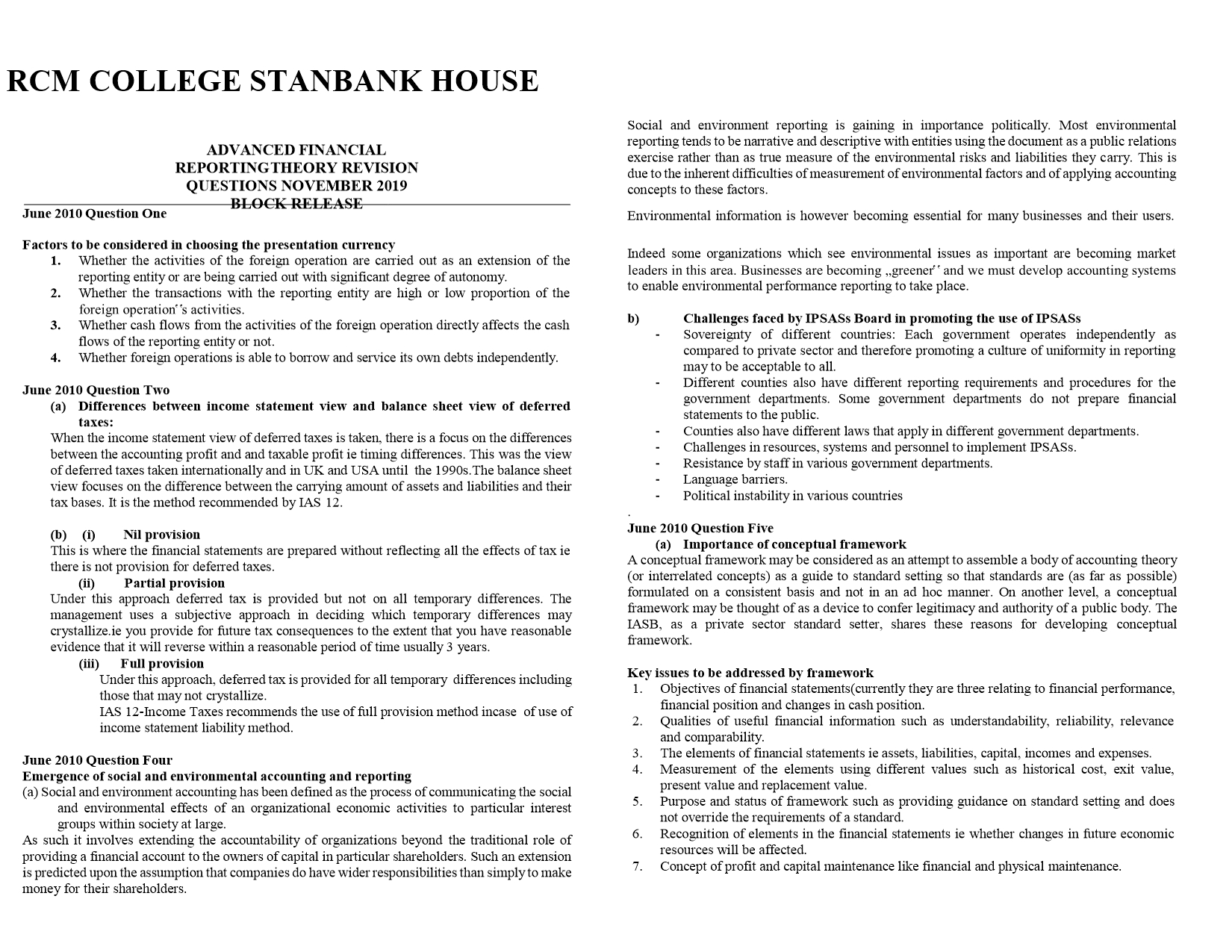
Factors to be considered in choosing the presentation currency
1. Whether the activities of the foreign operation are carried out as an extension of the
reporting entity or are being carried out with significant degree of autonomy.
2. Whether the transactions with the reporting entity are high or low proportion of the
foreign operations activities.
3. Whether cash flows from the activities of the foreign operation directly affects the cash
flows of the reporting entity or not.
4. Whether foreign operations is able to borrow and service its own debts independently.
June 2010 Question Two
(a) Differences between income statement view and balance sheet view of deferred
taxes:
When the income statement view of deferred taxes is taken, there is a focus on the differences
between the accounting profit and and taxable profit ie timing differences. This was the view
of deferred taxes taken internationally and in UK and USA until the 1990s.The balance sheet
view focuses on the difference between the carrying amount of assets and liabilities and their tax bases. It is the method recommended by IAS 12.
(b) (i) Nil provision
This is where the financial statements are prepared without reflecting all the effects of tax iethere is not provision for deferred taxes.
(ii) Partial provision
Under this approach deferred tax is provided but not on all temporary differences. The
management uses a subjective approach in deciding which temporary differences may
crystallize.ie you provide for future tax consequences to the extent that you have reasonable
evidence that it will reverse within a reasonable period of time usually 3 years.
Below is the document preview.

Polyhydramnios and Oligohydramnios
Trending!
•It’s a pregnancy induced condition characterized by
excess amount of liquor amnii (amniotic fluid) to more than 1500ml, based on ultrasound scanning.
NB
Clinical diagnosis is only possible where the amount is at least 3000 ml.
31 Pages
4601 Views
0 Downloads
1.01 MB
Multiple Pregnancy
Trending!
Multiple pregnancy refers to the development of more than one(1)fetus in the uterus at a specific duration. Classification of Multiple Pregnancy
It’s based on the number of fetuses and type of placentation
(placental formation).
The primary classification are based on;
1. Number of fetuses
2. Zygosity
3. Chorionicity and Amnionicity
4. Vanishing Twin Syndrome
59 Pages
4770 Views
0 Downloads
1.7 MB
Induction of labour & Augumentation of labour
Trending!
Induction of labor is an obstetrical intervention which involves the initiation of uterine contractions (labour) artificially or prior it’s spontaneous onset.
• It’s done after viability at gestation ages of 28 weeks and above.
• Commonly performed when the risks of continuing the pregnancy are perceived to outweigh the risk of shortening the duration of pregnancy.
42 Pages
4426 Views
0 Downloads
1.05 MB
Abnormal Labor
Trending!
Definition; Also referred to as dysfunctional labor or dystocia, is labor that does not progress in atypical or expected manner.
61 Pages
4512 Views
0 Downloads
1.21 MB
FORCEPS DELIVERY
Trending!
Forceps delivery is a means of extracting the foetus with the aid of obstetric forceps when it is inadvisable or impossible for the mother to complete the delivery by her own effort.
• This procedure is performed by a forceps; an instrument that
has two parts that cross each other like scissors and lock at
the intersection.
• The lock may be of sliding type or of screw type.
• Each part consists of a handle, a lock, a shank and a blade.
• The blade is joined to the handle by a shank.
• The blade has two curves, cephalic curve to fit the head, and
pelvic curve that correspond with the curved axis of the
pelvis.
96 Pages
4413 Views
0 Downloads
2.32 MB
EPILEPSY IN PREGNANCY
Trending!
Epilepsy is a central nervous system (neurological) disorder in which brain activity becomes abnormal, causing seizures or periods of unusual behavior, sensations, and sometimes loss of awareness
14 Pages
4478 Views
0 Downloads
342.71 KB
Abnormal puerperium
Trending!
Abnormal Puerperium:
Breast complications
Maternal blues
Postpartum depression
Puerperal psychosis
Post-partum Haemorrhage (PPH)
Puerperal pyrexia
Puerperal sepsis
Deep venous Thrombosis
111 Pages
4333 Views
0 Downloads
2.2 MB
Primary Post Partum Hemorrhage
• It’s excessive bleeding occurring during 3
rd stage or any
time within the first 24 hours of delivery.
Major causes
• Uterine atony or atonic uterus (Tone /tissue = 70% )
• Trauma along the genital tract. ( Trauma = 20% )
• Blood coagulation disorder. ( Thrombin = 1% )
(4 Ts – Tone, Tissue, Trauma, Thrombin)
44 Pages
575 Views
0 Downloads
1.24 MB
COMPUTER LITERACY SKILLS
Trending!
Computer literacy as defined by Webopedia is: The level of expertise and familiarity someone has with computers. Computer literacy generally refers to the ability to use applications rather than to program.
39 Pages
4935 Views
0 Downloads
703.41 KB
THE MEDIASTINUM
Trending!
THE MEDIASTINUM is the Region of the thoracic cavity, between the two lungs
Extents of the mediastinum:
Sternum to the thoracic spine
Thoracic inlet to the thoracic diaphragm
112 Pages
4648 Views
0 Downloads
7.08 MB