ADVANCED FINANCIAL REPORTING THEORY REVISION
| Institution | University |
| Course | CERTIFIED PUBLIC ACC... |
| Year | 1st Year |
| Semester | Unknown |
| Posted By | stephen |
| File Type | |
| Pages | 17 Pages |
| File Size | 785.01 KB |
| Views | 4736 |
| Downloads | 0 |
| Price: |
Buy Now
 Buy via
whatsapp Buy via
whatsapp
|


Description
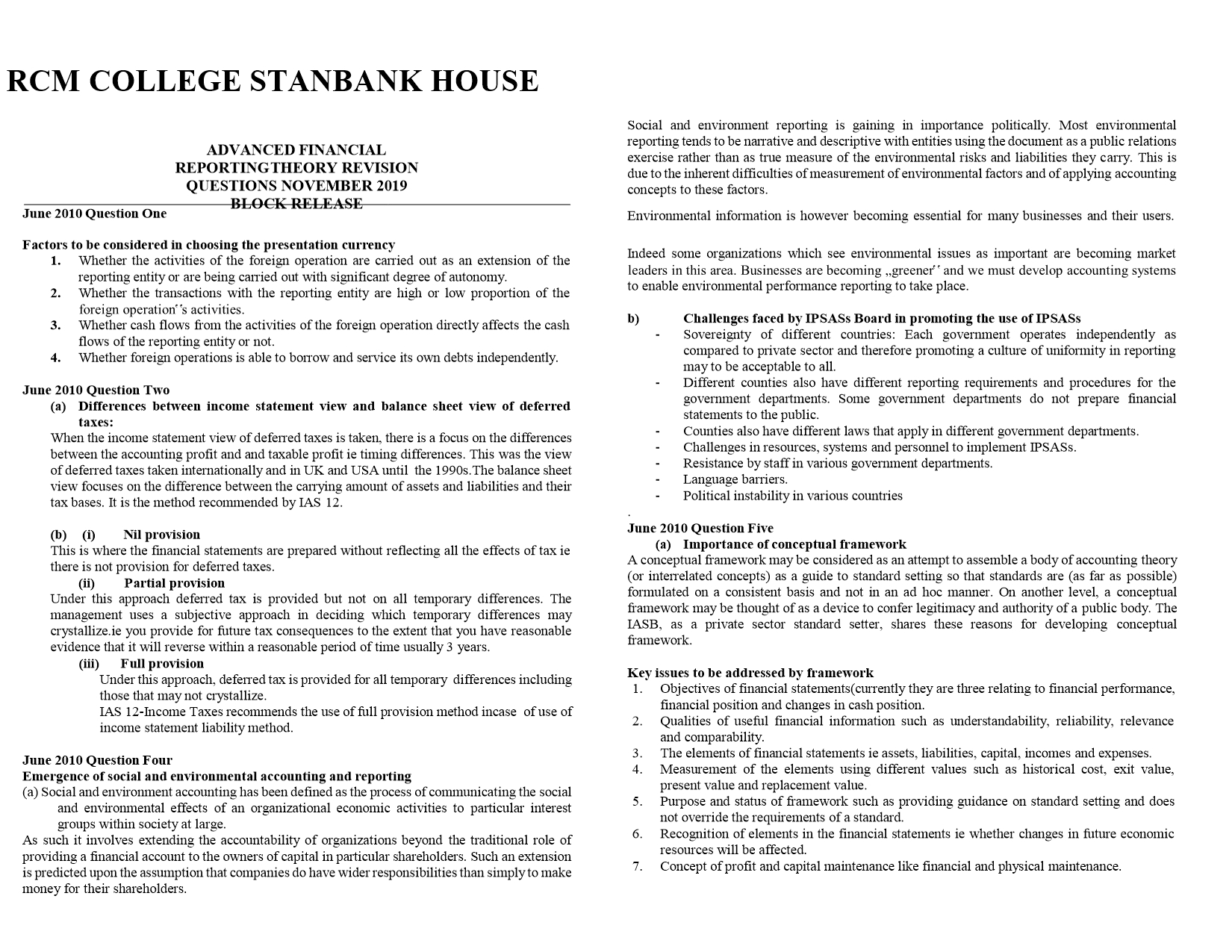
Factors to be considered in choosing the presentation currency
1. Whether the activities of the foreign operation are carried out as an extension of the
reporting entity or are being carried out with significant degree of autonomy.
2. Whether the transactions with the reporting entity are high or low proportion of the
foreign operations activities.
3. Whether cash flows from the activities of the foreign operation directly affects the cash
flows of the reporting entity or not.
4. Whether foreign operations is able to borrow and service its own debts independently.
June 2010 Question Two
(a) Differences between income statement view and balance sheet view of deferred
taxes:
When the income statement view of deferred taxes is taken, there is a focus on the differences
between the accounting profit and and taxable profit ie timing differences. This was the view
of deferred taxes taken internationally and in UK and USA until the 1990s.The balance sheet
view focuses on the difference between the carrying amount of assets and liabilities and their tax bases. It is the method recommended by IAS 12.
(b) (i) Nil provision
This is where the financial statements are prepared without reflecting all the effects of tax iethere is not provision for deferred taxes.
(ii) Partial provision
Under this approach deferred tax is provided but not on all temporary differences. The
management uses a subjective approach in deciding which temporary differences may
crystallize.ie you provide for future tax consequences to the extent that you have reasonable
evidence that it will reverse within a reasonable period of time usually 3 years.
Below is the document preview.

Research Methodology Full Notes
Trending!
Research is a serious academic activity with a set of objectives to explain or analyse or
understand a problem or finding solution(s) for the problem(s) by adopting a systematic
approach in collecting, organizing and analyzing the information relating to the problem.
87 Pages
2632 Views
0 Downloads
519.7 KB
Question Bank On Research Methodology
Trending!
This document contains a question bank on research methodology covering 6 units: 1. Introduction to research - defining research, differences between methods and methodology, objectives of research, research process, criteria for good research. 2. Research design - meaning and significance, differences from problem approach, exploratory vs descriptive design, research hypotheses, experimental designs. 3. Sampling methods - sample design, probability vs non-probability sampling, random sampling, stratified sampling, sampling bias, sample size. 4. Data collection methods - primary vs secondary data, surveys, questionnaires, interviews, observation, case studies, attitudes measurement techniques. 5. Attitude measurement and scaling - types of scales, sources of error,
16 Pages
2673 Views
0 Downloads
54.66 KB
Chemistry For Engineers Complete Notes
Trending!
Understanding the electronic structure of atoms requires an understanding of the properties of waves and electromagnetic radiation.A basic knowledge of the electronic structure of atoms requires an understanding of the properties of waves and electromagneticradiation.
152 Pages
4262 Views
0 Downloads
9.98 MB
FONETIKI NA FONOLOJIA YA KISWAHILI
Trending!
Sehemu hii ya kwanza (1.0) inahusu maana ya dhana fonetiki na pia fonolojia. Vilevile,
inabainisha kwamba lugha haichunguzwi tu kifonetiki na kifonolojia, bali pia katika mawanda mengine ambayo ni mofolojia, sintaksia, semantiki, pragmatiki, na kadhalika.
50 Pages
4337 Views
0 Downloads
414.75 KB
HDR 103: DEVELOPMENT CONCEPTS AND ITS APPLICATION NOTES
Trending!
Historically the word development in its present context is of a very recent origin. It was used in the covenant of League of Nations and much later by the charter of the United Nations. The concept of development acquired more significance after the Second World War in 1945, partly as a requirement to help reconstruct the countries, which had been ruined by the two world wars, and later extended towards development of countries emerging from colonial rule.
61 Pages
3996 Views
1 Downloads
601.64 KB
PROJECT PLANNING AND MANAGEMENT HANDBOOK
Trending!
According to Gittinger (1982) and Todaro (1986) planning is an activity, which minimizes future risks that is minimizing the unknown and maximizing the known.
104 Pages
3819 Views
0 Downloads
1.12 MB
BAS 101: QUANTUM MECHANICS NOTES
Trending!
Quantum mechanics is the fundamental theory in physics that explains the behavior of matter and energy at the atomic and subatomic scales, where it deviates from the laws of classical physics. Key concepts include wave-particle duality, where particles like electrons can act as both waves and particles, and quantum superposition, where a quantum object can exist in multiple states simultaneously until measured.
126 Pages
3760 Views
0 Downloads
18.87 MB
Management Consultancy Practice Notes
Trending!
Management consultancy provides professional advice and services to clients facing business problems. Common areas include business planning, IT systems, and process improvement. 2. Consultants are hired for their independence, expertise, and ability to drive change. They use analytical processes like defining problems, gathering facts, developing solutions, and implementing recommendations.
4 Pages
4135 Views
0 Downloads
61.21 KB
Management Consultancy Principles and Engagements Notes
Trending!
The document provides an overview of management consultancy services, focusing on the role of independent accounting firms and the qualifications of management consultants. It outlines the reasons individuals enter the consulting field, the objectives of management advisory services, and the various types of consulting engagements. Additionally, it discusses the evolving nature of the consulting industry, the career structure within consulting firms, and the future prospects for management consulting.
51 Pages
4080 Views
0 Downloads
1.94 MB
COMPLETE COMMERCE NOTES
Trending!
The document discusses the key aspects of starting and operating a business. It begins by defining business and listing its main characteristics, including that a business involves an entrepreneur, enterprise, continuous deals, risk, and profit. It then outlines the main functions of business such as organizing, financing, production, distribution, personnel management, and research and development. Finally, it provides a 10 step process for starting a business, covering topics like developing a business plan and financial projections, choosing a legal structure, obtaining licenses, setting up accounting and business locations, and promoting the new business.
82 Pages
3758 Views
0 Downloads
1.2 MB