Agent Environment in AI
| Institution | Jomo Kenyatta University of Science and Technology |
| Course | Information Technol... |
| Year | 3rd Year |
| Semester | Unknown |
| Posted By | Jeff Odhiambo |
| File Type | |
| Pages | 3 Pages |
| File Size | 71.25 KB |
| Views | 3658 |
| Downloads | 0 |
| Price: |
Buy Now
 Buy via
whatsapp Buy via
whatsapp
|


Description
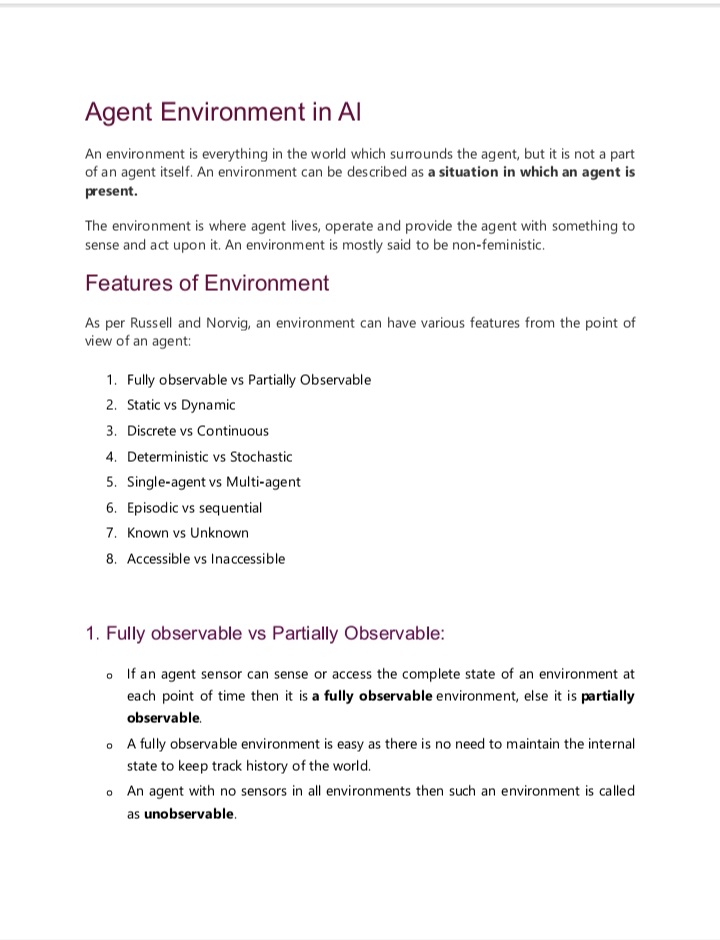
In AI, the agent environment refers to the external context or surroundings in which an AI agent operates. It includes everything that the agent can perceive and interact with, influencing its actions and decisions. The environment provides feedback to the agent’s actions, which is typically used to adjust behavior or strategy. The environment can be physical, such as a robot navigating a room, or abstract, like a game environment. It is characterized by its dynamics, including whether it is static or dynamic, fully observable or partially observable, deterministic or stochastic, and discrete or continuous. The interaction between the agent and the environment is fundamental to AI decision-making and learning processes.
Below is the document preview.

Introduction to cloud computing
Trending!
Cloud computing refers to the delivery of computing services over the internet ("the cloud"). These services include servers, storage, databases, networking, software, analytics, and more. Instead of owning physical data centers or servers, businesses and individuals can access technology resources on-demand from a cloud service provider.
3640 Views
0 Downloads
2.21 MB
Building cloud infrastructure
Trending!
Building cloud infrastructure involves creating and deploying a combination of hardware, software, networking, and services to host and manage applications, data, and resources in a cloud computing environment.
3510 Views
0 Downloads
1.32 MB
Physical layer
Trending!
In cloud computing, the physical layer refers to the foundational hardware infrastructure and resources that support the cloud environment. It includes all the physical components necessary to store, process, and transmit data.
3612 Views
0 Downloads
3.48 MB
Virtual Layer
Trending!
A virtual layer refers to an abstraction layer that separates the physical resources or systems from the applications or processes that utilize them. It creates an interface or "virtualization" to make underlying resources more flexible, scalable, and easier to manage. Virtual layers are commonly used in computing, networking, and software environments.
3495 Views
0 Downloads
1.82 MB
Control Layer
Trending!
control layer refers to the management and orchestration layer that oversees the underlying cloud infrastructure. It acts as an intermediary between the physical or virtual resources and the user or application interfaces. The control layer is responsible for enabling resource provisioning, monitoring, scaling, and other management tasks.
3669 Views
0 Downloads
1.5 MB
Service and Orchestration
Trending!
A service in cloud computing refers to a specific resource or functionality provided by a cloud provider. Services can range from infrastructure to platforms and applications.Service orchestration is the automated coordination and management of multiple services to achieve a specific outcome. It ensures that individual services work together efficiently to deliver complex workflows or applications.
3641 Views
0 Downloads
2.1 MB
Business Continuity
Trending!
Business continuity refers to the ability of a business or organization to maintain essential functions during and after a disruptive event. In the context of cloud computing, it ensures that cloud-based services and applications remain available and operational, even in the event of hardware failures, cyberattacks, natural disasters, or other emergencies. Business continuity in cloud computing focuses on resilience, redundancy, and minimizing downtime.
3567 Views
0 Downloads
4.71 MB
Security
This module focuses security cross-layer function of the cloud computing reference model. This module focuses on key security threats to a cloud infrastructure. It focuses on the various security mechanisms that enables the cloud service providers to mitigate these threats. Finally, this module focuses on the governance, risk, and compliance (GRC) aspect in a cloud environment.
992 Views
0 Downloads
1.91 MB
Service Management
This module focuses on the service management cross-layer function of the cloud computing reference model. This module focuses on service portfolio management and service operation management processes.
573 Views
0 Downloads
1.46 MB
Introduction to advanced database
Trending!
An Introduction to Advanced Databases typically covers a range of advanced topics related to the design, management, and optimization of large and complex database systems. The focus is often on systems that go beyond basic relational databases, delving into areas that involve performance optimization, data integrity, distributed systems, and advanced querying techniques.
4083 Views
0 Downloads
789.5 KB