Agent Environment in AI
| Institution | Jomo Kenyatta University of Science and Technology |
| Course | Information Technol... |
| Year | 3rd Year |
| Semester | Unknown |
| Posted By | Jeff Odhiambo |
| File Type | |
| Pages | 3 Pages |
| File Size | 71.25 KB |
| Views | 3651 |
| Downloads | 0 |
| Price: |
Buy Now
 Buy via
whatsapp Buy via
whatsapp
|


Description
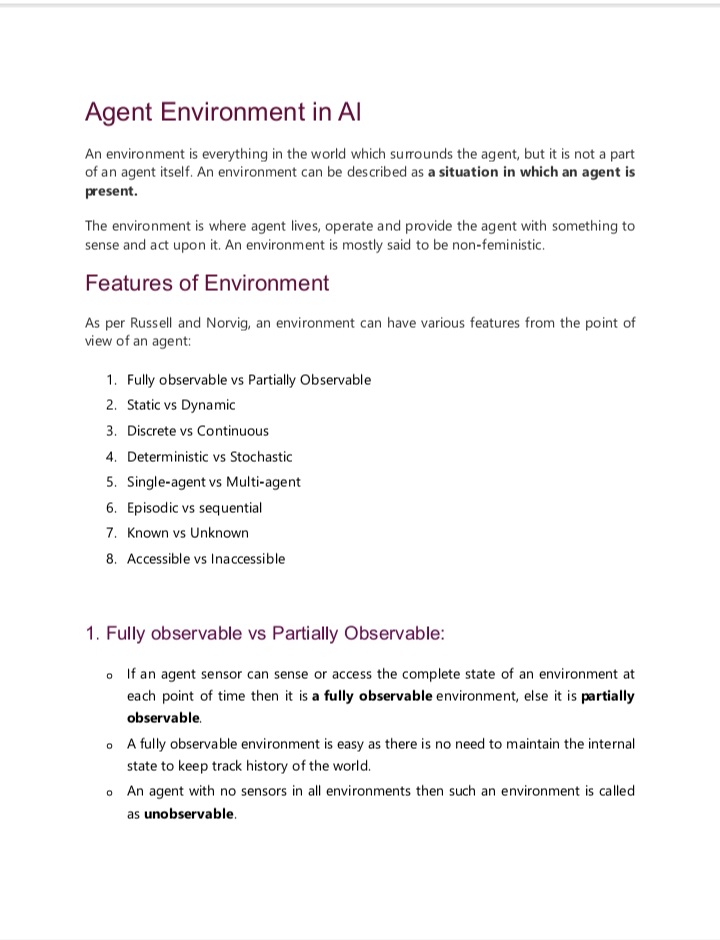
In AI, the agent environment refers to the external context or surroundings in which an AI agent operates. It includes everything that the agent can perceive and interact with, influencing its actions and decisions. The environment provides feedback to the agent’s actions, which is typically used to adjust behavior or strategy. The environment can be physical, such as a robot navigating a room, or abstract, like a game environment. It is characterized by its dynamics, including whether it is static or dynamic, fully observable or partially observable, deterministic or stochastic, and discrete or continuous. The interaction between the agent and the environment is fundamental to AI decision-making and learning processes.
Below is the document preview.

SMA 2371: Partial Differential Equations (Complete Notes, Examples & Solutions) – JKUAT Biostatistics Year 2 Semester 2
These are comprehensive and well-organized lecture notes for SMA 2371: Partial Differential Equations (PDE) offered to BSc. Biostatistics Year 2 Semester 2 students at JKUAT. The notes are neatly arranged from lecture one to the final topics, making them ideal for class learning, revision, CAT preparation, and final examinations.
The notes include detailed explanations, worked examples, step-by-step mathematical derivations, solved exercises, and applications of Partial Differential Equations. Topics covered include:
• Review of basic concepts and partial derivatives
• Jacobians, surfaces and curves in three dimensions
• Simultaneous first-order differential equations
• Methods of solving symmetric differential equations
• Orthogonal trajectories
• Pfaffian differential equations
• Linear first-order partial differential equations
• Formation of PDEs
• Elimination of arbitrary constants and arbitrary functions
• Heat, Wave, Laplace and Poisson equations
• Separation of variables
• Fourier and Laplace Transform methods
• Numerous worked examples, tutorial questions and examination-style problems with solutions.
These notes are suitable for JKUAT students and other university students studying Mathematics, Statistics, Biostatistics, Engineering, Applied Mathematics or related courses. They are an excellent revision resource for CATs and final examinations.
57 Pages
1359 Views
0 Downloads
1.77 MB