 Join Our WhatsApp Channel for Updates!
HRD 2101: LESSON 9 Ethical, Legal and Social Issues for Use of Information
| Institution | JKUAT |
| Course | Common Units |
| Year | 1st Year |
| Semester | Unknown |
| Posted By | Jeff Odhiambo |
| File Type | |
| Pages | 44 Pages |
| File Size | 369.34 KB |
| Views | 2457 |
| Downloads | 0 |
| Price: |
Buy Now
 Buy via
whatsapp Buy via
whatsapp
|


Description
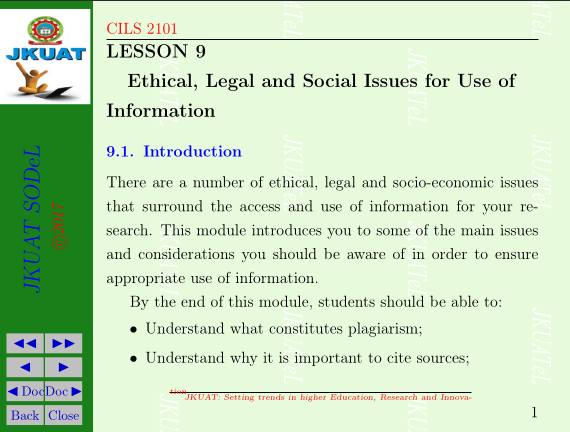
There are a number of ethical, legal and socioeconomic issues that surround the access and use of information for your research. This module introduces you to some of the main issues and considerations you should be aware of in order to ensure appropriate use of information
Below is the document preview.

SZL 2111: HIV/AIDs - Lesson 1
General introduction: Public health and hygiene, human reproductive system, sex and sexuality. History of sexually transmitted diseases (STDs); History of Human Immunodeficiency virus/Acquired Immune deficiency Syndrome (HIV/AIDS), Comparative information on trends, global and local distribution, Justification of importance of course. Biology of HIV/AIDS; Overview of immune system, natural immunity to HIV/AIDS. The AIDS virus and its life cycle, disease progression, transmission and diagnosis. Discordant couples. Treatment and Management; nutrition, prevention and control; Abstain, Be faithful, Condom use, Destigmatize HIV/AIDS (ABCD) methods
56 Pages
350 Views
0 Downloads
477.39 KB
SZL2111: HIV/AIDs - Sex education and Human sexuality
Trending!
Sex education, also called sexuality education or sex and relationships education.
It's the process of acquiring information and forming attitudes and beliefs about sex, sexual identity, relationships and intimacy. It is also about developing young people's skills so that they make informed choices about their behavior, and feel confident and competent about acting on these choices. It is widely accepted that young people have a right to sex education, partly because it is a means by which they are helped to protect themselves against abuse, exploitation, unintended pregnancies, sexually transmitted diseases and HIV/AIDS.
68 Pages
2412 Views
0 Downloads
1.5 MB
SZL2111: HIV/AIDs - The Immune system
Immune system is a system of biological structures and processes within an organism that protects against diseases by identifying and killing pathogens and tumor cells. The immune system is made up of organs that are involved in fighting invasion by foreign bodies.
24 Pages
1847 Views
0 Downloads
289.22 KB
SZL 2111: HIV/AIDs - Biology of HIV
Trending!
HIV can’t grow or reproduce on its own. It requires cell of living organisms to infect & reproduce. HIV is specific to CD4+ cells in the human body i.e. cells with surface molecule called Cluster of Differentiation 4. Cells carrying this molecule are called CD4+ cells. Therefore HIV cant survive in the animal blood, because its only human blood that contains CD4+cells. HIV is a lentivirus. Like all viruses in this group it attacks the immune system. Lentiviruses are in turn part of a larger group of viruses called retroviruses. The term ”retrovirus” stems from the fact that these kinds of viruses are capable of copying RNA into DNA. The name lentivirus means slow virus. This is because they take such a longtime to produce any adverse effects in the body.
24 Pages
2022 Views
0 Downloads
293.16 KB
SZL 2111: HIV/AIDs - Disease progression and symptoms
HIV infects cells of the immune system and the central nervous system. The main cell HIV infects is T helper cell which is a crucial part of the immune system, because it co-ordinates the actions of other cells of the immune system. A large reduction in the number of T helper cells seriously weakens the immune system.
37 Pages
1543 Views
0 Downloads
327.7 KB
SZL 2111: HIV/AIDs - Lesson 6
Trending!
General introduction: Public health and hygiene, human reproductive system, sex and sexuality. History of sexually transmitted diseases (STDs); History of Human Immunodeficiency virus/Acquired Immune de
ciency Syndrome (HIV/AIDS), Compara-
tive information on trends, global and local distribution, Justification of importance of course. Biology of HIV/AIDS; Overview of immune system, natural immunity to HIV/AIDS. The AIDS virus and its life cycle, disease progression, transmission and
diagnosis.
48 Pages
2400 Views
0 Downloads
401.01 KB
SZL 2111: HIV/AIDs - Lesson 7
Trending!
General introduction: Public health and hygiene, human reproductive system, sex and sexuality. History of sexually transmitted diseases (STDs); History of Human Immunodeficiency virus/Acquired Immune deficiency Syndrome (HIV/AIDS), Comparative information on trends, global and local distribution, Justification of importance of course. Biology of HIV/AIDS; Overview of immune system, natural immunity to HIV/AIDS. The AIDS virus and its life cycle, disease progression, transmission and diagnosis.
42 Pages
2235 Views
0 Downloads
2.19 MB
SZL 2111: HIV/AIDs - Lesson 8
General introduction: Public health and hygiene, human reproductive system, sex and sexuality. History of sexually transmitted diseases (STDs); History of Human Immunodeficiency virus/Acquired Immune deficiency Syndrome (HIV/AIDS), Comparative information on trends, global and local distribution, Justification of importance of course. Biology of HIV/AIDS; Overview of immune system, natural immunity to HIV/AIDS. The AIDS virus and its life cycle, disease progression, transmission and diagnosis. Discordant couples.
20 Pages
1988 Views
0 Downloads
286.61 KB
SZL 2111: HIV/AIDs -Lesson 9
General introduction: Public health and hygiene, human reproductive system, sex and sexuality. History of sexually transmitted diseases (STDs); History of Human Immunodeficiency virus/Acquired Immune deficiency Syndrome (HIV/AIDS), Comparative information on trends, global and local distribution, Justification of importance of course. Biology of HIV/AIDS; Overview
of immune system, natural immunity to HIV/AIDS. The AIDS
virus and its life cycle, disease progression, transmission and
diagnosis.
44 Pages
1780 Views
0 Downloads
369.34 KB
SZL 2111: HIV/AIDs - Lesson 10
General introduction: Public health and hygiene, human reproductive system, sex and sexuality. History of sexually transmitted diseases (STDs); History of Human Immunodeficiency virus/Acquired Immune deficiency Syndrome (HIV/AIDS), Compara-
tive information on trends, global and local distribution, Justification of importance of course.
38 Pages
1694 Views
0 Downloads
339.57 KB