Nanoparticles: synthesis and applications
| Institution | UNIVERSITY |
| Course | BACHELOR OF SCIENCE... |
| Year | 4th Year |
| Semester | Unknown |
| Posted By | stephen oyake rabilo |
| File Type | |
| Pages | 30 Pages |
| File Size | 1.73 MB |
| Views | 6372 |
| Downloads | 0 |
| Price: |
Buy Now
 Buy via
whatsapp Buy via
whatsapp
|


Description
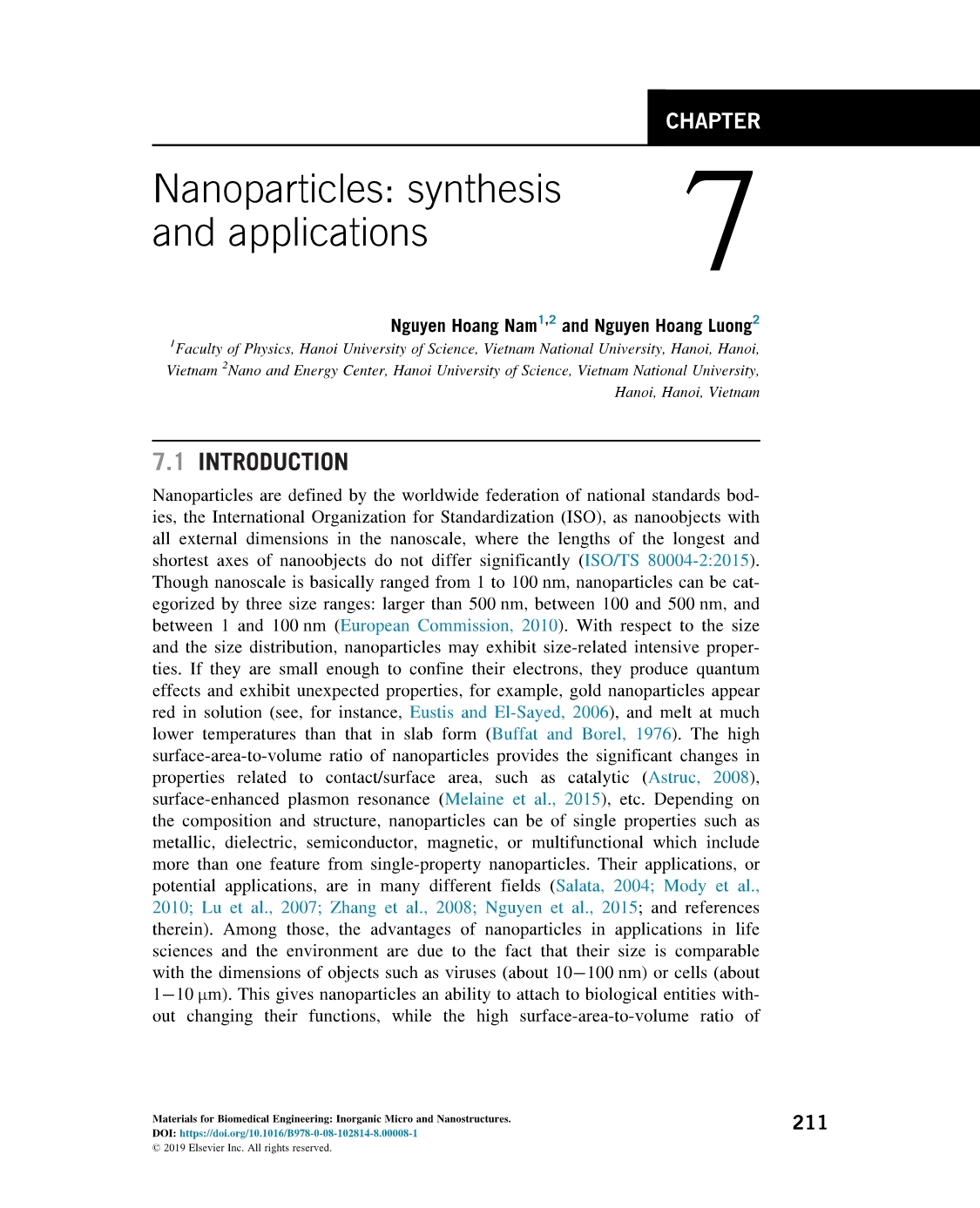
Nanoparticles are defined by the worldwide federation of national standards bodies, the International Organization for Standardization (ISO), as nanoobjects with
all external dimensions in the nanoscale, where the lengths of the longest andshortest axes of nanoobjects do not differ significantly . Though nanoscale is basically ranged from 1 to 100 nm, nanoparticles can be categorized by three size ranges: larger than 500 nm, between 100 and 500 nm, and
between 1 and 100 nm (European Commission, 2010). With respect to the size and the size distribution, nanoparticles may exhibit size-related intensive properties. If they are small enough to confine their electrons, they produce quantum effects and exhibit unexpected properties, for example, gold nanoparticles appear red in solution (see, for instance, Eustis and El-Sayed, 2006), and melt at much lower temperatures than that in slab form (Buffat and Borel, 1976). The high surface-area-to-volume ratio of nanoparticles provides the significant changes in properties related to contact/surface area, such as catalytic (Astruc, 2008),surface-enhanced plasmon resonance (Melaine et al., 2015), etc.
Below is the document preview.

ANSC332: ANIMAL DISEASES NOTES
Trending!
Definition of terminologies:
Disease: Is deviation from normal status. A state or condition brought about in living organism
by some micro-organisms or parasites or unknown cause which is detrimental to health or
wellbeing of that living organism. This includes mechanical or thermal injuries and nutritional deficiencies, poisons, hereditary and congenital diseases. It may also be defined as abnormal breakdown, destruction or malfunction of cells in animal
body.
43 Pages
8761 Views
0 Downloads
1.22 MB
ANSC 427 :PIG AND RABBIT PRODUCTION
Trending!
Barrow- male pig castrated before reaching sexual maturity. Barrows are commonly raised as market hogs and show good weight gain. Boar- male hog or pig with intact testicles. Boars are primarily used for breeding purposes only, since it is said that testosterone in the system gives the meat a foul taste. Boars should be castrated prior to butchering and given at least 30 days on feed to cleanse the system prior to butchering. It should be said that some people do not notice a difference in the flavor of the
meat and castrating a boar over 110kg is quite a challenge without the proper confinement
tools.
35 Pages
8807 Views
0 Downloads
914.3 KB
AGRO 433: CONSERVATION AGRICULTURE
Trending!
What is Conservation Agriculture? It is a way of farming that conserves, improves, and ensures efficient use of natural resources.
• It aims to help farmers achieve profits with sustained production levels while conserving the environment.
90 Pages
8809 Views
0 Downloads
3.41 MB
AGRO 241 : Crop Protection
Trending!
Types and importance of crop pests and diseases, principles and practices of crop pest and disease management: non-chemical: and chemical approaches to protection; integrated management of pests and diseases.
114 Pages
8234 Views
0 Downloads
2.9 MB
HOEC414: FOODPRESERVATIONANDPROCESSING
Trending!
Food preservation
The science which deals with the process of prevention of delay or spoil age of food thus allowing it to be stored in good condition for future use. It is the state in which any food may be retained over a period of time without; being contaminated by pathogenic organisms; loosing optimum qualities of color, texture flavor but rive value
23 Pages
8512 Views
0 Downloads
601.69 KB
AGEN 418-Soil & Water Management
Trending!
Soil and water management can be defined as active involvement in controlling soil water content at an optimal state (most desirable or best level) for all given purposes including environmental needs. Soil water is the medium from which all plant nutrients are assimilated by plants.
67 Pages
8361 Views
1 Downloads
1.69 MB
AGEN 0111: LAND SURVEY, SOIL AND WATER CONSERVATION, IRRIGATION AND DRAINAGE
Trending!
Land degradation is a process that lowers the current potential capability of land to produce goods such as crops, livestock, timber etc or provide services such as unpolluted water.
Causes of land degradation;
Soil erosion (by water and wind)
Fertility degradation (loss of plant nutrients, chemicals, physical and biological degradation)
Degradation of vegetative cover.
Degradation of water resources.
38 Pages
8466 Views
0 Downloads
2.29 MB
KCSE 2024 BUSINESS STUDIES REVISION BOOKLET ANSWERS AND QUESTIONS
Trending!
Get a copy of the KCSE 2024 BUSINESS STUDIES REVISION BOOKLET ANSWERS AND QUESTIONS. This booklet consist of up to 20 consolidated Business Studies 2024 Mock papers from Top National Schools and Joint Exams. They come with a comprehensive and well coordinated Marking scheme making it a great and valuable resource for your revision!
721 Pages
11706 Views
4 Downloads
14.19 MB
KCSE 2022 C.R.E PP1 & PP2 QUESTIONS & ANSWERS
Trending!
Download a copy of KCSE 2022 C.R.E PP1 & PP2 QUESTIONS with comprehensive KNEC Marking Schemes, This is instrumental in aiding your revision for your fourth coming examinations.
17 Pages
11360 Views
1 Downloads
7.14 MB
The Samaritan excerpts and answers
Recommended!
Trending!
Get The Samaritan excerpts questions and answers.
43 Pages
25638 Views
93 Downloads
8.68 MB