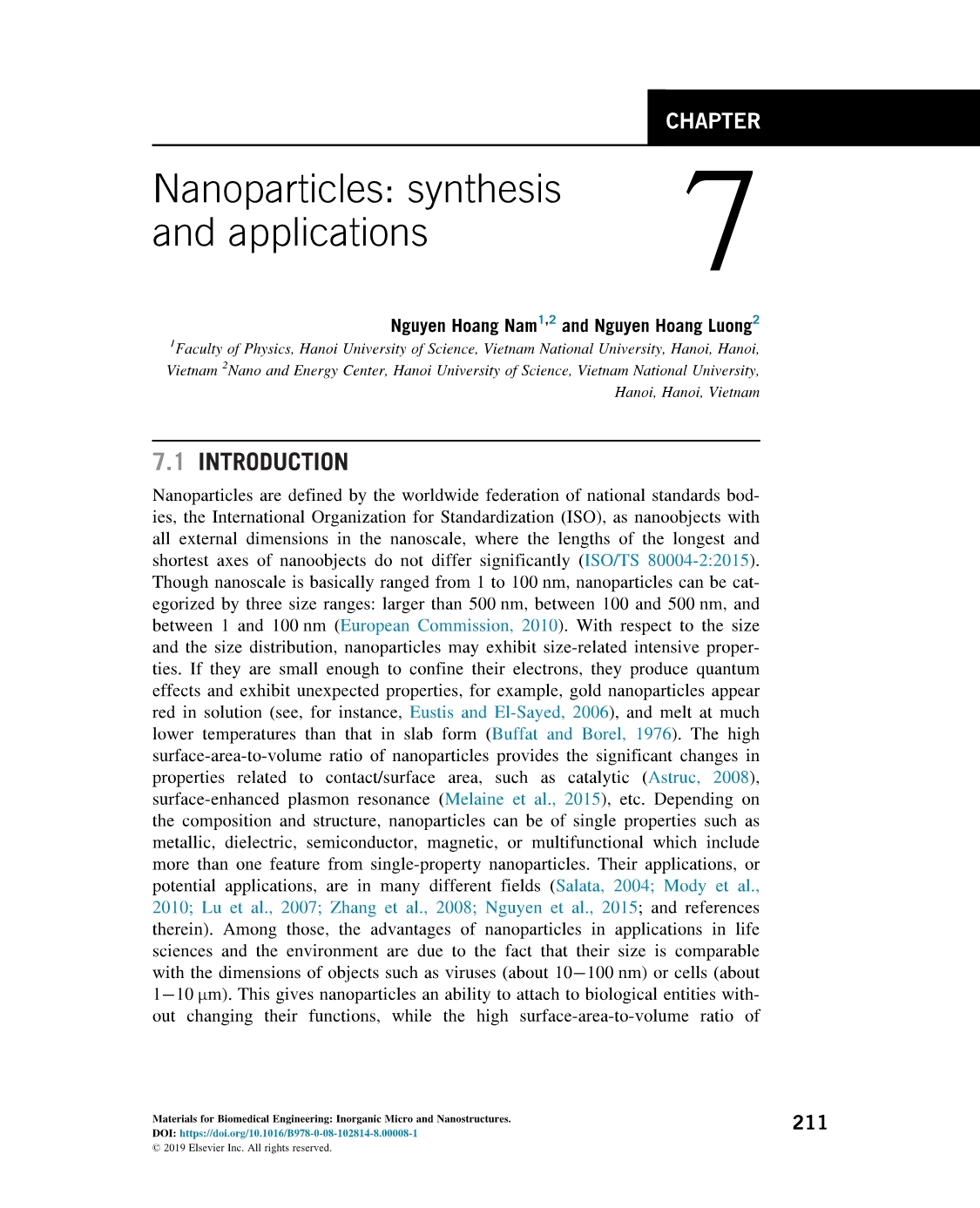
Nanoparticles: synthesis and applications
| Institution | UNIVERSITY |
| Course | BACHELOR OF SCIENCE... |
| Year | 4th Year |
| Semester | Unknown |
| Posted By | stephen oyake rabilo |
| File Type | |
| Pages | 30 Pages |
| File Size | 1.73 MB |
| Views | 6388 |
| Downloads | 0 |
| Price: |
Buy Now
 Buy via
whatsapp Buy via
whatsapp
|


Description
Nanoparticles are defined by the worldwide federation of national standards bodies, the International Organization for Standardization (ISO), as nanoobjects with
all external dimensions in the nanoscale, where the lengths of the longest andshortest axes of nanoobjects do not differ significantly . Though nanoscale is basically ranged from 1 to 100 nm, nanoparticles can be categorized by three size ranges: larger than 500 nm, between 100 and 500 nm, and
between 1 and 100 nm (European Commission, 2010). With respect to the size and the size distribution, nanoparticles may exhibit size-related intensive properties. If they are small enough to confine their electrons, they produce quantum effects and exhibit unexpected properties, for example, gold nanoparticles appear red in solution (see, for instance, Eustis and El-Sayed, 2006), and melt at much lower temperatures than that in slab form (Buffat and Borel, 1976). The high surface-area-to-volume ratio of nanoparticles provides the significant changes in properties related to contact/surface area, such as catalytic (Astruc, 2008),surface-enhanced plasmon resonance (Melaine et al., 2015), etc.
Below is the document preview.

COMP 224: OPERATING SYSTEMS
Trending!
Operating System Introduction: Operating Systems Objectives and functions, Computer System Architecture,
OS Structure, OS Operations, Evolution of Operating Systems - Simple Batch, Multi programmed, time
shared, Personal Computer, Parallel, Distributed Systems, Real-Time Systems, Special - Purpose Systems,
Operating System services, user OS Interface, System Calls, Types of System Calls, System Programs,
Operating System Design and Implementation, OS Structure, Virtual machines
28 Pages
6589 Views
0 Downloads
1.82 MB
DEM100:HIVANDAIDSPREVENTIONANDMANAGEMENT
Trending!
HIV-Human Immune Virus
This is a virus that causes AIDS and is passed from person to person through body fluids, particularly blood, semen and breast milk .After a person has been infected, the virus starts breaking down their immune system .After sometime the immune system is so weak that they become susceptive to a variety of illness
100 Pages
7496 Views
0 Downloads
2.71 MB
INTER-PROCESS COMMUNICATION OR PROCESS SYNCHRONIZATION
Trending!
Concurrent access to shared data may result in data
inconsistency. Maintaining data consistency requires mechanisms to ensure the orderly execution of cooperating processes. Suppose that we wanted to provide a solution to the consumer-producer problem that fills all the buffers.
8 Pages
7119 Views
0 Downloads
557.98 KB
PROCESS SCHEDULING:
Trending!
CPU is always busy in Multiprogramming. Because CPU switches from one job to another job. But in simple computers CPU sit idle until the I/O request granted. Scheduling is an important OS function. All resources are scheduled before use.(cpu, memory, devices…..) Process scheduling is an essential part of a Multiprogramming operating systems. Such operating systems allow more than one process to be loaded into the executable memory at a time and the loaded process shares the CPU using time multiplexing
15 Pages
7167 Views
0 Downloads
349.86 KB
COUNSELLING IN HIV AND AIDS
Trending!
Counseling is a professional relationship between two or more people, one of whom is a trained counselor, and the other(s), a person or persons undergoing therapy. The relationship is aimed at helping the counselee identify his/her own strength and use it to solve their problems. Counselling refers to the skilled and principled use of relationships (rapport) to facilitate self–knowledge, emotional acceptance, growth and the optimal (maximum) development of personal resource.
21 Pages
5652 Views
0 Downloads
872.88 KB
Common Diode Applications
Trending!
State the purposes served by clippers,
clampers, and voltage multipliers.
Describe the operation of series and shunt
clippers.
Describe the effects of negative and
positive clampers on an input waveform.
Describe the use of the LED in
multisegment displays.
Study simple diode logic circuits.
24 Pages
6407 Views
0 Downloads
414.35 KB
Digital Fundamentals
Trending!
Digital technology pervades almost everything in our daily lives. For example, cell phones and other types of wireless communications, television, radio, process controls, automotive
electronics, consumer electronics, aircraft navigation— to name only a few applications— depend heavily on digital electronics.
953 Pages
7422 Views
0 Downloads
45.05 MB
Microbiology and Parasitology
Trending!
Microbiology is the study of small living organisms (things) that cannot be seen with our naked eyes but with a help of a
Microscope e.g.: Viruses, Bacteria Fungi, Algae, Protozoans etc.
Microorganisms are those living things that are too small to be seen with the naked eye
88 Pages
8406 Views
0 Downloads
2.24 MB
PARASITOLOGY INTRODUCTION
Trending!
Parasitology is the science that deals with organisms living in the human body (the host) and the medical significance of
this host-parasite relationship. A Parasite is a living organism,
which takes its nourishment and other needs from a host; the
host is an organism which supports the parasite.
27 Pages
7156 Views
1 Downloads
833.6 KB
PORT HEALTH
Trending!
Port sanitation is the work carried out by all designated port health authorities in the world towards the control of spread of quarantinable diseases. The essential aim is to ensure the
maximum security against the international spread of the disease with the minimal interference with
world traffic
60 Pages
6499 Views
0 Downloads
616.79 KB