Nanoparticles: synthesis and applications
| Institution | UNIVERSITY |
| Course | BACHELOR OF SCIENCE... |
| Year | 4th Year |
| Semester | Unknown |
| Posted By | stephen oyake rabilo |
| File Type | |
| Pages | 30 Pages |
| File Size | 1.73 MB |
| Views | 6614 |
| Downloads | 0 |
| Price: |
Buy Now
 Buy via
whatsapp Buy via
whatsapp
|


Description
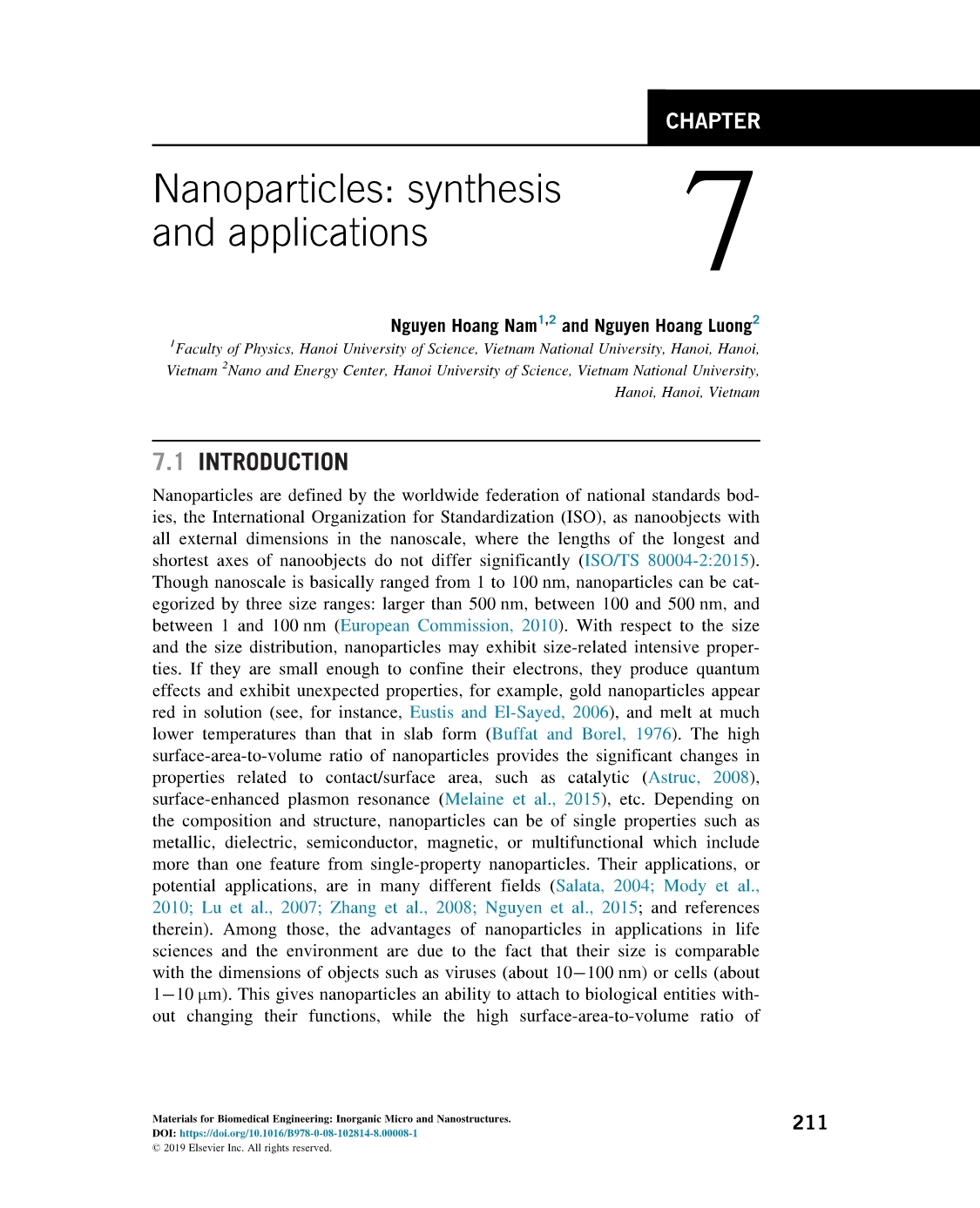
Nanoparticles are defined by the worldwide federation of national standards bodies, the International Organization for Standardization (ISO), as nanoobjects with
all external dimensions in the nanoscale, where the lengths of the longest andshortest axes of nanoobjects do not differ significantly . Though nanoscale is basically ranged from 1 to 100 nm, nanoparticles can be categorized by three size ranges: larger than 500 nm, between 100 and 500 nm, and
between 1 and 100 nm (European Commission, 2010). With respect to the size and the size distribution, nanoparticles may exhibit size-related intensive properties. If they are small enough to confine their electrons, they produce quantum effects and exhibit unexpected properties, for example, gold nanoparticles appear red in solution (see, for instance, Eustis and El-Sayed, 2006), and melt at much lower temperatures than that in slab form (Buffat and Borel, 1976). The high surface-area-to-volume ratio of nanoparticles provides the significant changes in properties related to contact/surface area, such as catalytic (Astruc, 2008),surface-enhanced plasmon resonance (Melaine et al., 2015), etc.
Below is the document preview.

FINANCIAL MATHEMATICS STUDY NOTES
Introduction to financial mathematics
- Nature and scope of finance; financing, investment, management of working capital and
profit sharing (dividend policy) decisions
- Relationship between finance and other disciplines; finance and economics, finance and
accounting, finance and mathematics
- Purpose of financial modeling
175 Pages
593 Views
0 Downloads
2.85 MB
Financial Accounting Revision Kit NOTES
Trending!
Partnership Accounts
Basic contents for a partnership agreement; provisions of the Kenya Partnership Act; formation
of a partnership
Accounting for initial investment of
partners Current and capital accounts
Division of profits and losses, preparation of trading and profit and loss accounts, appropriation
accounts and balance sheets
Admission of partner(s)
Retirement of partner(s)
1026 Pages
9098 Views
0 Downloads
5.51 MB
FINANCIAL ACCOUNTING - BLOCK REVISION MOCK 1
Trending!
FINANCIAL ACCOUNTING - BLOCK REVISION MOCK 1
166 Pages
9707 Views
1 Downloads
4.95 MB
Frank Woods Business Accounting 1 - Recommended
Trending!
This part is concerned with the basic principles underlying the
double entry system of bookkeeping.
1 The accounting equation and the balance sheet 3
2 The double entry system for assets, liabilities and capital 18
3 The asset of stock 28
4 The effect of profit or loss on capital and the double entry
system for expenses and revenues 38
5 Balancing off accounts 49
6 The trial balance 57
793 Pages
4769 Views
0 Downloads
6.81 MB
Frank Wood_s Business Accounting 2 NOTES
Trending!
Introduction
This part is concerned with two items that are treated in a similar
way, irrespective of the form of business involved.
1 Accounting for branches 3
2 Hire purchase accounts 29
844 Pages
5888 Views
0 Downloads
11.4 MB
TAXATION – BLOCK REVISION MOCK 1
Trending!
TAXATION – BLOCK REVISION MOCK 1
301 Pages
8039 Views
0 Downloads
12.7 MB
TAXATION REVISION PARTNER
Trending!
TAXATION REVISION PARTNER
177 Pages
7937 Views
0 Downloads
2.7 MB
ESSENTIALS OF macroeconimics
Trending!
In Macroeconomics the object is to study the performance, structure and behavior of a national or regional economy as a whole. In Macroeconomics the object is to study the performance, structure and behavior of a national or regional economy as a whole.
160 Pages
5644 Views
0 Downloads
3.68 MB
SMA 432: TRIGONOMENTRY
Trending!
Linear correlation refers to a directly proportional relationship between two variables, while nonlinear correlation refers to a relationship that is not directly proportional.
34 Pages
5985 Views
0 Downloads
11.63 MB
B.TECH III YEAR – I SEM (R17)
Trending!
Object Oriented Programming is a paradigm that provides many concepts such as
inheritance, data binding, polymorphism etc.
Simula is considered as the first object-oriented programming language. The programming
paradigm where everything is represented as an object is known as truly object-oriented
programming language.
Smalltalk is considered as the first truly object-oriented programming language.
OOPs (Object Oriented Programming System)
Object means a real word entity such as pen, chair, table etc. Object-Oriented Programming is
a methodology or paradigm to design a program using classes and objects. It simplifies the
software development and maintenance by providing someconcepts:
o Object
o Class
o Inheritance
o Polymorphism
o Abstraction
o Encapsulation
Object
Any entity that has state and behavior is known as an object. For example: chair, pen, table,
keyboard, bike etc. It can be physical and log
60 Pages
8921 Views
0 Downloads
2.43 MB