Nanoparticles: synthesis and applications
| Institution | UNIVERSITY |
| Course | BACHELOR OF SCIENCE... |
| Year | 4th Year |
| Semester | Unknown |
| Posted By | stephen oyake rabilo |
| File Type | |
| Pages | 30 Pages |
| File Size | 1.73 MB |
| Views | 6311 |
| Downloads | 0 |
| Price: |
Buy Now
 Buy via
whatsapp Buy via
whatsapp
|


Description
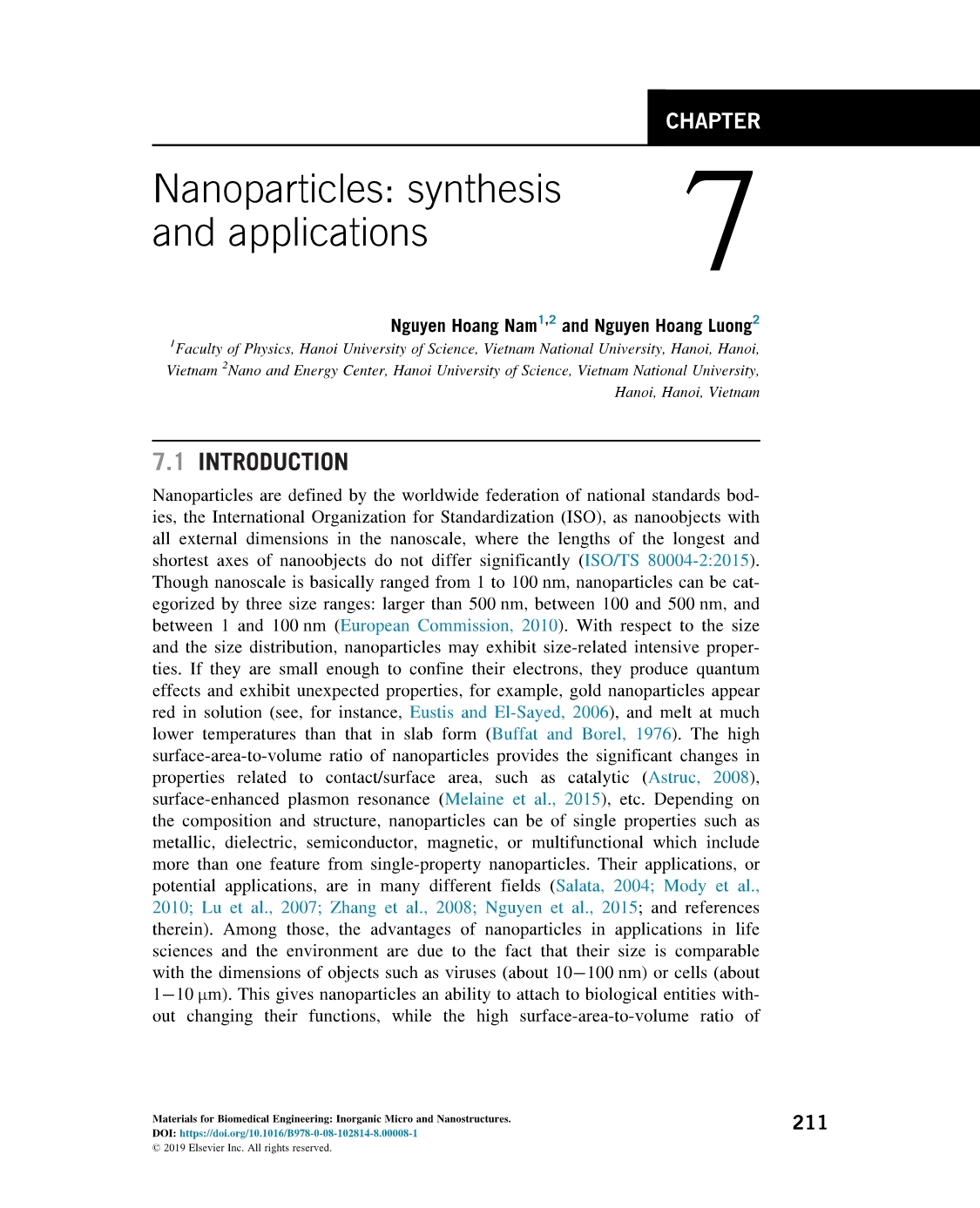
Nanoparticles are defined by the worldwide federation of national standards bodies, the International Organization for Standardization (ISO), as nanoobjects with
all external dimensions in the nanoscale, where the lengths of the longest andshortest axes of nanoobjects do not differ significantly . Though nanoscale is basically ranged from 1 to 100 nm, nanoparticles can be categorized by three size ranges: larger than 500 nm, between 100 and 500 nm, and
between 1 and 100 nm (European Commission, 2010). With respect to the size and the size distribution, nanoparticles may exhibit size-related intensive properties. If they are small enough to confine their electrons, they produce quantum effects and exhibit unexpected properties, for example, gold nanoparticles appear red in solution (see, for instance, Eustis and El-Sayed, 2006), and melt at much lower temperatures than that in slab form (Buffat and Borel, 1976). The high surface-area-to-volume ratio of nanoparticles provides the significant changes in properties related to contact/surface area, such as catalytic (Astruc, 2008),surface-enhanced plasmon resonance (Melaine et al., 2015), etc.
Below is the document preview.

AGRICULTURE SYLLABUS
Trending!
UPDATED KNEC AGRICULTURE SYLLABUS
23 Pages
11473 Views
2 Downloads
2.21 MB
HOMESCIENCE FORM 1 NOTES
Trending!
UPDATED HOMESCIENCE FORM 1 NOTES
147 Pages
11123 Views
4 Downloads
1.32 MB
K.C.S.E HRE SYLLABUS
Trending!
This is the comprehensive KNEC HRE SYLLABUS
10 Pages
9794 Views
0 Downloads
515.1 KB
K.C.S.E GERMAN SYLLABUS
Trending!
This is the comprehensive KNEC GERMAN SYLLABUS
No pages found
11555 Views
5 Downloads
60.04 KB
Isimu Jamii
Trending!
Isimujamii - Ni taaluma inayochunguza uhusianouliopo baina ya lugha na jamii.
Hasa hushughulikia jinsi watu wanavyotumia lugha katika jamii.
Isimu- ni uchunguzi wa lugha kisayansi.
Jamii – ni kundi filani la watu wenye uhusiano fulani.
24 Pages
6421 Views
3 Downloads
851.47 KB
FASIHI SIMULIZI NOTES
Trending!
Fasihi ni sanaa inayotumia lugha kuwasilisha ujumbe unaomhusu binadamu. Sanaa ni ufundi wa kuwasilisha fikra na hisia za binadamu kama vile maneno, maandishi,uchoraji, uchongaji, ufinyanzi n.k.
43 Pages
17737 Views
13 Downloads
752.59 KB