BEC 122;FOOD AND NUTRITION NOTES
| Institution | Mt Kenya university |
| Course | Bachelor in Educaton... |
| Year | 1st Year |
| Semester | Unknown |
| Posted By | Michael Paul |
| File Type | |
| Pages | 74 Pages |
| File Size | 279.91 KB |
| Views | 6940 |
| Downloads | 2 |
| Price: |
Buy Now
 Buy via
whatsapp Buy via
whatsapp
|


Description
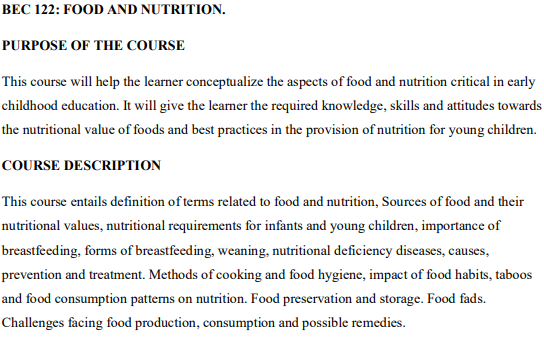
This course entails definition of terms related to food and nutrition, Sources of food and their
nutritional values, nutritional requirements for infants and young children, importance of
breastfeeding, forms of breastfeeding, weaning, nutritional deficiency diseases, causes,
prevention and treatment. Methods of cooking and food hygiene, impact of food habits, taboos
and food consumption patterns on nutrition. Food preservation and storage. Food fads.
Below is the document preview.

SOCIOLOGY
Sociology is the study of groups and group interactions, societies and social interactions, from small and personal groups to very large groups. A group of people who live in a defined
geographic area, who interact with one another and who share a common culture is what sociologists call a society. Sociologists study all aspects and levels of society. Sociologists
working from the micro-level study small groups and individual interactions, while those using macro-level analysis look at trends among and between large groups and societies. For
example, a micro-level study might look at the accepted rules of conversation in various groups such as among teenagers or business professionals. In contrast, a macro-level analysis
might research the ways that language use has changed over time or in social media outlets.
85 Pages
1297 Views
0 Downloads
1.02 MB
SCH 403: PHASE EQUILIBRIA
Trending!
At equilibrium a system composed of several phases is governed by the phase rule:
F = C – P + 2
F is the number of degrees of freedom, it is the least number of intensive variables that must
be fixed/known to describe the system completely. C is the number of components and P is the
number of phases present. The number of components is the smallest number of constituents by which the composition of each phase in the system at equilibrium can be expressed in the form of a chemical formula or equation.
44 Pages
10696 Views
0 Downloads
754.88 KB
SPH400: GENERAL MOTION OF RIGID BODIES
Trending!
At the end of the lectures on this topic you will be able to solve problems related to principal moment of inertia of rigid bodies. We are going to consider the general motion of a rigid body in space. This motion will consist of a translation of a fixed point of the body plus rotation about an axis through the fixed point which is not necessarily restricted in direction.
Angular Momentum and Kinetic Energy
First, we consider the angular momentum.
9 Pages
6401 Views
0 Downloads
151.04 KB
SPH400:MECHANICS OF A SYSTEM OF PARTICLES
Trending!
At the end of the lectures on this topic you will be able to understand the principles of conservation of linear momentum, angular momentum and energy of a system of particles. When we are considering the dynamics of a system of particles, we have to consider both the external forces acting on the particles due to sources outside the system and internal forces
on the particles due to the sources within the system.
7 Pages
8283 Views
0 Downloads
151.07 KB
SPH400:VIRTUAL WORK AND D’ALEMBERT’S PRINCIPLE
Trending!
While solving the problems in dynamics, one must take account of the constraints that limit the motion of the system.
Examples
(i) In rigid bodies, constraints keep distance between the particles unchanged.
(ii) The beads of an abacus are constrained to one dimensional motion by the supporting wires.
(iii) Gas molecules in a container are constrained by the walls of the vessel to move only inside the container.
(iv) A particle placed on the surface of a solid body is subject to the constraint that it can move only on the surface or in the region exterior to the body.
6 Pages
7268 Views
0 Downloads
210.58 KB
EMERGING ISSUES AND TRENDS IN HUMAN GROWTH AND DEVELOPMENT
Trending!
Emerging issues and trends in human growth and development encompass a wide array of
topics that are continually evolving as our understanding of human development deepens and
societal factors shift. Some notable emerging issues and trends include:
1. Technology and Development: The pervasive influence of technology on human
development is a significant trend. This includes concerns about screen time, social media
use, and the impact of digital devices on cognitive, social, and emotional development,
particularly in children and adolescents.
2. Changing Family Structures: Shifts in family structures, such as increasing rates of singleparent households, cohabitation, and same-sex parenting, have implications for child
development, family dynamics, and support systems.
3. Mental Health Awareness and Support: There is growing recognition of the importance of
mental health in overall development. Efforts to reduce stigma, increase access to mental
health services, and promote emotional well-being are gaining momentum.
5 Pages
9494 Views
1 Downloads
372.95 KB
LEGAL ASPECT IN SOCIAL DEVLOPMENT WORK-1 (1)
Trending!
Meaning of law
It’s a set rules or principles imposed against the citizens of the country by the state.
It’s also a set of rules that govern the conduct of affairs in a given community at a given time.
It’s also a body of principles required and applied by the state in the administration of justice.
The purposes of laws
1. To promote social cohesion among the society;- each society or community has its laws which regulate the mutual relations and contacts of its members. The laws are enforced to ensure that
members of the society may live or work together in an orderly and peaceful manner.
1. To regulate the behaviour/contact of persons.
2. To provide justice to the members of the society.
3. To maintain political and economical stability.
4. To protect fundamental rights and freedoms of the individuals.
5. To establish the procedures and regulations regarding the dealings among the individuals.
6. To maintain peace and the security in the country.
79 Pages
8360 Views
0 Downloads
833.77 KB
PERSONALITY DEVELOPMENT
Trending!
Personality refers to the unique combination of characteristics, qualities, and behaviors that make each person distinct from others. It's like the way a person thinks, feels, and acts, which sets them apart from everyone else. Personality refers to the unique set of psychological traits, characteristics, patterns of thinking, feeling, and behaving that distinguishes one individual from another. It encompasses a person's distinctive way of interacting with the world, including their attitudes, beliefs, values, emotions, motivations, and behaviors. Personality is often thought of as relatively stable over time, although it can also be influenced by various factors such as experiences, culture, environment, and development. Psychologists have developed various theories and models to understand and explain personality, including trait theories, psychodynamic theories, humanistic theories, and social-cognitive theories.
25 Pages
8916 Views
1 Downloads
774.14 KB
STAGES OF PRENATAL DEVELOPMENT
Trending!
The human life cycle may be said to begin with fertilization and then proceed through prenatal growth and development, birth, postnatal growth and development, maturity, senescence,
and death. While you might think of child development as something that begins during infancy, the prenatal period is also considered an important part of the developmental process. Prenatal development is a time of remarkable change that helps set the stage for future psychological development. The brain develops over the course of the prenatal period, but it will continue to go through more changes during the early years of childhood. The process of prenatal development occurs in three main stages. The first two weeks after conception are known as the germinal stage, the third through the eighth week is known as the
embryonic period, and the time from the ninth week until birth is known as the fetal period.
7 Pages
9098 Views
0 Downloads
404.95 KB
SCH 405 :ADVANCED ELECTROCHEMISTRY
Trending!
When at least two electrodes are dipped into an electrolyte and connected by an external electrical conductor, an electric current flows and chemical reactions occur in the half cells
111 Pages
8520 Views
0 Downloads
14.67 MB