Expanding Social Horizons: Socioemotional Development in Middle Childhood
| Institution | Keiser University |
| Course | Pschology |
| Year | 4th Year |
| Semester | Unknown |
| Posted By | Faith Kagwi |
| File Type | |
| Pages | 34 Pages |
| File Size | 174.87 KB |
| Views | 6685 |
| Downloads | 0 |
| Price: |
Buy Now
 Buy via
whatsapp Buy via
whatsapp
|


Description
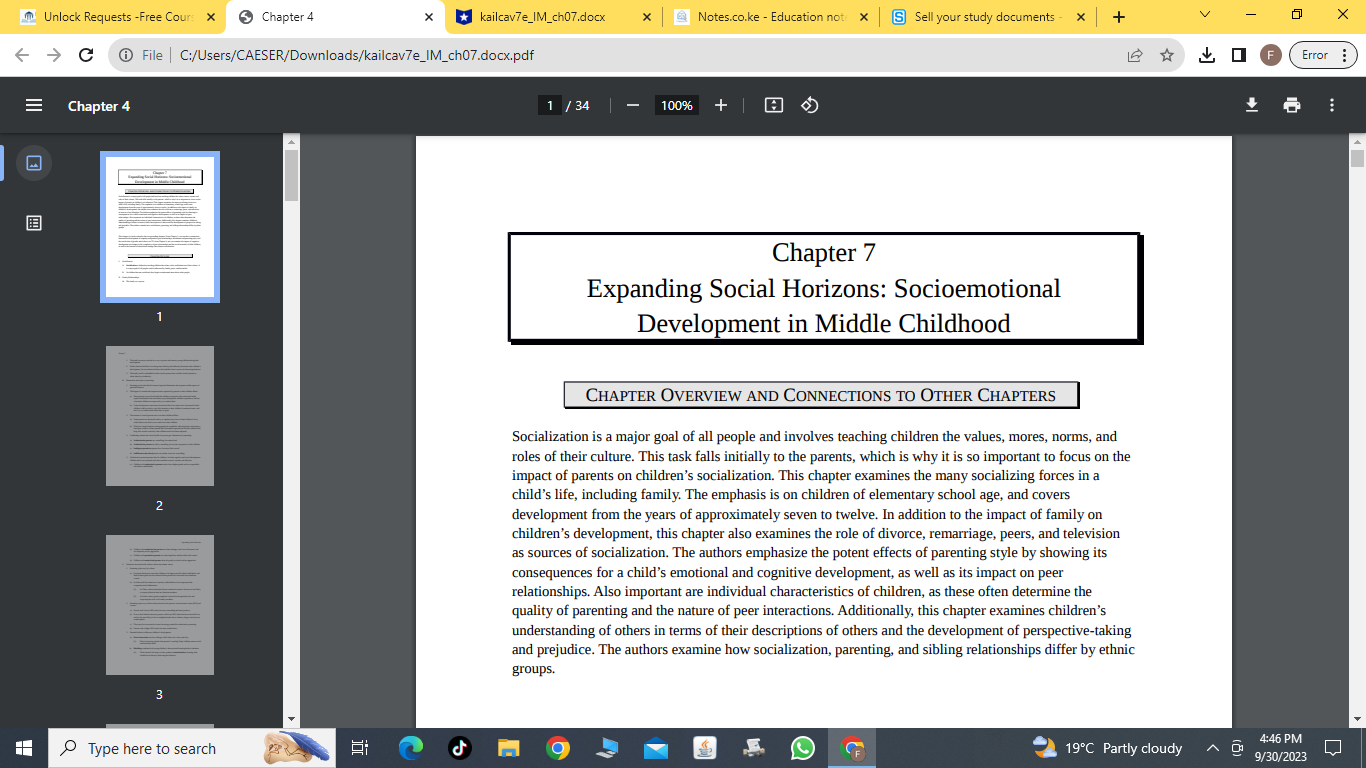
CHAPTER OVERVIEW AND CONNECTIONS TO OTHER CHAPTERS
Socialization is a major goal of all people and involves teaching children the values, mores, norms, and
roles of their culture. This task falls initially to the parents, which is why it is so important to focus on the
impact of parents on children’s socialization. This chapter examines the many socializing forces in a
child’s life, including family. The emphasis is on children of elementary school age, and covers
development from the years of approximately seven to twelve. In addition to the impact of family on
children’s development, this chapter also examines the role of divorce, remarriage, peers, and television
as sources of socialization. The authors emphasize the potent effects of parenting style by showing its
consequences for a child’s emotional and cognitive development, as well as its impact on peer
relationships. Also important are individual characteristics of children, as these often determine the
quality of parenting and the nature of peer interactions. Additionally, this chapter examines children’s
understanding of others in terms of their descriptions of others and the development of perspective-taking
and prejudice. The authors examine how socialization, parenting, and sibling relationships differ by ethnic
groups.
This chapter is closely related to the two preceding chapters. From Chapter 5, you can draw connections
between the development of empathy and positive peer relationships, attachment and parenting style, and
the social roles of gender and violence on TV; from Chapter 6, you can examine the impact of cognitive
development on changes in the complexity of peer relationships and the social networks of older children,
as well as the features of educational settings that enhance socialization.
Below is the document preview.

INTERLOCUTORY INJUCTION
Trending!
IN THE COURT OF APPEAL
AT NAIROBI
(Coram: Gicheru, Akiwumi & Tunoi JJ A )
CIVIL APPEAL NO. 60 OF 1993
BETWEEN
ROCKLAND KENYA LIMITED.....................................................APPELLANT
AND
ELLIOT WHITE MILLER...........................................................RESPONDENT
(Appeal from an order of the High Court of Kenya at Nairobi (Shields J) dated 9th February, 1993
in HCCC No 342 of 1992
25 Pages
7618 Views
0 Downloads
93.46 KB
HORT 322: PRINCIPAL OF HORTICULTURAL CROP PRODUTION
Trending!
Horticulture
Is an Agricultural science that deals with production, utilization &improvement of fruits,vegetables and ornamental plant.
54 Pages
8719 Views
0 Downloads
1.16 MB
EVIDENCE OPINION
Trending!
As a general rule, opinion evidence is inadmissible; a
witness may only speak of facts which he personally
perceived, not the inferences drawn from those facts:
36 Pages
6401 Views
0 Downloads
2.13 MB
ORAL LITERATURE
Trending!
Have you ever imagined what life was like in the days of our great –great
grandfathers? How did
they spend their leisure time? Certainly they did no t spend their free
time reading the works of
their great writers. This is simply because they could not read. The
civilization of reading and
writing was still at its rudimentary stages and in some parts o f the
world this civilization was
104 Pages
3319 Views
1 Downloads
405.01 KB
BUSINESS STUDIES JOINT EXAMINATION REVISION BOOKLET Q AND A
Trending!
The purpose of this business studies joint examination Revision booklet Q and A is to equip the student with knowledge and skills to enable him or her pass the final exams with flying colours
272 Pages
9631 Views
2 Downloads
4.56 MB
EPY 310: HUMAN GROWTH AND DEVELOPMENT FULL NOTES
Trending!
The purpose of the course is to acquaint students with knowledge on theories of human development and the human development process so that they can apply these in their teaching profession.
73 Pages
9815 Views
0 Downloads
1.4 MB
ECT 212: CURRICULUM DEVELOPMENT
Trending!
Schooling refers to the act of physically attending a formal institution of learning e.g. primary or a secondary school. It involves systematic promotion through the grade range governing the learning institution with the assumption that at the end of their institutionalized cycle some learning will have taken place.
10 Pages
12894 Views
0 Downloads
776.26 KB
A Doll's House Notes and Analysis
Trending!
A Doll’s House opens on Christmas Eve. Nora Helmer enters her well-furnished living room—the setting of the entire play—carrying several packages. Torvald Helmer, Nora’s husband, comes out of his study when he hears her arrive. He greets her playfully and affectionately, but then chides her for spending so much money on Christmas gifts. Their conversation reveals that the Helmers have had to be careful with money for many years, but that Torvald has recently obtained a new position at the bank where he works that will afford them a more comfortable lifestyle.
25 Pages
10087 Views
0 Downloads
707.13 KB
AEN 102: THE USE OF ENGLISH FOR ACADEMIC PURPOSES
The general objective of this course is to enable students and other professionals skills which they may need to perform effectively their activities in the university and later on life.
16 Pages
652 Views
1 Downloads
936.04 KB
AEN 200: INTRODUCTION TO PHONETICS AND PHONOLOGY OF ENGLISH
Trending!
Phonetics is a discipline that deals with the systematic study of all speech sounds
which human beings are capable of producing. It provides means of identifying,
recognizing, describing and classifying virtually all the speech sounds that can be
produced by the human vocal tract.
37 Pages
11204 Views
2 Downloads
704.71 KB