Expanding Social Horizons: Socioemotional Development in Middle Childhood
| Institution | Keiser University |
| Course | Pschology |
| Year | 4th Year |
| Semester | Unknown |
| Posted By | Faith Kagwi |
| File Type | |
| Pages | 34 Pages |
| File Size | 174.87 KB |
| Views | 6687 |
| Downloads | 0 |
| Price: |
Buy Now
 Buy via
whatsapp Buy via
whatsapp
|


Description
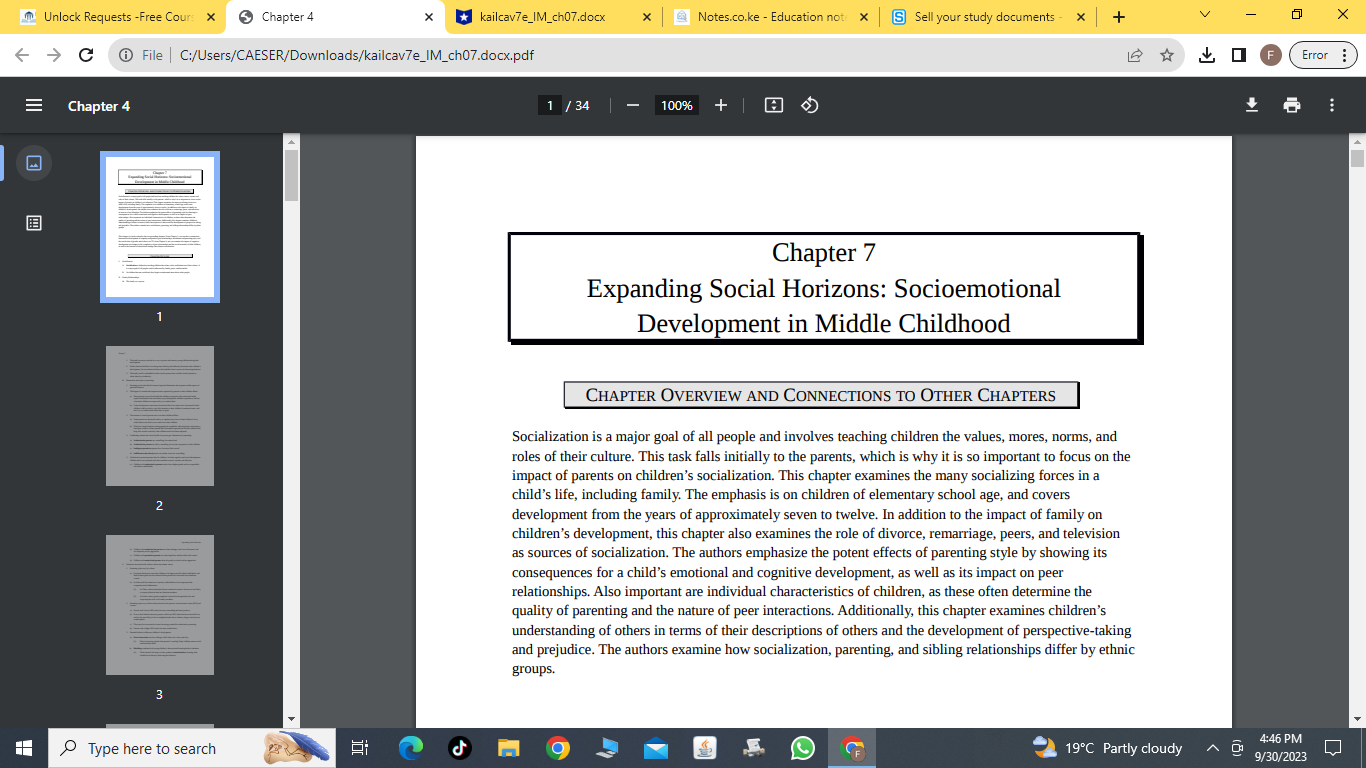
CHAPTER OVERVIEW AND CONNECTIONS TO OTHER CHAPTERS
Socialization is a major goal of all people and involves teaching children the values, mores, norms, and
roles of their culture. This task falls initially to the parents, which is why it is so important to focus on the
impact of parents on children’s socialization. This chapter examines the many socializing forces in a
child’s life, including family. The emphasis is on children of elementary school age, and covers
development from the years of approximately seven to twelve. In addition to the impact of family on
children’s development, this chapter also examines the role of divorce, remarriage, peers, and television
as sources of socialization. The authors emphasize the potent effects of parenting style by showing its
consequences for a child’s emotional and cognitive development, as well as its impact on peer
relationships. Also important are individual characteristics of children, as these often determine the
quality of parenting and the nature of peer interactions. Additionally, this chapter examines children’s
understanding of others in terms of their descriptions of others and the development of perspective-taking
and prejudice. The authors examine how socialization, parenting, and sibling relationships differ by ethnic
groups.
This chapter is closely related to the two preceding chapters. From Chapter 5, you can draw connections
between the development of empathy and positive peer relationships, attachment and parenting style, and
the social roles of gender and violence on TV; from Chapter 6, you can examine the impact of cognitive
development on changes in the complexity of peer relationships and the social networks of older children,
as well as the features of educational settings that enhance socialization.
Below is the document preview.

LLBK 319: CONSUMER PROTECTION ACT NO. 46 OF 2012
Trending!
Consumer Protection Act No. 46 of 2012
6563 Views
0 Downloads
895.45 KB
BASIC CONCEPTS IN INSURANCE LAW
Trending!
This is a full summary of all concepts under Insurance Law.
33 Pages
6493 Views
0 Downloads
567.67 KB
COMPUTER SYSTEMS
Computer system has three components namely: Hardware, software and liveware (computer user).
A system is a collection of different entities that collectively work together to achieve a desired goal.
Examples of systems are human body, social system, school system etc.
A computer system is a collection of three components namely hardware, software and liveware
entities that work together to receive, process, manage and present information in a meaningful
format using computers
14 Pages
311 Views
0 Downloads
707.89 KB
EEN 110: CONCEPTS IN ENVIRONMENTAL EDUCATION AND SUSTAINABLE DEVELOPMENT
Trending!
The term environment comes from a French word ‘environmer’ meaning the surrounding. It is
perceived as that part of the world with which humans interact, a sum of the total natural and
socio components which are or may be in direct interaction with humans. The environment is
also seen as a social construct made up of four dimensions; the biophysical, social, economic
and political dimensions. The environment with its dimensions form a system whose dimensions
interact affect and is affected by other dimensions. When any of the dimensions is affected
negatively or positively the entire environment is affected. Environment is a system made up of
components that interact with each other, the environment is complex system affecting the
development of humanity, and it provides resources for economic growth and for ecological and
social wellbeing.
90 Pages
8705 Views
2 Downloads
573.22 KB
LISTENING AND SPEAKING.
Trending!
In English, we have various vowel sounds. We shall study them one after the other.
Sound
Consider the letter a n the words below. Each says this sound
144 Pages
3202 Views
0 Downloads
1.81 MB
LISTENING AND SPEAKING FOR FORM FOUR
Oral poetry refers to the verbal expression of feelings, ideas and thoughts using words
arranged in their best possible order.
If sung ,it is a song
108 Pages
1699 Views
0 Downloads
1.12 MB
BIOL 244: ENVIRONMENT AND NATURAL RESOURCE MANAGEMENT
Trending!
Environment-surrounding
The surrounding conditions which
influence behaviour and development of
living things.
Environmental science therefore is the
study of the environment, its living and
non-living components and their
interactions.
273 Pages
9785 Views
0 Downloads
14.7 MB
FOND 314: FOOD SERVICE SYSTEMS
Trending!
Management is a technique of leadership or a means of coordination or cooperation. It is
systemized knowledge based on general principles which are verifiable in business practice. The
management; plans, organizes, motivates directs and controls six ‘m’ – men, money, materials,
machinery, market and minutes (time).
20 Pages
6662 Views
1 Downloads
650.95 KB
HISTORY FORM ONE
Trending!
History is the study of the past events and developments of man.
History is the study of Man’s past chronological account and record of events in
relation to his environment .Or:
162 Pages
10254 Views
0 Downloads
2.24 MB
FUNCTIONAL WRITING FORM ONE
Trending!
Sending an e-mail
-To be able to send an e-mail, you must have the e-mail address of the recipient. e.g
To: You write the address of the recipient.
From: You write the address of the sender
Cc: meaning coupon copy- other people who can be sent copies of the same mail.
Bc: a blind copy to be seen by the recipient only.
157 Pages
9228 Views
0 Downloads
1.1 MB