Expanding Social Horizons: Socioemotional Development in Middle Childhood
| Institution | Keiser University |
| Course | Pschology |
| Year | 4th Year |
| Semester | Unknown |
| Posted By | Faith Kagwi |
| File Type | |
| Pages | 34 Pages |
| File Size | 174.87 KB |
| Views | 6694 |
| Downloads | 0 |
| Price: |
Buy Now
 Buy via
whatsapp Buy via
whatsapp
|


Description
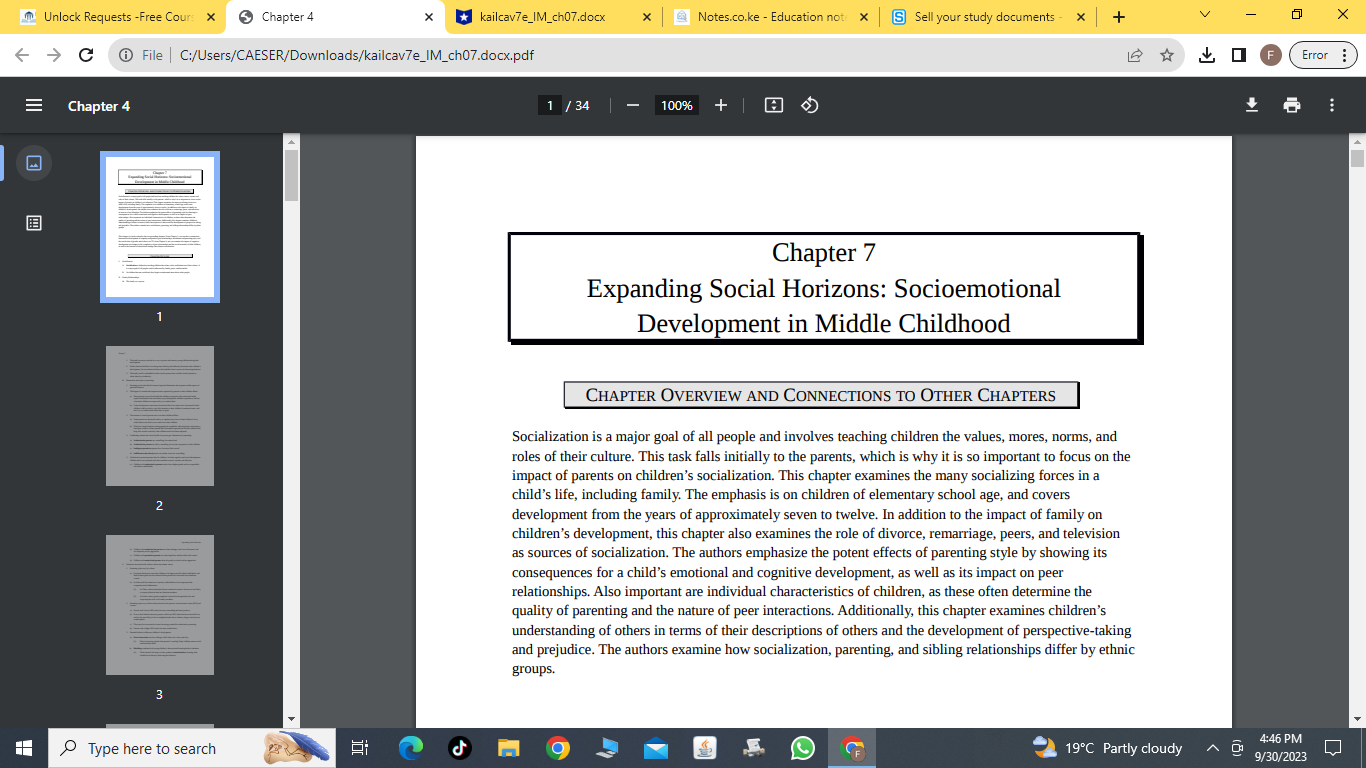
CHAPTER OVERVIEW AND CONNECTIONS TO OTHER CHAPTERS
Socialization is a major goal of all people and involves teaching children the values, mores, norms, and
roles of their culture. This task falls initially to the parents, which is why it is so important to focus on the
impact of parents on children’s socialization. This chapter examines the many socializing forces in a
child’s life, including family. The emphasis is on children of elementary school age, and covers
development from the years of approximately seven to twelve. In addition to the impact of family on
children’s development, this chapter also examines the role of divorce, remarriage, peers, and television
as sources of socialization. The authors emphasize the potent effects of parenting style by showing its
consequences for a child’s emotional and cognitive development, as well as its impact on peer
relationships. Also important are individual characteristics of children, as these often determine the
quality of parenting and the nature of peer interactions. Additionally, this chapter examines children’s
understanding of others in terms of their descriptions of others and the development of perspective-taking
and prejudice. The authors examine how socialization, parenting, and sibling relationships differ by ethnic
groups.
This chapter is closely related to the two preceding chapters. From Chapter 5, you can draw connections
between the development of empathy and positive peer relationships, attachment and parenting style, and
the social roles of gender and violence on TV; from Chapter 6, you can examine the impact of cognitive
development on changes in the complexity of peer relationships and the social networks of older children,
as well as the features of educational settings that enhance socialization.
Below is the document preview.

GPR 424: Nature and Scope of Conflict of Laws
Trending!
The document provides a summary of all the basic concepts of conflict of laws.
11 Pages
7257 Views
0 Downloads
216.49 KB
LLBK 319: SUMMARY OF CONCEPTS IN CONSUMER PROTECTION LAW
Trending!
A succinct introduction and summary of concepts on Consumer Protection law.
9 Pages
7885 Views
1 Downloads
445.96 KB
EPY 310 Topic 1: INTRODUCTION TO GROWTH AND DEVELOPEMENT
Trending!
Growth refers to the quantitative change that occurs in human beings. It is characterized by increase in size and weight. Development refers to patterns of change over time which begin at conception and continue throughout the life span. Development is both qualitative and quantitative in nature and takes place within the physical, social, cognitive and emotional domains. It occurs because of maturation and experience.
4 Pages
8054 Views
0 Downloads
131.98 KB
EPY 310 Topic 2: Psychoanalytic theory of human development
Trending!
Sigmund Freud argued strongly for the role of the unconscious and other internal processes in human development, behaviour and mental disorders. According to him, most of our behaviour and development is determined by the unconscious (innate aggressive and sexual urges- libido). The psychoanalytic school sees people as being in constant conflict between their biological urges (sex aggression, instincts – i.e. the id and the need to tame /control these urges by the super ego. The super-ego uses feelings of pride or guilt to achieve compliance.
11 Pages
9611 Views
0 Downloads
466.82 KB
EPY 310 Topic 3: Theory of Cognitive development
Trending!
While conducting intelligence tests on children, Swiss psychologist Jean Piaget began to investigate how children think. According to Piaget, children’s thought processes change as they mature physically and interact with the world around them. Piaget believed that children develop schema, or mental models, to represent the world. As children learn, they expand and modify their schema through the processes of assimilation and accommodation.
5 Pages
7285 Views
0 Downloads
388.84 KB
EPY 310 Topic 4: PRENATAL DEVELOPMENT
Trending!
The prenatal stage occurs during the nine months or so between conception and birth. As we will cover later on in this topic, the period in the womb can have a considerable impact on our later well-being. The nine months of prenatal development can be characterized as involving three periods...
6 Pages
7222 Views
0 Downloads
634.24 KB
EPY 310 Topic 6: Middle childhood (7 – 11years)
Trending!
Middle childhood covers the period 7-11 years while. This period is characterized by further development of the child in all domains, however the rate of development is not as rapid as it was during infancy and early childhood.
7 Pages
7158 Views
0 Downloads
565.68 KB
EPY 310 Topic 7: PARENTING STYLES AND THEIR EFFECTS ON THE ADOLESCENT
Trending!
A parent who is very responsive but not at all demanding is labelled indulgent , whereas one who is equally responsive but also very demanding is labelled authoritative. Parents who are very demanding but not responsive are Authoritarian. Parents who are neither demanding nor responsive are labelled indifferent.
4 Pages
7646 Views
0 Downloads
508.7 KB
EPY 310 Topic 8: SEXUALALITY IN ADOLESCENCE
Trending!
Every human being is a sexual being. To master the important developmental tasks of forming new and more mature relationships with members of the opposite sex and of of playing the approved role for one’s sex, the young adolescent must acquire more complete and more mature concepts of sex than had as a child. Because of his/her growing interest in sex, the adolescent seeks more information about it.
9 Pages
7341 Views
0 Downloads
726.88 KB
EPY 310 Topic 9: SOCIAL CHANGES DURING ADOLESCENCE
Trending!
One of the most difficult developmental tasks of adolescence relates to social adjustments. These adjustments must be made to members of the opposite sex in a relationship that never existed before and to adults outside the family and school environments. To achieve the goal of adult patterns of socialization, the adolescent must make many new adjustments.
4 Pages
7317 Views
0 Downloads
377.22 KB