Expanding Social Horizons: Socioemotional Development in Middle Childhood
| Institution | Keiser University |
| Course | Pschology |
| Year | 4th Year |
| Semester | Unknown |
| Posted By | Faith Kagwi |
| File Type | |
| Pages | 34 Pages |
| File Size | 174.87 KB |
| Views | 6695 |
| Downloads | 0 |
| Price: |
Buy Now
 Buy via
whatsapp Buy via
whatsapp
|


Description
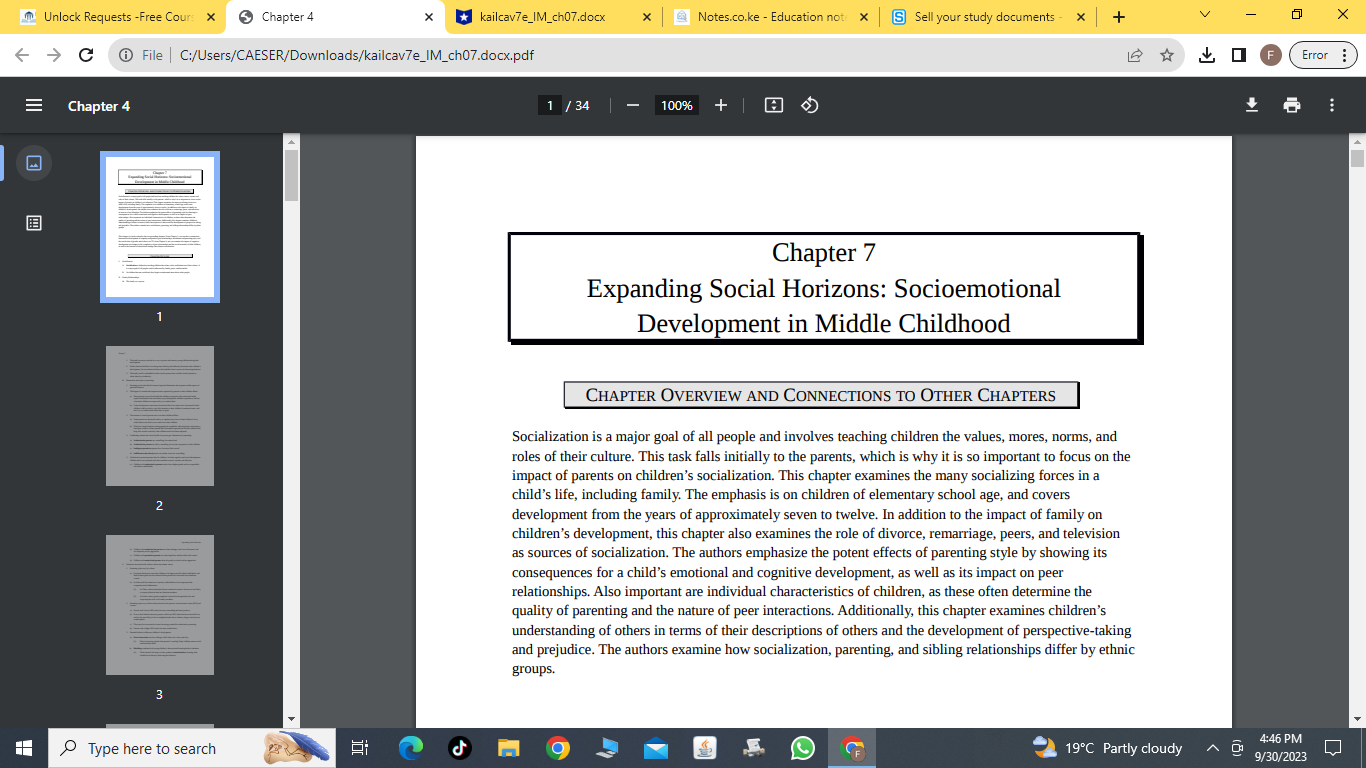
CHAPTER OVERVIEW AND CONNECTIONS TO OTHER CHAPTERS
Socialization is a major goal of all people and involves teaching children the values, mores, norms, and
roles of their culture. This task falls initially to the parents, which is why it is so important to focus on the
impact of parents on children’s socialization. This chapter examines the many socializing forces in a
child’s life, including family. The emphasis is on children of elementary school age, and covers
development from the years of approximately seven to twelve. In addition to the impact of family on
children’s development, this chapter also examines the role of divorce, remarriage, peers, and television
as sources of socialization. The authors emphasize the potent effects of parenting style by showing its
consequences for a child’s emotional and cognitive development, as well as its impact on peer
relationships. Also important are individual characteristics of children, as these often determine the
quality of parenting and the nature of peer interactions. Additionally, this chapter examines children’s
understanding of others in terms of their descriptions of others and the development of perspective-taking
and prejudice. The authors examine how socialization, parenting, and sibling relationships differ by ethnic
groups.
This chapter is closely related to the two preceding chapters. From Chapter 5, you can draw connections
between the development of empathy and positive peer relationships, attachment and parenting style, and
the social roles of gender and violence on TV; from Chapter 6, you can examine the impact of cognitive
development on changes in the complexity of peer relationships and the social networks of older children,
as well as the features of educational settings that enhance socialization.
Below is the document preview.

AGE 101: DEVELOPMENT OF GEOGRAPHICAL THOUGHTS
Trending!
Geography; It’s concerned with the relationship between man’s way of life and the places in which he lives. Geo tries to study the earth as the world of man. It deals with differentiation and integration of places. Describing location of places.
30 Pages
7935 Views
1 Downloads
406.88 KB
RURAL SOCIOLOGY
Rural sociology is one of the various aspects of general sociology such as
urban, medical, family, race, relation, criminal, religion sociology etc.
To define rural sociology we must first define general sociology.
Sociology may be defined as science that deals with the study of the structures and changes of human groups in relation to other members and other groups.
Man is a social being and interacts with other groups. This interaction usually takes some form of repetitive patterns that culminates into larger groups with similar characteristics.
In the process of these interactions with others, man enters up forming other patterns that gives rise to Social groups when these social groups which usually tend to be interrelated and overlap as considered as whole they form a large social group with similar characteristics known as Society
104 Pages
602 Views
0 Downloads
1.58 MB
AGD 309: GENDER, ECONOMIC PLANNING AND POLICY DEVELOPMENT
Trending!
The topic will give definitions of the concepts that will used throughout in this module, and their application in gender and development studies. These include:development, economics, economics policy, economic planning and economic empowerment, economic growth and development.
38 Pages
7011 Views
0 Downloads
673.95 KB
INTRODUCTION TO SOIL SCIENCE
Trending!
SOIL is a naturally occurring unconsolidated material on the earth surface that has been influenced by parent material, climate, organisms and relief, all acting over a period of time to produce a soil that may differ from the material from which it was derived from in terms of physical, chemical, mineralogical, biological and morphological properties.
Soil is composed of particles of broken rock that have been altered by chemical and mechanical processes that include weathering, erosion and precipitation. Soil is altered from its parent rock due to interactions between the lithosphere, hydrosphere, atmosphere, and the biosphere
Soil therefore is a dynamic and complex media developing under the influence of external factors i.e hydrosphere (water), atmosphere (air) and biosphere (flora and fauna).
Soil science. Is the study of properties and reactions of soils and materials, its relationship with man and how it can be used in the benefit of man.
31 Pages
8871 Views
0 Downloads
883.69 KB
AGRO 332 : SOIL FERTILITY AND PLANT NUTRITION NOTES
Trending!
Soil fertility: Is the ability of the soil to supply elements/nutrients essential for plant growth (From germination to physiological maturity) without toxic concentration of any element i.e. in the required amount and at the required time.
Soil productivity: Is the ability of the soil to produce a particular crop or sequence of crops under a specified management system.
NB: Productive soils are fertile for the crops being grown. However, many fertile soils are unproductive because they have poor climate.
42 Pages
9277 Views
1 Downloads
851.24 KB
AGD 300: GENDER ANALYSIS FRAMEWORKS
Trending!
The course is designed to present and discuss the methodologies of the best known analytical frameworks which have been used to integrate gender considerations into development initiatives. It gives practical examples of each framework, and provides accessible commentaries discussing the frameworks' potential uses, advantages, and limitations, as well as recent adaptations.
97 Pages
9048 Views
0 Downloads
1.78 MB
CROP IMPROVEMENT
Trending!
Crop improvement can be defined as
i. An art, a science, and technology of improving the genetic makeup of plants in relation to their economic use for the mankind.
ii. The art and science of improving the heredity of plants for the benefit of mankind.
iii. Science of changing and improving the heredity of plants
2. Genetics
The study of heredity and the variation of inherited characteristics, the science of genetics enables plant breeders to predict to varying extents the outcome of genetic manipulation of plants. The techniques and methods employed in breeding are determined based on the genetics of the trait of interest, regarding, for example, the number of genes coding for it and gene action. For example, the size of the segregating population to generate in order to have a chance of observing that unique plant with the desired combination of genes depends on the number of genes involved in the expression of the desired trait.
29 Pages
7140 Views
0 Downloads
605.71 KB
AGD 102: GENDER, CULTURE AND DEVELOPMENT
Trending!
In this unit, we will learn that gender describes those characteristics, roles and behavior patterns that distinguish men from women and are socially and culturally defined. These perceptions are quite in contrast to sex roles that are biologically determined. We therefore learn that there is a distinction between gender and sex.
36 Pages
2394 Views
0 Downloads
1.3 MB
Principles of Conflict of Laws Third Edition
Trending!
The document is a course textbook that contains the specifics of application of International and Municipal Laws, specifically where the two come into contact and it appears that only one or the other should apply. It introduces the concept and builds up into such concepts as forum shopping, superiority of municipal law, application of laws in foreign marriages, among others. It brings all in clear light, making it a necessary tool for students.
509 Pages
7115 Views
0 Downloads
1.69 MB
Law 514: Validity and Formality of Marriage
Trending!
The document provides the full exposition on the place of marriages under the different systems, where there arises conflict of various laws.
176 Pages
9099 Views
0 Downloads
764.05 KB