CROP IMPROVEMENT
| Institution | UNIVERSITY |
| Course | Diploma in Agribusin... |
| Year | 1st Year |
| Semester | Unknown |
| Posted By | stephen oyake rabilo |
| File Type | |
| Pages | 29 Pages |
| File Size | 605.71 KB |
| Views | 6270 |
| Downloads | 0 |
| Price: |
Buy Now
 Buy via
whatsapp Buy via
whatsapp
|


Description
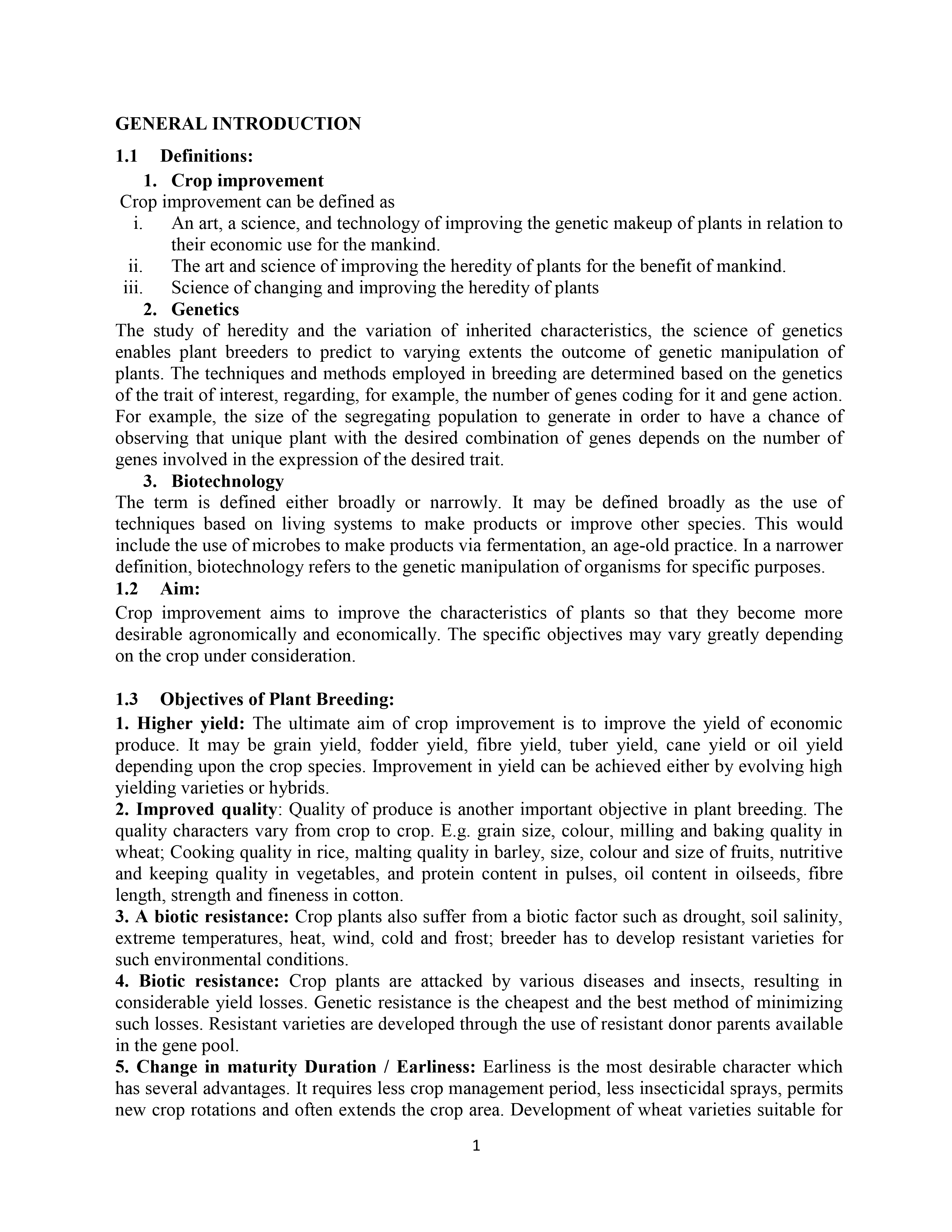
Crop improvement can be defined as
i. An art, a science, and technology of improving the genetic makeup of plants in relation to their economic use for the mankind.
ii. The art and science of improving the heredity of plants for the benefit of mankind.
iii. Science of changing and improving the heredity of plants
2. Genetics
The study of heredity and the variation of inherited characteristics, the science of genetics enables plant breeders to predict to varying extents the outcome of genetic manipulation of plants. The techniques and methods employed in breeding are determined based on the genetics of the trait of interest, regarding, for example, the number of genes coding for it and gene action. For example, the size of the segregating population to generate in order to have a chance of observing that unique plant with the desired combination of genes depends on the number of genes involved in the expression of the desired trait.
Below is the document preview.

INTRODUCTION TO PHILOSOPHY
This sub- topic is intended to equip the learner with knowledge, skills and positive attitudes towards the understanding and appreciating the role of philosophy in human life and endeavors. It covers the definition, meaning, branches and uses of philosophy in the cultivation of better thinking and meaningful living.
8 Pages
1936 Views
0 Downloads
888.5 KB
APP 201: POLITICAL THEORY
This is a second year, first semester course that focuses on political theories that political science is grounded. The module aims at exposing you to different concepts, theories and ideologies. It will help you understand the difference between political theory and political science, evaluate the theories used in political inquiry, comprehend the concepts state, power and authority and differentiate the different political ideologies.
36 Pages
294 Views
0 Downloads
1012.65 KB
APP 201: POLITICAL THEORY
This is a second year, first semester course that focuses on political theories that political science is grounded. The module aims at exposing you to different concepts, theories and ideologies. It will help you understand the difference between political theory and political science, evaluate the theories used in political inquiry, comprehend the concepts state, power and authority and differentiate the different political ideologies.
36 Pages
393 Views
0 Downloads
1012.65 KB
CILS 2101: COMMUNICATION AND INFORMATION LITERACY SKILLS
Communication refers to the conveying of ideas from the mind of one person to the
mind of another which takes place between two or more people, (Harding, 1985 ).
Simply put, it implies that when a person has some idea, they can easily transfer
this idea as it is, to another person’s mind or other people’s minds with no difficulty.
159 Pages
1541 Views
0 Downloads
2.24 MB
ECO 213: INTERMEDIATE MICROECONOMICS
Trending!
The purpose of intermediate microeconomic theory is to provide an adequate exposition of the basic concepts and techniques of microeconomic analysis. The consumer and producer theory and the theory of markets will be treated mathematically and diagrammatically. Further, pure aspects of general equilibrium theory and welfare economics will be covered.
59 Pages
7583 Views
0 Downloads
1.78 MB
GEO 222: SPATIAL ORGANIZATION
Trending!
Spatial organization refers to the arrangement of physical and human objects on the Earth's surface. In this course, we look at how the environment is arranged, how the environment affects man, how man adapts to the environment, how culture is developed and finally how man can conserve the environment.
38 Pages
6643 Views
0 Downloads
777.93 KB
LECTURE 5: MARKET STRUCTURES
Trending!
Market structure refers to the nature and degree of competition in the market for goods and services. The structures of market both for goods market and service (factor) market are determined by the nature of competition prevailing in a particular market.
13 Pages
5724 Views
1 Downloads
191.87 KB
GEO 221: PHYSICAL GEOGRAPHY
Trending!
The rocks that make up Earth’s mantle are mostly silicates a wide variety of compounds that share a silicon and oxygen structure. Common silicates found in the mantle include olivine, garnet, and pyroxene. The other major type of rock found in the mantle is magnesium oxide. Other mantle elements include iron, aluminum, calcium, sodium, and potassium.
49 Pages
5055 Views
0 Downloads
1.3 MB
THEORY OF DEMAND NOTES
Trending!
The purpose of the theory of demand is to determine the various factors that affect
demand of a commodity. That is, the establishment of the law of demand that states that the market demand is negatively related to the price.
53 Pages
5965 Views
0 Downloads
663.65 KB
ABA 404 TOPIC 1: NATURE AND SCOPE OF MANAGEMENT ACCOUNTING
Trending!
Accounting is the process of identifying measuring and communicating economic information to permit informed judgments and decisions by users of information.
It is therefore concerned with providing information that will help decision makers make good decisions.
6 Pages
7687 Views
0 Downloads
349.38 KB