COURSE CODE: DAF1201:COST ACCOUNTING
| Institution | Mount Kenya University |
| Course | DIPLOMA IN BUSINESS... |
| Year | 2nd Year |
| Semester | Unknown |
| Posted By | francis nduni nzambei |
| File Type | |
| Pages | 248 Pages |
| File Size | 1.16 MB |
| Views | 1914 |
| Downloads | 0 |
| Price: |
Buy Now
 Buy via
whatsapp Buy via
whatsapp
|


Description
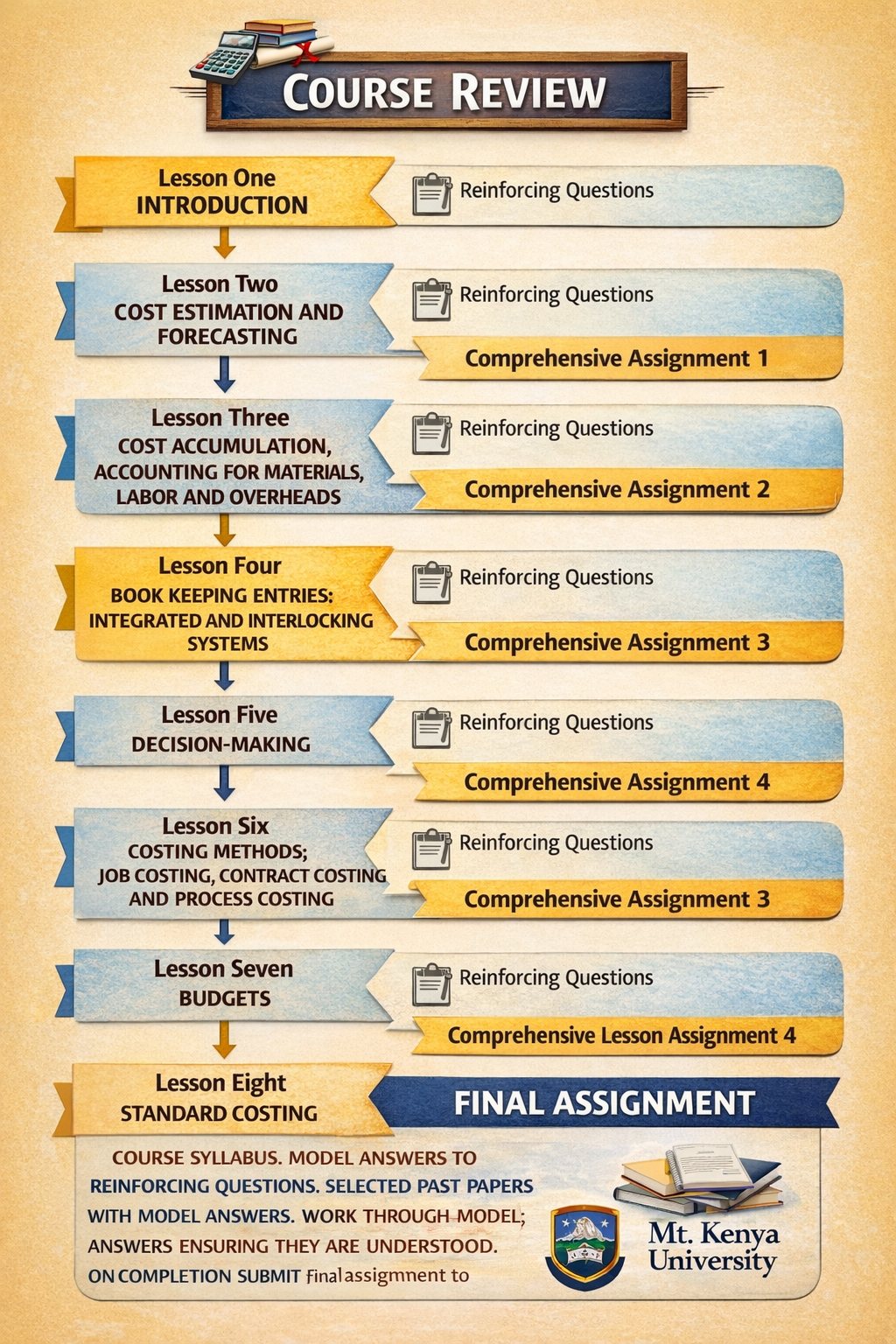
Lesson One Introduction
Reinforcing Questions
Lesson Two Cost estimation and forecasting
Reinforcing Questions
Comprehensive Assignment 1
Lesson Three Cost accumulation, Accounting for materials, labor and
overheads
Reinforcing Questions
Lesson Four Book keeping entries: Integrated and interlocking systems
Reinforcing Questions
Comprehensive Assignment 2
Lesson Five Decision-making
Reinforcing Questions
Lesson Six Costing Methods; Job costing, contract costing and Process
cositng
Reinforcing Questions
Comprehensive Ass ignment 3
Lesson Seven Budgets
Reinforcing Questions
Comprehensive Lesson Assignment 4
Lesson Eight Standard Costing
Lesson Nine COURSE Syllabus. Model answers to reinforcing questions.
Selected past papers with model answers. Work through model;
answers ensuring they are understood. On completion submit
final assignment to Mt. Kenya University.
FINAL ASSIGNMENT
Below is the document preview.

DAF 1301: FUNDAMENTALS OF ACCOUNTING II
Trending!
DAF 1301: FUNDAMENTALS OF ACCOUNTING II
Pre-requisites: DBM 114
Purpose: To develop the learners deeper understanding of the principles of book-keeping and accounts and the ability to maintain books of accounts and preparation of financial statements Course Objectives: By the end of the course unit the student should be able to:- Compile accounting data
• Prepare financial statements
• Interpret accounting information
• Use accounting information in decision making.
Course Content:
• Partnership accounts; the partnership agreement, formation of a partnership, final accounts of partnerships, valuation of goodwill and change in partnership
• Introduction to company accounts, Introduction to published financial statements
• Financial Reporting by Manufacturing enterprise
• Financial statement analysis
• Cash flow Statements
• Accounting for not for profit organizations
• Incomplete records
Teaching / Learning Methodologies: Lectures and tutorials; group discussion; demonstration;
Individual assignment; Case studies
Instructional Materials and Equipment: Projector; test books; design catalogues; computer laboratory; design software; simulators
Recommended Text Books:
• Honrgren and Sundem, G. L, Introduction to Financial Accounting, (6th Edition), New York; Prentice Hall
• Larson, K.M and Pyre, D, Fundamentals of Accounting Principles, (12th Edition), Prentice Hall
• Frank Woods & Alan Sangster, Business accounting,(9th ) Prentice Hall
Text Books for further Reading:
• Wood, Frank, Business Accounting (17th Edition), International Thompson
138 Pages
2088 Views
0 Downloads
1.67 MB
BIT 1106: INTRODUCTION TO COMPUTER APPLICATION PACKAGES
Trending!
Institution: Mount Kenya University
Year: 2024/2025
Semester: 1st Year, 1st Semester (1.1)
BUSINESS LAW DBM1311
Trending!
This is a first-year Diploma course in business course which gives the students exposure to the legal principles
that bind transactions that business people engage in. The course first explores the nature of Law and introduces
the student to the Kenyan legal system. Further, the course explores diverse areas of law that relate to the
activities that business people engage in daily. These include the law of torts, the law of contract, the law of
agency, the law of employment, and the sale of goods law The course is divided into two parts: Business Law 1
and Business Law 2. Business Law 1 is offered in the first semester and business law 2 is provided in the
second trimester of study.
Course objectives
By the end of the course unit, the students should be able to: -
a) Appreciate the legal context in which business law applies.
b) Comprehend but simplify the account of rules relating to the formation, content, and enforcement of
contracts.
c) Illustrate how the law applies to business content.
d) Appreciate the significance of business law and its contribution to the development and success of business.
Course instruction will be through lectures, tutorials, group discussions, and individual assignments.
Attendance and participation in lectures, tutorials, and group discussions is required. Through this, the student
will understand the legal concepts.
The course will be assessed as per the university examinations regulations where the continuous assessment
tests carry 30 marks and the final exam carry 70 marks
169 Pages
2074 Views
0 Downloads
1.01 MB
DAF1101 BUSINESS STATISTICS I
Business statistics is the science of good decision-making in the face of uncertainty and is used
in many disciplines such as financial analysis, econometrics, auditing, production, and
operations including services improvement, and marketing research.
1.2 Uses of Statistics
a) To present the data in a concise and definite form: Statistics helps in classifying and
tabulating raw data for processing and further tabulation for end users.
b) To make it easy to understand complex and large data: This is done by presenting the
data in the form of tables, graphs, diagrams, etc., or by condensing the data with the help
of means, dispersion, etc.
c) For comparison: Tables, measures of means, and dispersion can help in comparing
different sets of data.
d) In forming policies: It helps in forming policies like a production schedule, based on the
relevant sales figures. It is used in forecasting future demands.
e) Enlarging individual experiences: Complex problems can be well understood by
statistics, as the conclusions drawn by an individual are more definite and precise than
mere statements of facts.
f) In measuring the magnitude of a phenomenon:- Statistics has made it possible to count
the population of a country, the industrial growth, the agricultural growth, the educational
level (of course in numbers)
1.3 Limitations of Statistics
1. Statistics does not deal with individual measurements. Since statistics deals with
aggregates of facts, it cannot be used to study the changes that have taken place in
individual cases. For example, the wages earned by a single industry worker at any time,
taken by itself is not a statistical datum. However, the wages of workers in that industry
can be used statistically. Similarly, the marks obtained by Kamau of your class or the
height of Atieno (also of your class) are not the subject matter of statistical study. But the
average marks or the average height of your class has statistical relevance.
254 Pages
1292 Views
0 Downloads
3.33 MB
DBM1214: SUPPLY CHAIN VULNERABILITY
This unit is designed to enable students to undertake risk analysis and a variety of risk
assessments relating to different aspects of purchasing and supply and to implement a range of
appropriate risk management tools and techniques.
Students will use a variety of risk assessment tools and techniques designed to provide a detailed
analysis of supply chain situations, including legal, corporate social responsibility, ethical, health
and safety, financial, international, innovation and a variety of other potential risk scenarios.
The scope covers both the proactive identification and avoidance of risk, as well as provision for
post-event recovery initiatives.
By the end of the unit students should be able to apply a variety of tools and techniques, in a
diverse range of contexts, to proactively establish the level of risk presented and to recommend
ways of avoiding, mitigating or managing those risks.
84 Pages
533 Views
0 Downloads
1.51 MB
DBM3110 OPERATIONS MANAGEMENT
COURSE OBJECTIVES: By the end of the course the student should be able to: I.
Understand the concepts and principles of Operations Management ii. Visualize
Production and Operations Management as an interdisciplinary function. iii. Understand
the significance of production processes and process change
iv. Understand the importance of planning and control in a production environment
v. Understand the aspect of quality in products and services
vi. Appreciate the need for cost optimization techniques in production and operations
management
144 Pages
187 Views
0 Downloads
2.56 MB
DBM3110 OPERATIONS MANAGEMENT
COURSE OBJECTIVES: By the end of the course the student should be able to: I.
Understand the concepts and principles of Operations Management ii. Visualize
Production and Operations Management as an interdisciplinary function. iii. Understand
the significance of production processes and process change
iv. Understand the importance of planning and control in a production environment
v. Understand the aspect of quality in products and services
vi. Appreciate the need for cost optimization techniques in production and operations
management
144 Pages
181 Views
0 Downloads
2.56 MB
DAF1305: MANAGEMENT ACCOUNTING
DAF1305: MANAGEMENT ACCOUNTING
Contact Hours: 30
Pre-requisites: DBM 114 and DBM 121
Purpose: To provide the student with the knowledge of important concepts and techniques needed by
managers in planning, control, management and decision making in business organization
Expected Learning Outcomes of the Course:
By the end of the course unit the learners should be able to:-
i) Explain the importance of management accounting in the management of organizations ii) Apply
management accounting techniques to solve various management dilemmas iii) Explain the
importance of budgeting and responsibility accounting in management of organizations
Course Content:
Nature, Purpose and scope of Management Accounting; Decision Making environments and
techniques; Cost Behavior; Cost Estimation; Relevant costing; Cost-Volume- Profit Analysis;
Variable and absorption costing; Master Budget and Responsibility Accounting
91 Pages
567 Views
0 Downloads
1.87 MB
DBM1214 – Supply Chain Vulnerability Management
This pdf contains 5 past papers with answers for quick revision onDBM1214 – Supply Chain Vulnerability Management. It is compilation of questions and answers.
27 Pages
608 Views
0 Downloads
754.55 KB
DAF1307 TITLE: FINANCIAL MANAGEMENT
Contact hours: 42
COURSE OUTLINE
The Financial Management course, in particular, exposes the student to the nature, scope and
role of financial management in business and in an economy. The course further seeks to equip
the students with financial analysis skills for effective financing and investment decisions
analysis.
Purpose: Develop learners understanding of financial management and apply financial
management tools in decision making for business.
Course Objectives
As a result of this course unit, the student should:
1. Understand the nature, scope and role of financial management in business and in an
economy;
2. Gain an understanding of the functioning of financial markets;
3. Acquire knowledge and skills in financial planning, analysis and control.
97 Pages
759 Views
0 Downloads
1.1 MB