 Join Our WhatsApp Channel for Updates!
MBA PSYCHOLOGY NOTES
| Institution | University |
| Course | PYSCHOLOGY |
| Year | 1st Year |
| Semester | Unknown |
| Posted By | Verah Cate |
| File Type | |
| Pages | 66 Pages |
| File Size | 494.24 KB |
| Views | 3333 |
| Downloads | 0 |
| Price: |
Buy Now
 Buy via
whatsapp Buy via
whatsapp
|


Description
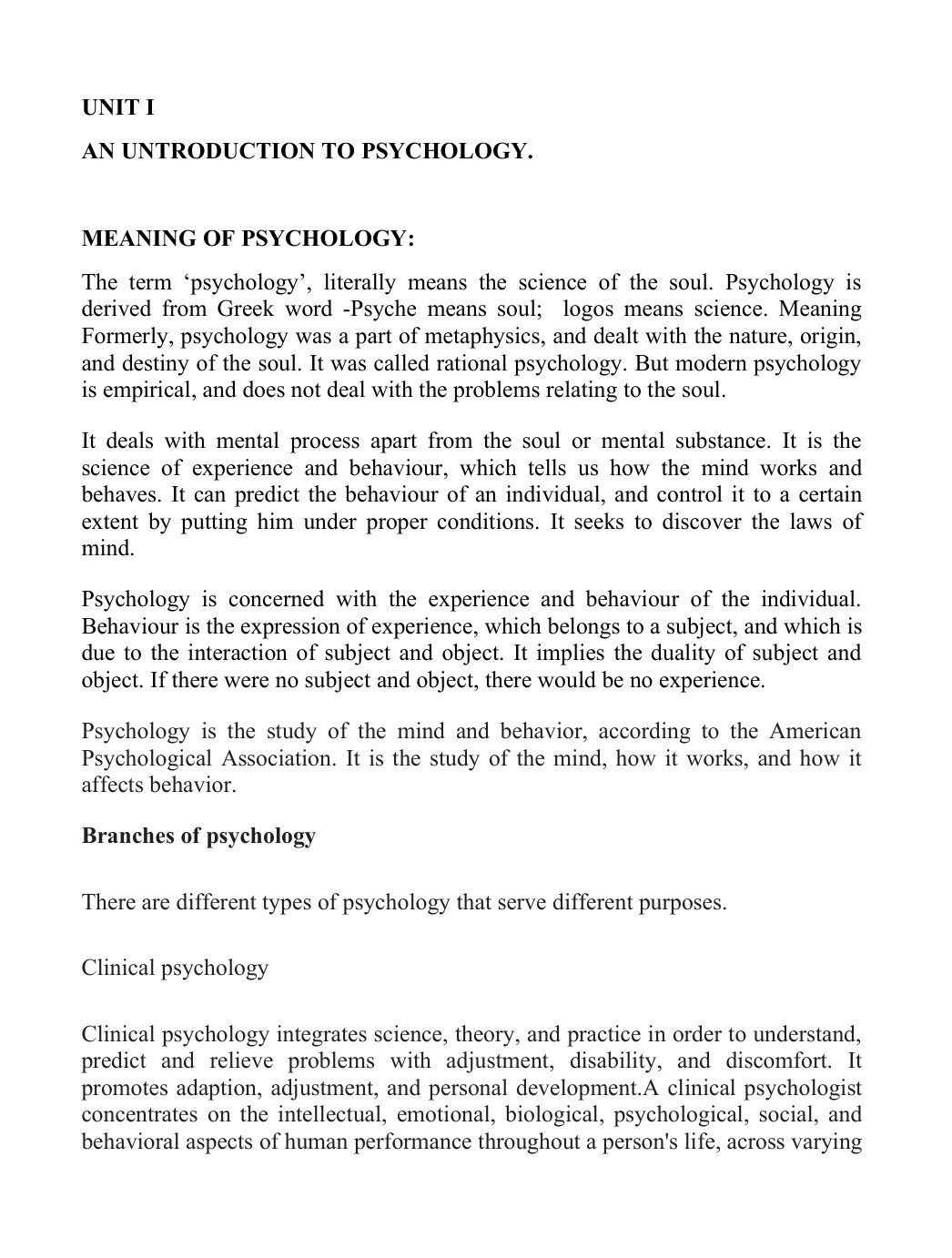
Psychology is the scientific study of the mind, how it works, and how it influences behavior. It has many branches that study specific areas. Some of the major branches described in the document are clinical psychology, which focuses on mental health diagnosis and treatment; cognitive psychology, which studies thinking, memory, and learning; developmental psychology, which focuses on lifespan development; and social psychology, which examines how people influence each other and interact in groups.
Below is the document preview.

Antepartum Hemorrhage (APH)
Trending!
It’s any bleeding from or into the genital tract occurring after 28 weeks gestation which is unrelated to labor and delivery.
• Any bleeding after 28weeks gestation and before
2nd stage of labour
31 Pages
3982 Views
0 Downloads
916.06 KB
Critical Thinking
Critical thinking
Definition is a continuous process characterized by open-mindedness, continual enquiry combined with a willingness to look at each unique patient situation and determine which identified assumptions are true and relevant.
Critical Thinking is a method of analyzing and looking at
problems, decisions, and goals. This results in faster decisions, more creative and innovative solutions, and higher quality deliverables. Critical thinking Involves recognizing that an issue (e.g., patient problem) exists, analyzing information about the issue (e.g. clinical data about a patient), evaluating information
and making conclusions.
35 Pages
407 Views
0 Downloads
708.59 KB
HYPEREMESIS GRAVIDARUM
Trending!
Hyperemesis Gravidarum
• It’s a condition characterized by excessive & persistent pregnancy related nausea or vomiting or both, associated with weight loss of
>5% of body mass, & ketosis.
• Ossurs between 4th
-10th week and resolves before 20th week of pregnancy after interventions.
• In its severe state, malnutrition and metabolic disturbance occur
which may be fatal.
21 Pages
4039 Views
0 Downloads
982.01 KB
\ Endocrine System Anatomy and Physiology
Trending!
Endocrine system has far-reaching effects in the human body
because of its links with the nervous system and the immune
system. The nervous system and the interconnected network of glands known as the endocrine system control body systems
Other tissues produce hormones that are secreted into body
fluids and act on nearby cells and tissues. Hormones are important in regulation of the internal environment of the body and affect every aspect of life
129 Pages
4991 Views
0 Downloads
1.72 MB
Diabetes Mellitus
A group of metabolic diseases in which a person has high blood sugar, either because
the body does not produce enough insulin, or
cells don’t respond to the insulin that is produced.
High blood sugar produces the classical symptoms of
Polyuria (frequent urination),
Polydipsia increased thirst) and
Polyphagia (increased hunger).
60 Pages
477 Views
0 Downloads
1.29 MB
RESPIRATORY SYSTEM DISORDERS
Trending!
Review of anatomy and physiology
i) Nose
A. Structure
The nose and mouth allow air to flow in and out of the body. They also humidify inhaled air, which reduces irritation of the mucous membranes.
B. Functions
1. Passage for incoming and outgoing air, filtering, warming and
moisturizing
2. Organ of smell; the nares (nostrils) contain olfactory receptor
sites and provide the body’s sense of smell.
62 Pages
3739 Views
0 Downloads
1.78 MB
THYROID DISORDERS
Trending!
The thyroid gland is a butterfly-shaped organ located in the lower neck anterior to the trachea.
• It consists of two lateral lobes connected by an isthmus.
• The gland is about 5 cm long and 3 cm wide and weighs about 30 g.
• The blood flow to the thyroid is very high (about 5 mL/min per gram of thyroid tissue), about five times the blood flow to the liver. This reflects the high metabolic activity of the thyroid gland.
58 Pages
3644 Views
0 Downloads
1.21 MB
PARATHYROID DISORDERS
Trending!
Parathyroid gland is located on the neck, embedded in the posterior aspect of the thyroid gland.
• They are four in number
• Parathormone, a protein hormone, regulates calcium and phosphate metabolism.
• Increased production results in increased calcium absorption from the kidney, the intestines and the bones.
25 Pages
3549 Views
0 Downloads
912.94 KB
COPD (CHRONIC OBSTRUCTIVE PULMONARY DISORDER)
Trending!
Chronic Obstructive Pulmonary Disease (COPD) is the third leading cause of death worldwide, causing 3.23 million deaths in 2019 .Over 80% of these deaths occurred in low- and middle-income countries (LMIC).COPD causes persistent and progressive respiratory symptoms, including difficulty in breathing, cough and/or phlegm production. COPD results from long-term exposure to harmful gases and particles combined with individual factors, including events which influence lung growth in childhood and genetics. Environmental exposure to tobacco smoke, indoor air pollution, and occupational dusts, fumes, and chemicals are important risk factors for COPD. Early diagnosis and treatment, including smoking cessation support, is needed to slow the progression of symptoms and reduce flare ups.(WHO,2019)
29 Pages
3697 Views
0 Downloads
619.83 KB
RESPIRATORY SYSTEM DISORDERS
Trending!
Acute Pharyngitis is an inflammation or infection in the throat usually characterized by sore throat
131 Pages
3759 Views
0 Downloads
1.07 MB