ASPHALT MATERIALS
| Institution | College |
| Course | DIPLOMA IN CIVIL EN... |
| Year | 1st Year |
| Semester | Unknown |
| Posted By | stephen oyake rabilo |
| File Type | |
| Pages | 13 Pages |
| File Size | 1.19 MB |
| Views | 2712 |
| Downloads | 0 |
| Price: |
Buy Now
 Buy via
whatsapp Buy via
whatsapp
|


Description
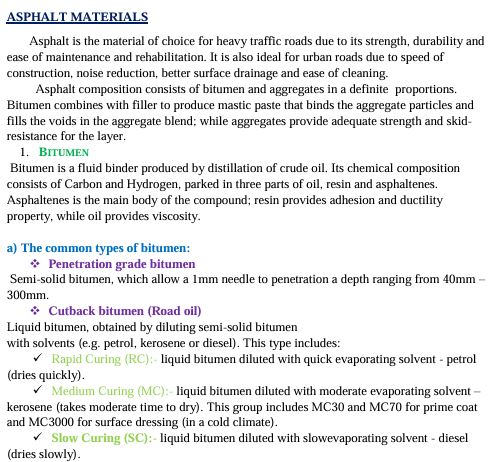
Asphalt is the material of choice for heavy traffic roads due to its strength, durability and ease of maintenance and rehabilitation. It is also ideal for urban roads due to speed of construction, noise reduction, better surface drainage and ease of cleaning.
Asphalt composition consists of bitumen and aggregates in a definite proportions. Bitumen combines with filler to produce mastic paste that binds the aggregate particles and fills the voids in the aggregate blend; while aggregates provide adequate strength and skid resistance for the layer.
Below is the document preview.

CADASTRAL SURVEYING
Trending!
Grab full notes on CADASTRAL SURVEYING for studies.
88 Pages
2267 Views
0 Downloads
1.5 MB
CARTOGRAPHY
In an introductory theoretical way the authors attempt to place cartography into the general
context of sciences. Based on the traditional definition describing cartography as a science,
technique and art, its defined scientific role in the development of geographic thinking is
analyzed. This approach corresponds to the procedural method in epistemology. Cartography is, according to a general model in science, classified considering the fact whether its sources of origin of the concepts, its principles and postulates are genuine or derivatives from other disciplines.
94 Pages
540 Views
0 Downloads
2.58 MB
LAND LAW
Trending!
Get yourself full notes on Land Law for your course of diploma in land survey .
110 Pages
2183 Views
0 Downloads
946.04 KB
Earth work quantity and mass haul diagram
Trending!
Earthwork is excavation of material from
cutting and/or construction of embankments
which is required to convert right of way from
natural condition and configuration to a level
that is ready for pavement works as
prescribed in the design of the road.
34 Pages
3001 Views
0 Downloads
1.34 MB
METHODS OF DIFFERENTIATION AND APPLICATIONS OF DERIVATIVE
Trending!
The rate of change of one dependent quantity with respect to another dependent quantity has great importance. E.g. the rate of change of displacement of a particle with respect to time is called its velocity and the rate of change
of velocity is called its acceleration. The rate of change of a quantity ‘y’ with respect to another quantity ‘x’ is known as the derivative or differentiable coefficient of ‘y’ with respect to ‘x.’
6 Pages
2004 Views
0 Downloads
2.04 MB
Continuous Random Variables & Probability Distributions
Trending!
A random variable X is continuous if possible values comprise either a single interval on the number line or a union of disjoint intervals.
Example: If in the study of the ecology of a lake, X, the r.v. may be depth measurements at randomly chosen locations.
Then X is a continuous r.v. The range for X is the minimum depth possible to the maximum depth possible.
71 Pages
2504 Views
0 Downloads
2.01 MB
COMPLEX NUMBERS
Trending!
Grab a copy of notes on complex numbers .
34 Pages
2434 Views
0 Downloads
278.38 KB
LAND CONTROL ACT
Trending!
Get a copy of LAND CONTROL ACT and get informed various laws and act that guides the land .
28 Pages
2223 Views
0 Downloads
259.37 KB
Photogrammetry RS Rectification
Trending!
Rectification in the photogrammetric sense means the removal of the effects of tilt on the images in a tilted photograph. It is the process of making equivalent vertical photographs from tilted photo negatives. The resulting equivalent vertical photos are called rectified photos.
The process of rectification may entail:
i) Plotting from the tilted photo onto another object sheet such that the plotted points are free from tilt displacement. This is called graphical rectification. An example of this is the
paper strip method.
ii) Optical projection of the photo image onto the map plane and alignment of corresponding
features before plotting the missing features in the map by direct tracing. The aero sketch master is an example of this.
iii) Photographic rectification (Optical- mechanical rectification) whereby the tilted photograph is projected optically such that the projected image is tilt-free and the image is then photographed to obtain the equivalent vertical photograph. Anharmonic Ratios
12 Pages
2520 Views
1 Downloads
406.73 KB