BIOCHEMISTRY
| Institution | University |
| Course | BACHELORS OF MEDICIN... |
| Year | 1st Year |
| Semester | Unknown |
| Posted By | Codred Agencies |
| File Type | |
| Pages | 22 Pages |
| File Size | 821.13 KB |
| Views | 1426 |
| Downloads | 1 |
| Price: |
Buy Now
 Buy via
whatsapp Buy via
whatsapp
|


Description
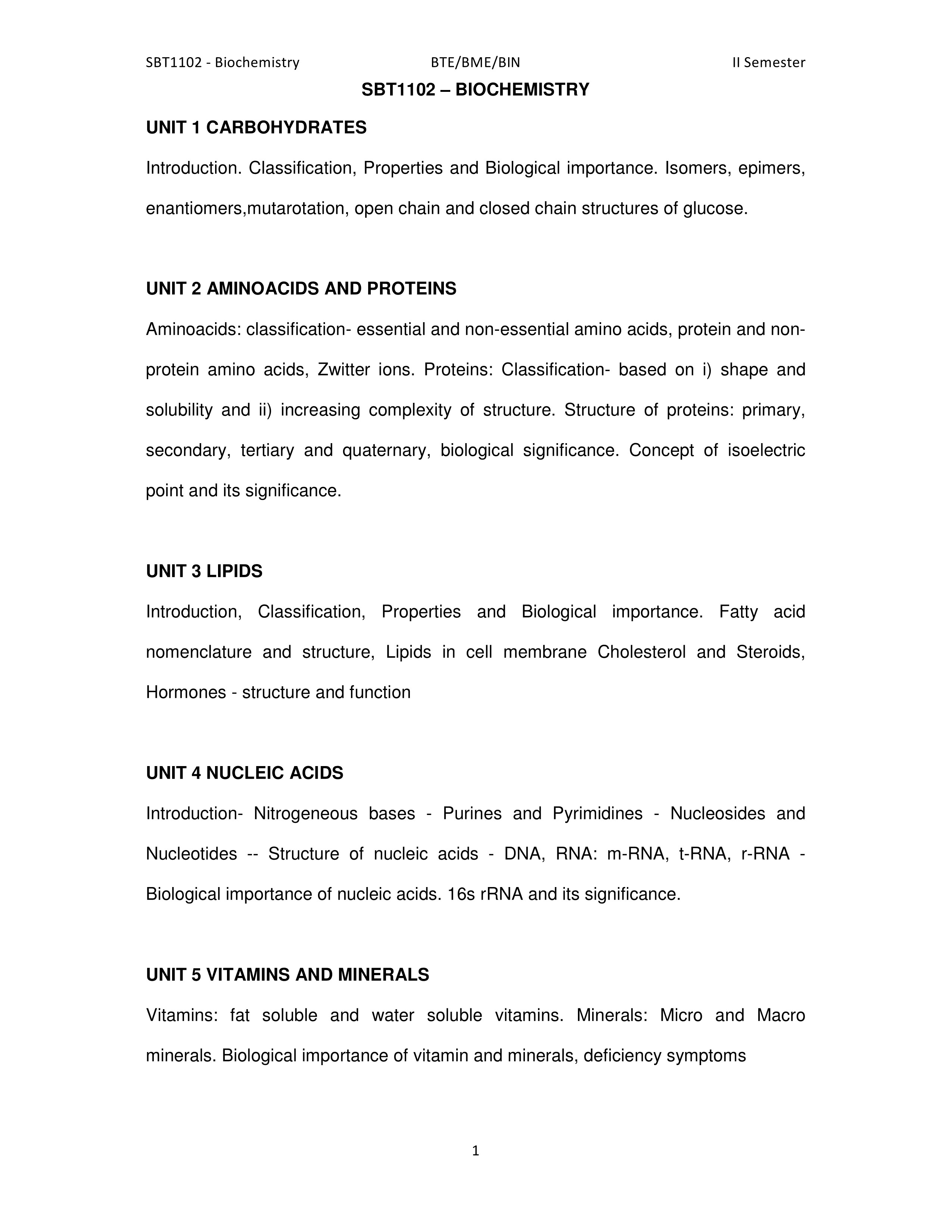
SBT1102 – BIOCHEMISTRY
UNIT 1 CARBOHYDRATES
Introduction. Classification, Properties and Biological importance. Isomers, epimers,
enantiomers,mutarotation, open chain and closed chain structures of glucose.
UNIT 2 AMINOACIDS AND PROTEINS
Aminoacids: classification- essential and non-essential amino acids, protein and nonprotein amino acids, Zwitter ions. Proteins: Classification- based on i) shape and
solubility and ii) increasing complexity of structure. Structure of proteins: primary,
secondary, tertiary and quaternary, biological significance. Concept of isoelectric
point and its significance.
UNIT 3 LIPIDS
Introduction, Classification, Properties and Biological importance. Fatty acid
nomenclature and structure, Lipids in cell membrane Cholesterol and Steroids,
Hormones - structure and function
UNIT 4 NUCLEIC ACIDS
Introduction- Nitrogeneous bases - Purines and Pyrimidines - Nucleosides and
Nucleotides -- Structure of nucleic acids - DNA, RNA: m-RNA, t-RNA, r-RNA -
Biological importance of nucleic acids. 16s rRNA and its significance.
UNIT 5 VITAMINS AND MINERALS
Vitamins: fat soluble and water soluble vitamins. Minerals: Micro and Macro
minerals. Biological importance of vitamin and minerals, deficiency symptoms
Below is the document preview.

BIOCHEMISTRY
DBY 2101 BIOCHEMISTRY
Introduction
The term ‘biochemistry’ was first introduced by a German chemist Carl Neuberg in 1903. Biochemistry
may be defined as a science concerned with the chemical nature and chemical behavior of the living
matter. Biochemistry is the study of the chemical basis of life. Biochemistry helps us understand how
biological systems work.
‘A biochemist is an investigator who utilizes chemical, physical or biological techniques to study
chemical nature and behavior of living matter
234 Pages
1525 Views
0 Downloads
5.29 MB
BIOCHEMISTRY
DBY 2101 BIOCHEMISTRY
Introduction
The term ‘biochemistry’ was first introduced by a German chemist Carl Neuberg in 1903. Biochemistry
may be defined as a science concerned with the chemical nature and chemical behavior of the living
matter. Biochemistry is the study of the chemical basis of life. Biochemistry helps us understand how
biological systems work.
‘A biochemist is an investigator who utilizes chemical, physical or biological techniques to study
chemical nature and behavior of living matter
234 Pages
1439 Views
0 Downloads
5.29 MB
BIOCHEMISTRY
Polyurethanes are prepared from diisocyanates
and diols. Urethane (also called a carbamate) is a
functional group that contains both an ester and an
amide at a single carbonyl group.
Nucleophilic Addition Reaction: Example 1:
Sevin is a highly effective, biodegradable insecticide. It
affects the nervous systems of insects by blocking
access to the neurotransmitter acetylcholine.
57 Pages
1452 Views
0 Downloads
1.68 MB
BIOCHEMISTRY
PETROLEUM CHEMISTRY
Carbon is so Important in the Life Cycle. It has
numerous ways of bonding with many other
elements, particularly oxygen and hydrogen.
It can form both “organic” and “inorganic”
compounds. Organic compounds are considered
unstable in the biosphere because they are in the
reduced state.
Whereas Inorganic compounds, principally
calcite (CaCO3
) and dolomite (CaMg(CO3
)2
), are
stable because they are in the oxidized state.
Carbon is present in most substances that are
vital for the development of life (called
“biomolecules”): Proteins, lipids, sacharides, etc
76 Pages
1434 Views
0 Downloads
1.86 MB
BIOCHEMISTRY
Alkyl halides are organic molecules containing a halogen
atom bonded to an sp3 hybridized carbon atom.
• Alkyl halides are classified as primary (1°), secondary (2°),
or tertiary (3°), depending on the number of carbons bonded
to the carbon with the halogen atom.
• The halogen atom in halides is often denoted by the symbol
“X”.
53 Pages
1522 Views
0 Downloads
2.07 MB
BIOCHEMISTRY
Natural Gas
Natural gas is a gaseous fossil fuel consisting
primarily of methane but including significant
quantities of ethane, butane, propane, carbon
dioxide, nitrogen, helium and hydrogen sulfide.
Obtained from oil fields and natural gas fields,
and in coal beds.
Methane-rich gases are produced by the
anaerobic decay of non-fossil organic material, ie
biogas.
Total world production of natural gas in 1986
was 100 trillion m3
.
It is used as feed stock as well as fuel. It is
preferred due to its high Calorific Value
52 Pages
1410 Views
0 Downloads
1.17 MB
BIOCHEMISTRY
Human physiology
Definition
physiology explains physical and
chemical factors that are
responsible for the origin,
development, and progression of
( .life ,(each type of life
18 Pages
1460 Views
0 Downloads
1.07 MB
BIOCHEMISTRY
ENDOCRINE SYSTEM
The endocrine system is a network of glands in your body
that make the hormones that help cells talk to each other. They’re responsible for almost every cell, organ, and
function in your body. If your endocrine system isn't healthy, you might have
problems developing during puberty, getting pregnant,
or managing stress. You also might gain weight easily,
have weak bones, or lack energy because too
much sugar stays in your blood instead of moving into
your cells where it's needed for energy
14 Pages
1380 Views
0 Downloads
376.4 KB
SBT 102: INTRODUCTORY BIOCHEMISTRY AND GENETICS
Trending!
Matter and living organisms are organized in
a certain order, from the simplest level to the
most complex level. Cells occupy the first level of matter that is
described as living as illustrated in the figure
below
16 Pages
8907 Views
1 Downloads
824.88 KB
BIOCHEMISTRY OF MUSCULAR TISSUE
Trending!
Sarcomere
• Is the smallest contractile unit in the myofibril.
• Is the region between 2 neighbouring Z LINES
• is composed of long, fibrous proteins as filaments that slide past
each other when a muscle contracts or relaxes.
• When the myofibril is examined by electron microscopy,
alternating dark and light bands can be observed.
37 Pages
8225 Views
0 Downloads
1.13 MB