 Join Our WhatsApp Channel for Updates!
BLA 1111: CRITICAL READING AND RESPONSE LECTURE NOTES
| Institution | University |
| Course | LITERATURE |
| Year | 1st Year |
| Semester | Unknown |
| Posted By | Mwalimu Evans Okoyo. |
| File Type | |
| Pages | 53 Pages |
| File Size | 423.6 KB |
| Views | 3768 |
| Downloads | 4 |
| Price: |
Buy Now
 Buy via
whatsapp Buy via
whatsapp
|


Description
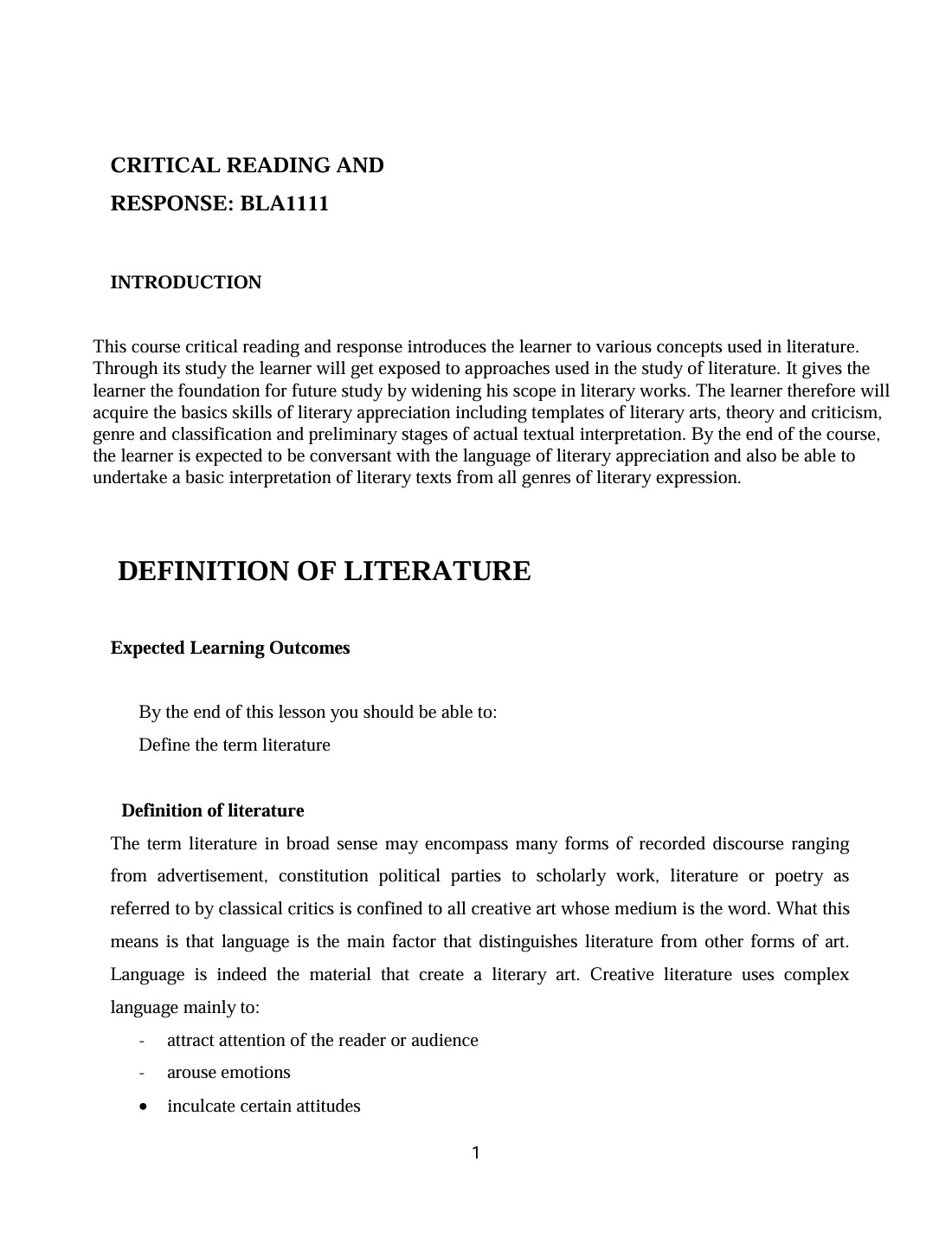
This document provides an introduction to a course on critical reading and response. It discusses how the course will introduce students to concepts in literature and give them the foundational skills for literary appreciation and analysis. Key topics that will be covered include literary genres, theory and criticism, and how to interpret texts. The goal is for students to understand the language of literary studies and be able to do basic interpretations of works from different genres.
Below is the document preview.

Hypertensive Disorders in Pregnancy
Trending!
Hypertensive disorders complicating pregnancy are common and are among the three (with hemorrhage and infection) leading
causes of death. Pregnancy can induce hypertension (HTN) or
aggravate pre-existing hypertension.
99 Pages
4410 Views
0 Downloads
1.38 MB
Hematologic disorders Anatomy and procedures
Trending!
Hematologic system consists of ; blood and sites where blood is produced, (bone marrow and the reticuloendothelial system (RES).
• Blood is composed of plasma and various types of cells.
• Plasma is the fluid portion of blood; it contains various proteins, such as albumin, globulin, fibrinogen, and other factors necessary for clotting, as well as electrolytes, waste products, and nutrients.
• About 55% of blood volume is plasma.
149 Pages
3784 Views
0 Downloads
1.33 MB
MUSCULOSKELETAL SYSTEM DISORDERS
Trending!
Anatomy and physiology
• There are 206 bones in the human body, divided into four categories:
• Long bones (eg, femur)
• Short bones (eg, metacarpals)
• Flat bones (eg, sternum)
• Irregular bones (eg, vertebrae)
• The shape and construction of a specific bone are determined by its function and the forces exerted on it
85 Pages
3812 Views
0 Downloads
1.57 MB
HAEMATOLOGIC DISORDERS
Trending!
It is an abnormally increased concentration of haemoglobin in the blood, either through reduction of plasma volume or increase in red cell numbers. People with polycythemia have an increase in hematocrit, hemoglobin or
red blood cell count above the normal limits.
35 Pages
3754 Views
0 Downloads
819.93 KB
MANAGEMENT OF FRACTURES
Trending!
In fracture management, the objectives of the treatment are as follows:
• To regain and maintain the normal alignment of the injured part.
• To regain normal function of the injured part.
• To achieve the above objectives for the patient in the shortest time possible.
44 Pages
3937 Views
0 Downloads
1.06 MB
Blood transfusion
Blood transfusion is the transfusion of whole blood or its
components such as blood cells or plasma from one person to
another person.
Blood transfusion involves two procedures;
• Collection of blood from a donor
• Administration of blood to the recipient.
37 Pages
655 Views
0 Downloads
969.94 KB
Anatomy of the neurological system
Trending!
Consists of two divisions:
• The central nervous system (CNS), including the brain and spinal cord, and
• The peripheral nervous system, made up of the cranial
and spinal nerves.
• The peripheral nervous system can be further divided into
• The somatic, or voluntary, nervous system, and
• The autonomic, or involuntary, nervous system.
39 Pages
3894 Views
0 Downloads
821.58 KB
Cardiovascular Anatomy
Trending!
The heart’s primary function is to pump blood to all parts of the body. The circulating blood not only brings oxygen and nutrients to the body’s tissues but also helps to take away the body’s waste products. Its essential to understand the structure and function of the heart in health and in disease in order to understand the assessment skills.
63 Pages
3226 Views
1 Downloads
1.02 MB
Cardiovascular disorders
Trending!
Cardiac surgery -performed on the heart to correct life- threatening conditions.
Types of heart surgeries
The surgery can be either;
OPEN HEART SURGERY
CLOSED HEART SURGERY
MINIMALLY INVASIVE SURGERY depending on the
conditions to be corrected.
62 Pages
3731 Views
0 Downloads
1.03 MB
NEUROLOGICAL NURSING
Anatomic and Physiologic Overview
• The nervous system consists of two divisions:
Central nervous system (CNS), including the brain and spinal cord
Peripheral nervous system (PNS), made up of the cranial and spinal nerves.
• The peripheral nervous system can be further divided into:
Somatic, or voluntary, nervous system
Autonomic, or involuntary, nervous system
228 Pages
456 Views
0 Downloads
1.96 MB