PHG 2223-1 108: ETHICS AND INTEGRITY
| Institution | Maasai Mara University |
| Course | BACHELORS OF ARTS GO... |
| Year | 1st Year |
| Semester | Unknown |
| Posted By | stephen oyake rabilo |
| File Type | |
| Pages | 48 Pages |
| File Size | 826.96 KB |
| Views | 782 |
| Downloads | 0 |
| Price: |
Buy Now
 Buy via
whatsapp Buy via
whatsapp
|


Description
Etymological definition
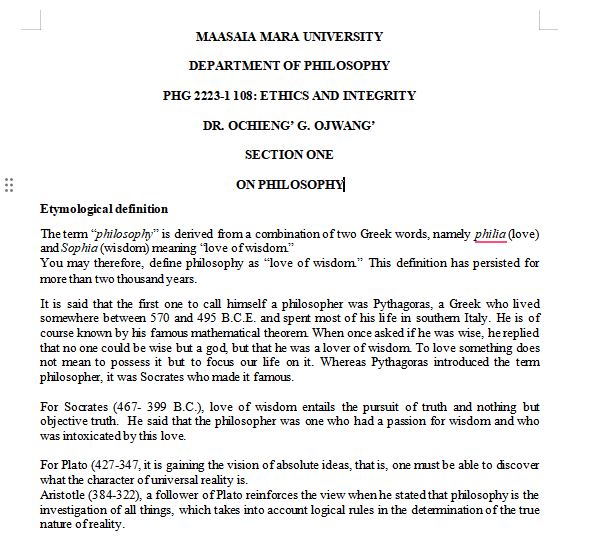
The term “philosophy” is derived from a combination of two Greek words, namely philia (love) and Sophia (wisdom) meaning “love of wisdom.”
You may therefore, define philosophy as “love of wisdom.” This definition has persisted for more than two thousand years. It is said that the first one to call himself a philosopher was Pythagoras, a Greek who lived somewhere between 570 and 495 B.C.E. and spent most of his life in southern Italy. He is of course known by his famous mathematical theorem. When once asked if he was wise, he replied that no one could be wise but a god, but that he was a lover of wisdom. To love something does not mean to possess it but to focus our life on it. Whereas Pythagoras introduced the term philosopher, it was Socrates who made it famous.
For Socrates (467- 399 B.C.), love of wisdom entails the pursuit of truth and nothing but objective truth. He said that the philosopher was one who had a passion for wisdom and who was intoxicated by this love.
For Plato (427-347, it is gaining the vision of absolute ideas, that is, one must be able to discover what the character of universal reality is.
Aristotle (384-322), a follower of Plato reinforces the view when he stated that philosophy is the investigation of all things, which takes into account logical rules in the determination of the true nature of reality.
Below is the document preview.

First Aid Skills Notes
First Aid Skills is fundamental necessity in tour guiding so trainees need to be equiped with first Aid Skills knowledge.
14 Pages
826 Views
0 Downloads
495.66 KB
TGA1: Tour Guiding Activities notes
Tour Guiding Activities notes gives full overview of what's involved in Conducting tours in various destinations. It's cuts across various Learning Outcomes aligning to the CBET curriculum as well as relationship with the Occupational Standards.
531 Views
1 Downloads
54.16 KB
FLS1: Foreign Language skills _FRENCH
This notes cuts across learning French just right from the scratch. Its content equips learners to be future-ready fluent french language speakers.
Dive in.
92 Pages
525 Views
0 Downloads
2.6 MB
FINANCIAL ACCOUNTING
introduction to the cash book questions in financial accounting. tested questions and answered questions in business studies.
single column cashbook, two column cashbook and three column cashbooks
7 Pages
371 Views
0 Downloads
1.61 MB