 Join Our WhatsApp Channel for Updates!
CULTURAL TOURISM KNEC NOTES
| Institution | College |
| Course | TOUR GUIDE |
| Year | 1st Year |
| Semester | Unknown |
| Posted By | Mwalimu Evans Okoyo. |
| File Type | |
| Pages | 58 Pages |
| File Size | 199.6 KB |
| Views | 2225 |
| Downloads | 2 |
| Price: |
Buy Now
 Buy via
whatsapp Buy via
whatsapp
|


Description
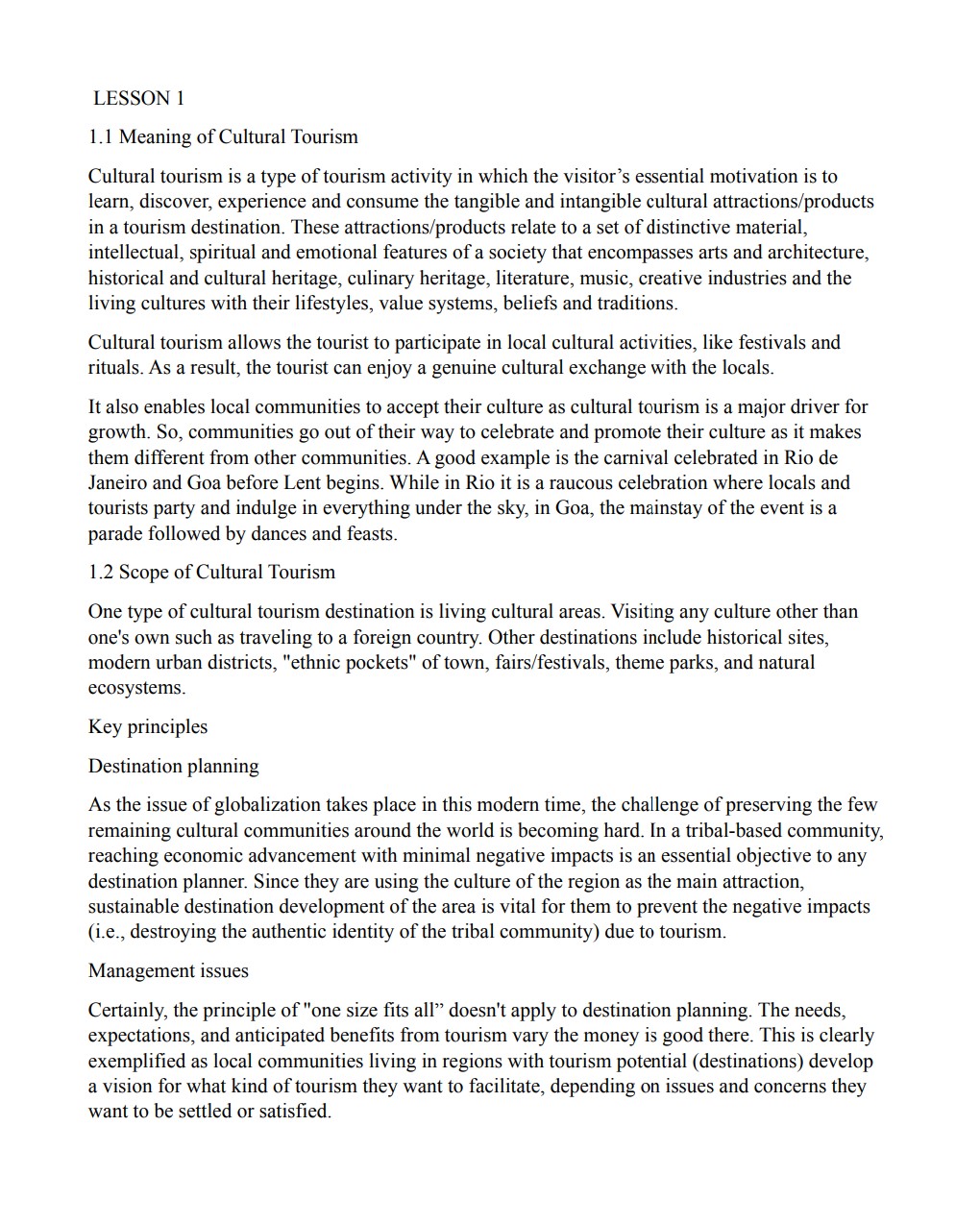
Cultural tourism is a type of tourism activity in which the visitor’s essential motivation is to learn, discover, experience and consume the tangible and intangible cultural attractions/products in a tourism destination. These attractions/products relate to a set of distinctive material, intellectual, spiritual and emotional features of a society that encompasses arts and architecture, historical and cultural heritage, culinary heritage, literature, music, creative industries and the living cultures with their lifestyles, value systems, beliefs and traditions.
Below is the document preview.

SUPPLY CHAIN MANAGEMENT KNEC NOTES
Supply management: This is a process responsible for the development and management of a firm’s total internal and external supply system.
99 Pages
418 Views
0 Downloads
233.74 KB
SUPPLY AND TRANSPORT MANAGEMENT KNEC NOTES
Supply is the willingness and ability of producer to create goods and services to take them to the market. Supply is positively related to price given that at higher prices there is an incentive to supply more as higher prices may generate increased revenue and profits.
129 Pages
1974 Views
0 Downloads
15.48 MB
The Hospitality Management Lecture Notes
Tourism is travel from one place to another for a period of more than 24 hours but less than one year for leisure or business. Tourism can be domestic or international. Domestic tourism involves residents of a given country travelling within their country. International tourism involves residents of a given country travelling to ither country. International tourism has both incoming and outgoing implication on country’s payment balance.
86 Pages
1831 Views
4 Downloads
2.57 MB
INTRODUCTION TO TOURISM AND TRAVEL MANAGEMENT
This document provides an introduction to tourism and travel management. It defines key terms like tourism, visitors, tourists, and discusses the tourism industry. The tourism industry comprises many sectors that work together to provide goods and services to tourists, like hospitality, transportation, travel agencies, guides, and attractions. It can be classified into main constituents which directly serve tourists, and secondary constituents which support the tourism industry.
38 Pages
1901 Views
0 Downloads
801.01 KB
CROP PRODUCTION MODULE 2 NOTES
Maize is the most important cereal/food crop in East Africa. The crop originated from Central America (Mexico). The crop was brought to Kenya by Portuguese traders in the 16th C and since then it has become a staple food. The chief growing areas are Trans Nzoia, Nakuru, Bungoma, and Uasin Gishu counties.
57 Pages
1985 Views
0 Downloads
543.44 KB
CROP PRODUCTION MODULE 1 NOTES
At the end of the topic, the trainee should be able to: Define crop ecology, State the biotic and abiotic factors that affect crop production, List various agro ecological zones in Kenya & List the crops grown in each agroecological zone.
289 Pages
1736 Views
1 Downloads
920.93 KB
CROP PRODUCTION MODULE 1 LECTURE NOTES
Agriculture means cultivation of the land for the purpose of producing crops and management of Llivestock. It also involves the storage, processing and marketing of agricultural products.
179 Pages
1889 Views
0 Downloads
653.77 KB
DPTE MUSIC DISCUSSION QUESTIONS FOR SUMMATIVE ASSESSMENT
Trending!
Your summative assessment is fast approaching. Next month there shall be SBA 2.
It may come in the form of a written examination or can be a combination of both
written and practical assessments.
5 Pages
3180 Views
1 Downloads
56.51 KB
DPTE MUSIC DISCUSSION QUESTIONS
The document outlines a comprehensive set of music discussion questions aimed at exploring various aspects of music education, including theories of learning, the role of music in child development, and the integration of music into the curriculum. It covers topics such as the significance of folk songs, the use of indigenous instruments, and the assessment of musical performances. Additionally, it addresses the social and economic importance of music, as well as opportunities for careers in the music industry.
6 Pages
414 Views
0 Downloads
58.22 KB
GENERAL METHODS AND PRINCIPLES OF TEACHING NOTES
Trending!
Teaching is the art of sharing knowledge and experiences from one person (teacher) to another (learner). It can also be a process in which teachers, learners, curriculum and other variables are organised in a systematic and psychological way to attain some pre-determined goals. Through teaching, learners acquire the desired knowledge, skills as well as desirable ways of living in the society
93 Pages
2365 Views
1 Downloads
379.6 KB