Factors Influencing Employee Creative Work Behavior The Case of Geosynthetics Industrial Works Plc - business research project
| Institution | Kimathi Institute of Technology |
| Course | Human resource manag... |
| Year | 3rd Year |
| Semester | Unknown |
| Posted By | MAKORI KERECHA |
| File Type | docx |
| Pages | |
| File Size | 268.79 KB |
| Views | 466 |
| Downloads | 0 |
| Price: |
Buy Now

|
Description
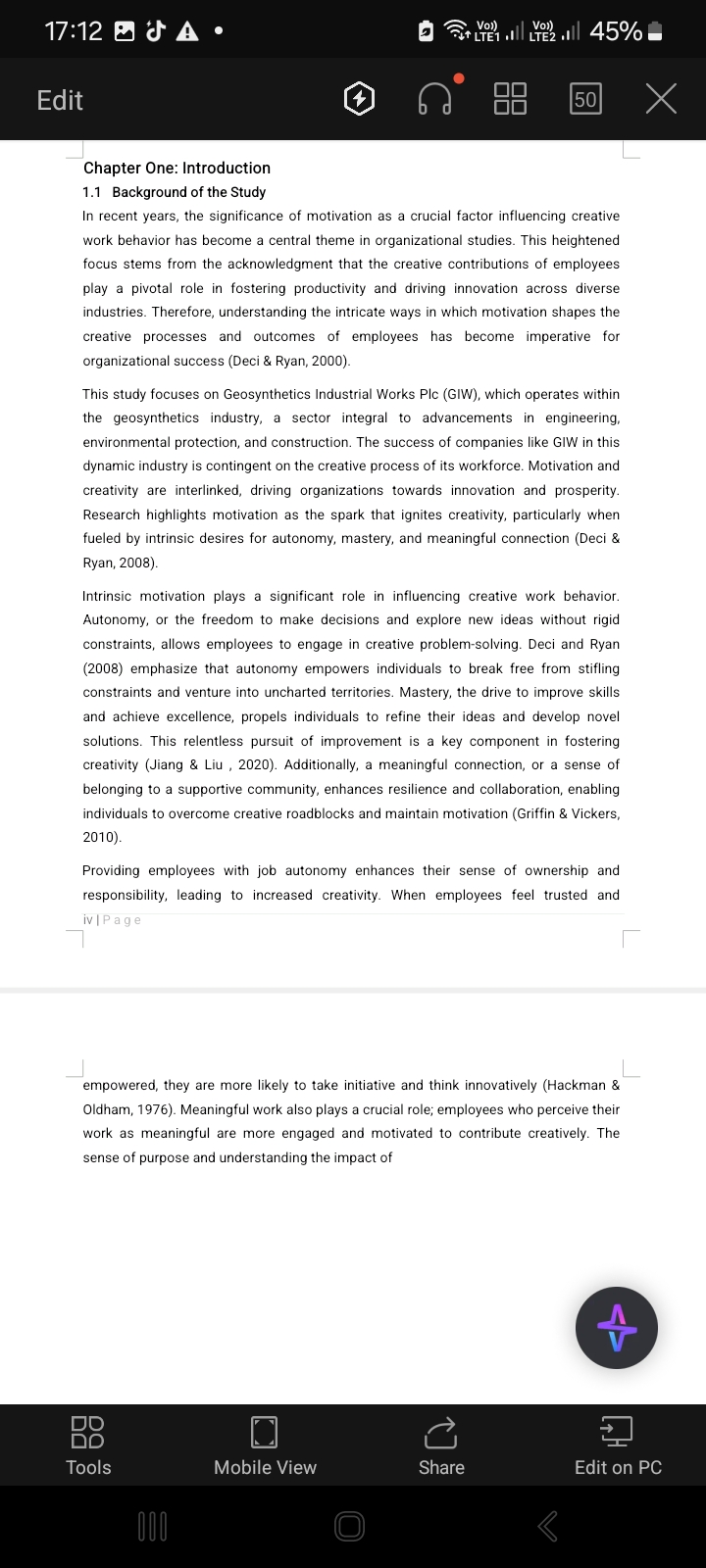
study investigates the factors influencing employee creative work behavior within Geosynthetics Industrial Works Plc (GIW) in Ethiopia, focusing on job autonomy, perceived work significance, work difficulty, supervisory support, and psychological safety. Adopting a mixed-methods research approach, the study integrates quantitative data from structured surveys and qualitative insights from interviews, targeting all 380 core employees, including process owners, senior managers, production supervisors, and non-managerial staff. A sample size of 197 was determined using Yamane's formula, with simple random sampling for surveys and purposive sampling for interviews. Quantitative data analysis involved descriptive statistics, correlation, and multiple linear regression, while qualitative data underwent thematic summarized and condensed form . The findings reveal that all five factors significantly predict the creative climate at GIW, with psychological safety being the strongest predictor. The study concludes that enhancing job autonomy, perceived work significance, challenging tasks, supervisory support, and psychological safety can foster a more creative work environment. Recommendations include increasing job autonomy, emphasizing the significance of work, providing challenging tasks, improving supervisory support, and strengthening psychological safety to drive organizational innovation and success.
| P a g e
Below is the document preview.
EFFECTS OF OCCUPATIONAL HEALTH AND SAFETY PRACTICES ON EMPLOYEE PERFORMANCE A CASE OF RIFT VALLEY ACADEMY IN KENYA.-HRM RESEARCH PROJECT
This research project investigated the impact of occupational health and safety practices on employee performance at Rift Valley Academy (RVA) in Kenya. The study investigated specific occupational health and safety programs and policies at Rift Valley Academy; evaluated the effect of work environment on employee performance within Rift Valley Academy; and examined the role of leadership and management in organization health and safety on employee’s performance.
This research was carried out using an explanatory research design. Data was collected through questionnaires to assess the level of adherence to OHS policies and its impact on employee performance using indicators such as absenteeism, job satisfaction and overall productivity. The target population consisted of all permanent employees working in Rift Valley Academy. The population size was 303. This study used the stratified sampling technique to select a cross section of staff at different departments. The sample size of the study was 120 respondents sampled from all departments at RVA. Primary data was collected primarily using questionnaires containing both open and closed ended questions. Data collected was first cleaned, sorted and matched, coded and analyzed using the Statistical Package for Social Scientist (SPSS) to obtain descriptive statistics such as means, standard deviation, percentages and frequencies used to describe the data. The first objective sought to evaluate the specific occupation health and safety programs and practices and policies adopted at RVA. The study established that majority agreed that there exists OHS practices such as safety inspection, safety trainings and safety audits at RVA and that OHS plays an important role in employee performance and that laws and regulations have been enforced to ensure adherence to OHS practices and thus ensure safety of employees at work. The second objective sought to determine the influence work environment on employee performance at RVA. Majority of the employees from RVA agreed that RVA provides a work environment that is safe and has adequate facilities and arrangements for employee welfare and it ensures employee health and safety for employees. The third objective sought to determine the role of leadership and management in OHS on employee performance. This study revealed that leadership and management at RVA ensured that resources were available and accessible to employees to support physical health and mental health at work and ensure that employees carried out their job safely.
The study concluded that Occupational Health and Safety programs and practices at RVA plays a crucial role employee performance. To ensure employees maintain good performance at work, the school has ensured that employees are aware of safety programs and policies and procedure, they are provided with the right necessary training on health and safety and safety inspections and audits are done on a regular basis. RVA has also ensured that safety committees are set up and are working to ensure the safety of employees. Along with that, RVA has also ensured that it promotes a good working environment both physically, socially and mentally.
It was recommended that employees need to be involved fully in the safety decision making process and this should be an agenda driven by the top management in order to increase commitment levels at RVA, Secondly, RVA needs to invest more time to educate the employees about set policies and set objectives. Thirdly, there is a need for RVA to offer motivation to the employees, and such incentives would lead to more commitment to employee performance. Lastly, RVA has formulated Standard OHS practices for employees therefore through the various departmental heads, closer supervision should be done to ensure all employees adhere to the set OHS practices.
113 Views
0 Downloads
236.36 KB
EMPLOYEES’ TRAINING PRACTICES AND CHALLENGES AT KENYA STANDARD GAUGE RAILWAY SHARE COMPANY- HRM RESEARCH PROJECT
Employees are backbones of an organization and Training plays a key role to achieve organizational goals by minimizing the gap between employees’ actual and desired skill. The main purpose of this study is to assess employees’ training practices and challenges conducted by Kenya Railway Share Company. The study employed a descriptive type of research design. Primary data collected through structured questionnaire and Semi-structured interview. A total of 112 questionnaires were distributed to employees from Head office and Lebu station are selected by using a stratified sampling technique. From the total distributed, 101(90.2%) questionnaires were properly filled and returned. Semi-structured interview was also used with sample from the management of the organization by using purposive sampling technique. After collecting the desired data, simple descriptive analysis such as frequency count, percentage, and mean are used to present and analyze using SPSS for primary data which is collected through questionnaires. According to the collected data, results of the study reveals, training need assessment is not clearly identified, weak participation of employees and lack of management follow up, training is not given frequently, lack of setting a measurable objective, gaps are seen in training design and implication, not formal training evaluation has been conducted, and communication gap with trainers. Based on the findings, the researcher recommended, the organization should assess, follow, evaluate, and carefully revise each training processes and practices to make the training practice more effective in the EDR.
427 Views
0 Downloads
451.75 KB
FACTORS ASSOCIATED WITH WAGE INEQUALITIES AMONG PAID WORKERS- HRM RESEARCH PROJECT
The call for decent wages without any form of discrimination and the justification of the level of wages paid to employees, whether in the private or public sector and to males or females, is ever loud today, even in developing countries. This is particularly important since any form of wage inequality reflects economic inequalities and may further exacerbates households’ income inequality. This study therefore sought to contribute to the literature on the determinants of wages in the Kenya labour market; estimating the private-public sector wage gap and to understand the factors associated with public sector employment. The study was guided by a cross-sectional descriptive research design; employing quantitative methods to establish the drivers of wage inequalities among paid employees in the Greater City Metropolitan Area (GAMA). The study used the Blinder Oaxaca decomposition method to estimate sector-wage gap, the Heckman two stage model to establish the determinants of public sector employment, and probit regression to find the factors associated with wages in Kenya using an analytical sample of 876 wage workers drawn from the seventh round of the Kenya Living Standards Survey (GLSS 7) data. The results indicate that private sector workers earn relatively lower wages than their counter-parts with the same level of human capital in the public sector. However, the wage gap becomes statistically insignificant when observed among formal private and formal public sector wage workers. Also, gender, age, education, sector of employment, and formalization of employment (formal/informal dichotomy) contribute significantly to the wage levels of workers in Kenya. It is imperative for the Government of Kenya through the Ministry of Employment and Labour relations to deepen compliance to the labour laws in the private sector to ensure fairness since the returns to education are higher in the public sector and for males due to the huge informal nature of the private sector
351 Views
0 Downloads
631.47 KB
FACTORS INFLUENCING LOAN PORTFOLIO PERFORMANCE OF COMMERCIAL BANKS IN KENYA-BUSINESS RESEARCH PROJECT
The banking sector is a key source of funding for most businesses. Improved loans portfolio management leads to high performance in functions and activities of an organization. It has an effect on total economy of the country and activities of all organizations. Commercial banks use various avenues to generate their income. Loans disbursed to customer are among many other avenues that are used to generate revenue. However, not all loans disbursed are serviced by debtors. Defaulted loans are on the increase in most Financial Institutions and this causes the banks not to meet their obligation of wealthy maximization. The study therefore sought to investigate factors influencing Loans Portfolio Performance in Commercial Banks of Kenya. Specific objectives were; to establish influence of Credit Management, to determine the influence of Unsecured Loans, to evaluate the effect of Repayment Characteristics and finally to analyze the influence of Technological advancement on loans Portfolio Performance of Commercial Banks in Kenya. Descriptive research design was used. Data collection was sought from Commercial Banks Headquarters in Nairobi. The study was based on census approach as it focused on all the commercial banks listed on Nairobi Security Exchange (NSE), Kenya. For each commercial bank listed, 5 respondents were sought and this provided 55 respondents. The study employed both secondary and primary data. Instruments used to collect data were questionnaires, financial reports of Central Bank of Kenya website and Kenya Bankers Association journals. The analysis of tabulated data employed descriptive statistics correlation and regression with the use of Statistical Package for Social Science (SPSS). The conclusion from the findings indicates that employing proper Credit Management has affirmative and considerable influence on Loans Portfolio Performance of Commercial Banks in Kenya. Unsecured Loans has a significant and positive impact on Loans Portfolio Performance of Commercial Banks in Kenya. Further it was revealed that employing proper evaluation of Repayment Characteristics has significant and positive influence on Loans Portfolio Performance of Commercial Banks in Kenya and that Technological Advancement has significant and positive influence on Loans Portfolio Performance of Commercial Banks in Kenya. Recommendation of the study is that commercial banks should ensure they adopt sound Polices review, carry out proper client functioning credit management department. Further it is recommended that commercial banks should engage more feasible loan security measures intended to lessen loan delinquency ratios which can subsequently encourage positive customer performance.
359 Views
0 Downloads
148.01 KB