Effect of remote working on employee wellness among Non-Governmental Organizations in Nairobi City County, Kenya- business research project
| Institution | Kimathi Institute of Technology |
| Course | Business , hrm |
| Year | 3rd Year |
| Semester | Unknown |
| Posted By | MAKORI KERECHA |
| File Type | docx |
| Pages | |
| File Size | 1.34 MB |
| Views | 2126 |
| Downloads | 0 |
| Price: |
Buy Now
 Buy via
whatsapp Buy via
whatsapp
|


Description
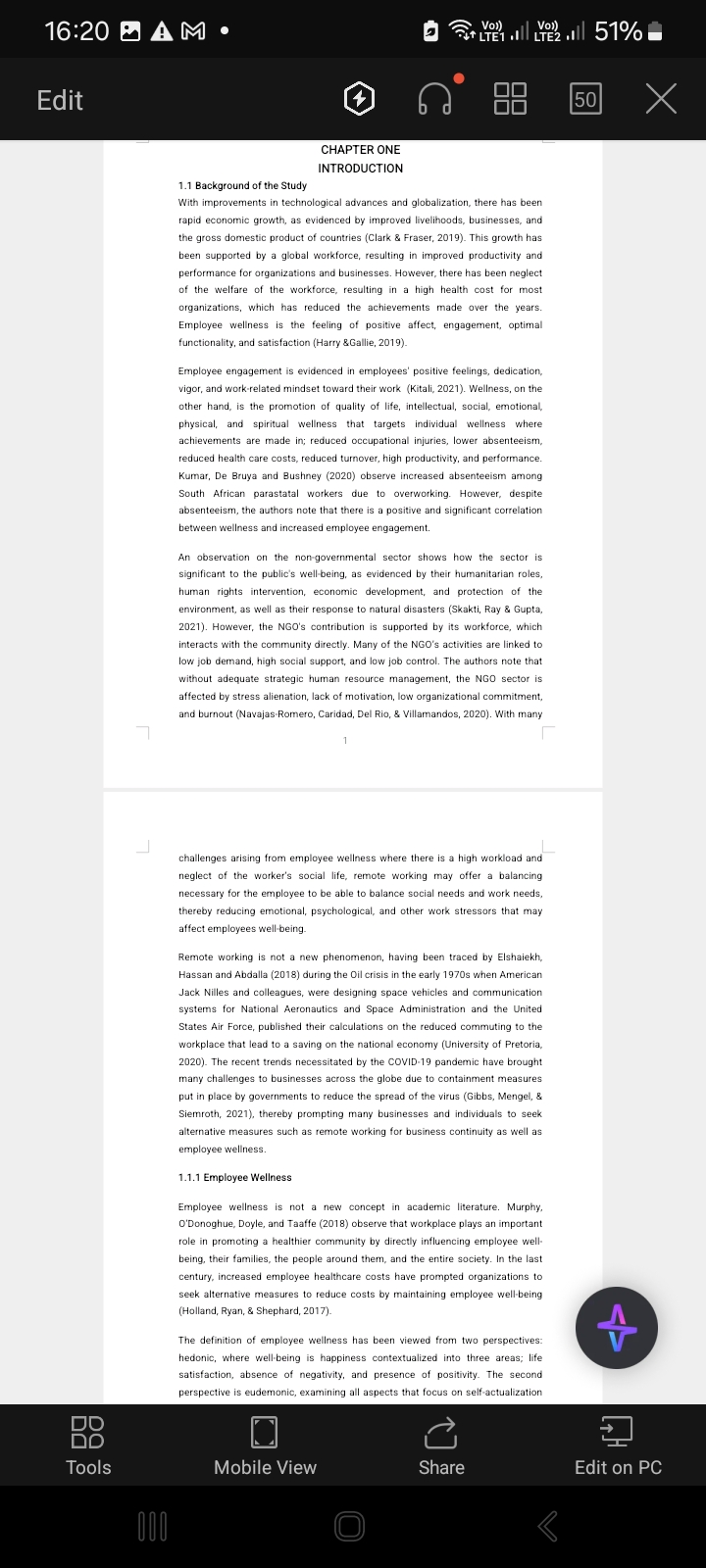
focus has over time been on competitiveness and productivity. Remote working has also been adopted to allow employees work from home. In such arrangement, workforce welfare is neglected and various health problems are reported, causing less employee engagement, morale, and dissatisfaction and suboptimal outputs. Consequently, even the adoption of technology turns out counterproductive in firms. This study sought to determine the effect of remote working on employee wellness by analyzing employees in non-governmental organizations in Nairobi City County, Kenya. The study's specific objectives were to determine the effect of job-related factors, organizational factors, and work-life balance on employee wellness. The study followed a positivist research paradigm and applied a crosssectional descriptive research design to quantitatively describe the relationships between the study variables. From the total population of 80,229 employees in the registered nongovernmental organizations in Kenya, a sample of 398 was targeted. To achieve adequate response rate, the study targeted 7 respondents, which is 1 senior-level, 3 mid-level and 3 junior-level employees from each of the 60 international and national non-governmental organizations based in Nairobi County. Therefore, stratified random sampling was employed for an even representation of the 60 organizations. A convenient sampling technique was applied to choose participants based on availability. A pilot study targeting 40 employees from 6 organizations in Kiambu County was conducted. The firms used for pilot testing were not considered during the actual research. Adequate research quality concerning validity and reliability was achieved through Cronbach’s alpha. Data was analysed through SPSS. Regression analysis results indicated a weak relationship between the independent variables: job-related factors, organizational factors and work-life balance and the employee wellness. Based on coefficients, both Job-related and organizational factors were significant at 0.05 significant level. Similarly, work-life balance had a positive, statistically significant influence on employee wellness. The study concludes that job-related factors, organizational factors, and work-life balance have a weak joint effect on employee wellness. Work-life balance has a positive, statistically significant correlation with employee wellness while job-related and organizational factors have significant influence on employee wellness. Organizations should enhance job-related and organizational factors to enhance employee work-life balance which in turn improves employee wellness. Further research can be implemented to test the mediational role of work-life balance in the relationship between job-related and organizational factors and employee wellness.
Below is the document preview.

FACTORS INFLUENCING LOAN PORTFOLIO PERFORMANCE OF COMMERCIAL BANKS IN KENYA-BUSINESS RESEARCH PROJECT
The banking sector is a key source of funding for most businesses. Improved loans portfolio management leads to high performance in functions and activities of an organization. It has an effect on total economy of the country and activities of all organizations. Commercial banks use various avenues to generate their income. Loans disbursed to customer are among many other avenues that are used to generate revenue. However, not all loans disbursed are serviced by debtors. Defaulted loans are on the increase in most Financial Institutions and this causes the banks not to meet their obligation of wealthy maximization. The study therefore sought to investigate factors influencing Loans Portfolio Performance in Commercial Banks of Kenya. Specific objectives were; to establish influence of Credit Management, to determine the influence of Unsecured Loans, to evaluate the effect of Repayment Characteristics and finally to analyze the influence of Technological advancement on loans Portfolio Performance of Commercial Banks in Kenya. Descriptive research design was used. Data collection was sought from Commercial Banks Headquarters in Nairobi. The study was based on census approach as it focused on all the commercial banks listed on Nairobi Security Exchange (NSE), Kenya. For each commercial bank listed, 5 respondents were sought and this provided 55 respondents. The study employed both secondary and primary data. Instruments used to collect data were questionnaires, financial reports of Central Bank of Kenya website and Kenya Bankers Association journals. The analysis of tabulated data employed descriptive statistics correlation and regression with the use of Statistical Package for Social Science (SPSS). The conclusion from the findings indicates that employing proper Credit Management has affirmative and considerable influence on Loans Portfolio Performance of Commercial Banks in Kenya. Unsecured Loans has a significant and positive impact on Loans Portfolio Performance of Commercial Banks in Kenya. Further it was revealed that employing proper evaluation of Repayment Characteristics has significant and positive influence on Loans Portfolio Performance of Commercial Banks in Kenya and that Technological Advancement has significant and positive influence on Loans Portfolio Performance of Commercial Banks in Kenya. Recommendation of the study is that commercial banks should ensure they adopt sound Polices review, carry out proper client functioning credit management department. Further it is recommended that commercial banks should engage more feasible loan security measures intended to lessen loan delinquency ratios which can subsequently encourage positive customer performance.
1655 Views
0 Downloads
148.01 KB