Assess factors influencing adoption of digital transformation among manufacturing sector firms in Nairobi region- business research project
| Institution | Kisii National Polytechnic |
| Course | Business , hrm |
| Year | 3rd Year |
| Semester | Unknown |
| Posted By | MAKORI KERECHA |
| File Type | docx |
| Pages | |
| File Size | 614.75 KB |
| Views | 2543 |
| Downloads | 0 |
| Price: |
Buy Now
 Buy via
whatsapp Buy via
whatsapp
|


Description
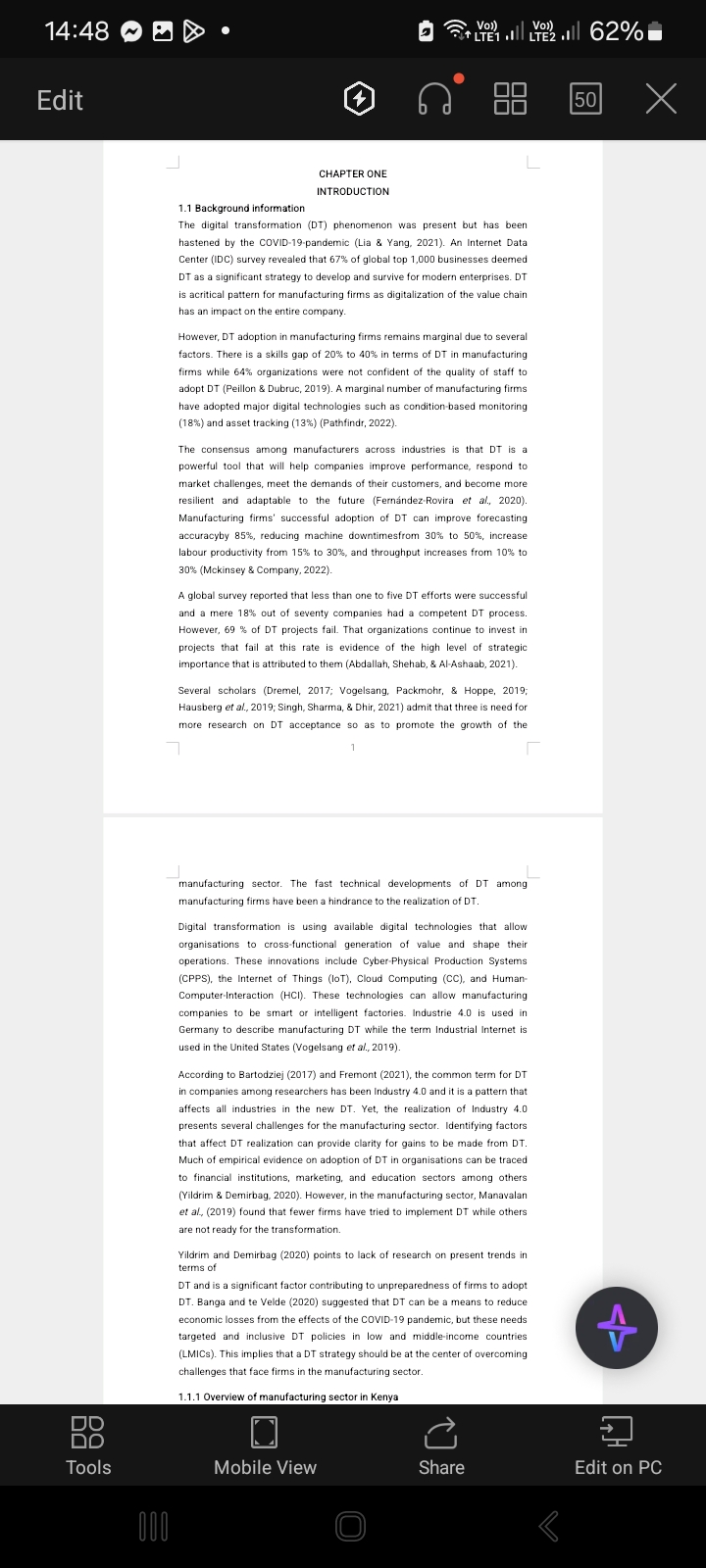
The rapid changes in technological advancement implications are for companies to keep up with the trends and exploit them to their advantage. The manufacturing sector has been signaled as one of the industries that have been slow in its digital transformation. Kenya’s manufacturing sector has not been able to leverage digital transformation to enhance its performance and is behind in meeting its Vision 2030 goals. Therefore, this study assessed the influence of technological, organisational, and environmental factors on DT in Kenya’s manufacturing firms in the Nairobi region. The study was anchored on the technology organisation and environment (TOE) Framework and Diffusion of Innovation (DOI) theory. A positivist research philosophy fits with the study’s objective and is thus adopted. A descriptive correlational design is used as the study aims to describe the association between factors that may influence digital transformation. The target population was 725 firms from which a sample size of 176 was selected as the units of analysis. In each of the 176 firms, a senior manager involved in strategy implementation was purposively and conveniently sampled. The data was gathered using a Likert scale-based questionnaire that waschecked for validity and reliability in a pilot study from which the internal consistency of items was assessed. The output indicated that technology, organisation, and environment factors together explained 47.5 % of the change in DT adoption in manufacturing firms and was significant at the 95 % confidence level. Independently, technological factors had a .577 positive and statistically significant effect on DT adoption. The study therefore concludes that increasing technological factors in manufacturing firms will contribute to an increase in DT adoption while organizational and environmental factors do not have any effects on DT adoption. the study recommends that manufacturing firms focus on using technology that has affords them a relative advantage over the existing technology.
Below is the document preview.

structural design of G4 commercial building - building and Civil engineering project report
Trending!
This project, titled “Structural and Architectural Design of a G+3 Residential Apartment in Kisii Town,
Kisii County,” was undertaken as part of the requirements for obtaining an Diploma at KNP Polytechnic Institute. The project encompasses both architectural conception and structural design, with a strong emphasis on effective communication to all stakeholders. Each section of the project is clearly numbered to facilitate easy navigation, allowing users to quickly access specific areas of interest. The design process was informed by a wide range of references and follows the standards set out in various authoritative documents, particularly the British Standards (BS). The structural analysis began with the calculation of all expected loads, including the building’s self-weight. The architectural design includes detailed plans showing the dimensions and overall shape of the building. The structural design covers critical elements such as beams, slabs, columns, stairs, and foundations, adhering to the guidelines of BS 8110-1:1997. Detailed plans and reinforcement schedules for these elements are also provided. The total cost of the building is estimated at 281,433,500 Ksh. The design criteria are primarily based on British Standards.
3908 Views
0 Downloads
5.36 MB
Car wash booking system project report
Trending!
This project is a web application for car wash management system for car wash service. The demand of car wash service nowadays is increasing as most of the people are too busy to wash car themselves. Car wash center has provided various car wash or car detailing services such as foam wash, waxing, polishing which cause convenient to customers. However, there are some limitations found which customers has to queue up for a long time until their turn. During the peak hour, customers might have to wait for a few hours which actually waste customers’ time.
Car wash management system A case study of kinamba car wash
Next, customers who are not familiar to the area are difficult to get a car wash service. They do not know which is the nearest car wash center from their own location. Another problem faced is the attendance of car wash appointment which people think that booking an appointment is troublesome as they have to go to the car wash center to book appointment or they have to make calls to discuss with staff for available time slot. These issues and limitations need to solved to improve the performance of appointment scheduling service. Hence, the proposed solutions in this application are able to solve the problems by integrating appointment scheduling system in car wash service mobile application. Customers are able to make appointment by using the application. Besides, GPS location tracking is used in order to solve the problem that users wanted to get car wash service at car wash center nearby them. The location of the car wash center is stored in the database and it will be retrieve and display at Google Map when it is nearby user’s current location. In addition, Improved Least Laxity First scheduling algorithm is also used to schedule the appointment on real-time basis. Customers can manage their appointment at anytime and anywhere. These proposed solutions are to improve the performance and customers’ user experience of the application.
3790 Views
0 Downloads
1.02 MB
DESIGN AND IMPLEMENTATION OF A SINGLE INVERTER
Trending!
project report covers the design and implementation of a single-output inverter. It converts a single 12V DC input to a 70V AC output at 7watts using Arduino-controlled MOSFETs. This setup is cost- efficient because one inverter can supply different loads, saving money and space, especially in renewable energy systems. The goal is to develop an inverter that provides multiple AC outputs from one DC source for various uses, including renewable energy and portable power supplies.
The core of the system is an Arduino microcontroller. It generates precise pulse-width modulation (PWM) signals to control the MOSFET switches, ensuring efficient conversion and stable output. The design process involves choosing the right MOSFETs and developing protective circuits to prevent overvoltage, under voltage, and short-circuits.
Experimental results show that the inverter can produce a stable 70V AC output with low harmonic distortion, maintaining performance under different load conditions. The system's efficiency, output quality, and response to changing loads are thoroughly analyzed. This project demonstrates the effective combination of Arduino control with power electronics, providing a high-performance solution for converting DC to AC power.
3909 Views
0 Downloads
696.23 KB
Design and implementation of a smart energy meter system for residential purpose.- electrical telecommunication option
Trending!
The core focus of this project lies in the development of an advanced Smart Energy Meter system, integrating a user-friendly web application and NodeMCU technology. This innovative system empowers users with the accessibility to monitor and manage their electricity consumption efficiently and effectively. Through an intuitive web application, users gain access to real-time data encompassing critical parameters, including voltage, power, power factor, and various essential metrics via a seamlessly designed web interface. One of the ground-breaking features of my system is its ability to simplify the process of loading tokens. Users can effortlessly regulate their energy consumption from their computers or mobile devices using the web interface, eliminating the need for complex, manual procedures. The convergence of a user-friendly web dashboard and Node MCU technology creates an accessible, transparent, and highly efficient solution. With this project, the objective is to revolutionize the way individuals engage with their energy consumption.
By providing accurate, real-time data and an effortless means of control, aim to set new standards in energy management. The Smart Energy Meter system promises enhanced user-friendliness and accessibility, ushering in a future where electricity management is simplified and truly responsive to the needs of the users.
3961 Views
0 Downloads
1.29 MB
Design and implementation of an automatic fan controller- electrical telecommunication option
Trending!
we know that automatic system and automation is the requirement of today’s technology. We are moving toward automation day after day. It is one of the tending topic. So in this project I will provide this function: Arduino Uno senses the temperature and control the speed with the set temperature. This is set by the user. When the current temperature is greater than or equal to the set temperature the fan turned on otherwise it will stay off. For turning on here should be two condition supposed to be true. One is object detection and other one is temperature should be appearing at set temperature. After turning on the fan speed will be change accordingly with temperature. Whenever the temperature will be increase fan speed will be increase. This paper presentation will present the whole working process of the system. There are six portions in this paper. Introduction part has detail introducing of the project, objective of the system, justification to make the project and about the scope of the project. Literature review has some review about the relevant project in our society . Methodology has detail description about the workflow which I used during the time of project completion. i gave here the justification of using the workflow as well. I think about hardware requirement, Software requirement, and block diagram, description of the component used in the project and about the flow chart. And described why this project will matter to the user. I also think that how much effective of my project in practical life. In the conclusion I will give some statement about the limitations and the scope of future enhancement of the project.
3924 Views
0 Downloads
450.07 KB
DESIGN AND IMPLEMENTATION OF THE SIMULATION SYSTEM- ELECTRICAL TELECOMMUNICATION OPTION
Trending!
Technology has emphatically expanded proficiency across various sector. We can now do more tasks quicker than expected since the gig is presently faster and more exact. Also, it’s plays a pivotal role in enabling effective energy management. Effectively, a prerequisite for optimizing energy efficiency is monitoring the energy consumption. In this project, our main objective is to facilitate the consumer to efficiently use the power source from the power grid in order to have an electricity bill that corresponds to its consumption. The system use a microcontroller-based architecture, using the ESP8266 NodeMCU for real-time data processing and communication. The power consumption is measured using the PZEM-004T sensor, which accurately tracks voltage, current, power, and energy usage in an AC circuit. The system is designed to automate the detection of excessive power utilization and to provide alerts when power consumption exceeds predefined limits (30W). The core of the system includes three relays that control the activation and deactivation of connected three electrical loads, based on the real-time power consumption data. The relays automatically switch off one load when excessive consumption (over 30W) is detected, thus improving energy efficiency and reducing the risk of overloading the circuit. The system also integrates a magnetic sensor to detect the state of power supply and manage the switching processes accordingly. Furthermore, a buzzer is incorporated to signal abnormal conditions, especially when the power consumption exceed 30W. Here we can see the real-time reading on the LCD (16×2) attached with our hardware and on the phone precisely on the Blynk application which represent the IOT tools we used. Furthermore, this application allow us to switch off and on loads through the phone. By providing real-time feedback on energy usage, the system helps users optimize power consumption and reduce energy costs. The simulation, conducted using proteus software, demonstrates the feasibility and effectiveness of the system in managing loads automatically, ensuring safety, and improving energy efficiency.
4205 Views
0 Downloads
416.71 KB
DESIGN AND IMPLEMENTATION OF VARIABLE DC
Trending!
The design and implementation of a variable DC power supply address the need for a versatile and adjustable power source suitable for a wide range of electronic applications. This project aims to create a reliable and efficient power supply that can provide a stable DC output voltage and current, which can be varied according to the specific requirements of different devices or circuits. The design process involves selecting appropriate components, including voltage regulators, transformers, and control circuits, to ensure accurate and stable output. Key considerations include achieving a high degree of voltage and current regulation, minimizing ripple and noise, and providing adequate safety features. The implementation phase involves the construction of the power supply unit, incorporating both hardware and software elements for precise control and monitoring. The resulting variable DC power supply will offer flexibility and precision, making it an invaluable tool for experimentation, testing, and development in various electronic and electrical engineering applications.
4062 Views
0 Downloads
174.73 KB
Design and implementation of wireless power transfer system - electrical telecommunication option
Trending!
Wireless power transfer system is define as the process of transmitting electricity without using wires. The purpose of this study is to minimize the use of wires when transmitting electricity in the environment. This research aim to identify key factors that influence productivity and provide actionable insights of the importance of wireless power transmission. The significance of this study lies in it’s potential to guide researchers and electrical engineers in developing more efficient and versatile power transfer systems, enhancing the convenience and accessibility of power delivery for various applications.
To achieve these objectives, a mixed-methods was used, involving the design and testing of wireless power transfer prototypes. Key performance metrics such as efficiency, range, and the distance over which power could be effectively transmitted. The findings of the study revealed that the wireless power transfer system successfully transmitted power over short distance. Efficiency decreased as the distance between the transmitter and receiver coils increased.
3776 Views
0 Downloads
229.92 KB
Design of reinforced concrete water storage tank- building and Civil engineering project
Trending!
The final year project titled “Design of Reinforced Concrete Water Storage Tank” addresses the pressing water shortage issue in Nyasiongo Ward, Nyasiongo Sub-County. This region currently suffers from inadequate and poorly maintained water storage facilities, which result in long travel distances and elevated costs for water procurement. The existing tanks are undersized and often exhibit unpleasant odors, underscoring the urgent need for a more effective solution.
This project aims to identify the requirements for a new water storage tank, define the necessary capacity for the system, conduct an economic analysis of the proposed tank, and design a reinforced concrete water storage structure to replace or supplement the outdated tanks in Nyasiongo Ward.
The research methodology involved engaging with local residents and experts in reinforced concrete water storage design through interviews, as well as conducting site visits by engineering students to collect data and assess current conditions.
Analysis of surveys and data revealed a critical need for a new reinforced concrete water storage tank in Nyasiongo Ward. Currently, residents must travel 1-2 km and spend approximately two hours to collect water, incurring a cost of 70 RWF for just 20 liters. The study determined that a tank with a capacity of 2009m³ is essential to meet the daily water demands of the ward's population, which totals 50,661 people.
The project successfully met its objectives by assessing the requirements, specifying the necessary capacity, performing an economic evaluation, and designing the water storage tank. The proposed reinforced concrete structure has the potential to significantly alleviate the water shortage issue in Nyasiongo Ward, enhancing access to clean water while reducing both travel time and associated costs for residents.
It is recommended that the design for the 2009m³ reinforced concrete water storage tank be implemented to ensure a reliable water supply and improve the overall quality of life for the residents of Nyasiongo Ward.
3620 Views
0 Downloads
1.44 MB
Structural and architectural design of a sustainable apartment complex - building and Civil engineering
Trending!
final year project presents an integrated design for a sustainable apartment complex in KNP Nyasiongo, aiming to harmonize architectural aesthetics with structural integrity. The primary objective was to develop a robust framework that accommodates the specific needs of the community while adhering to principles of sustainability and environmental responsibility. The project involved a thorough site analysis and the formulation of design specifications based on key objectives, which included enhancing safety, optimizing resource use, and minimizing environmental impact. Detailed methodologies were applied, encompassing soil testing, load calculations, and compliance with relevant building regulations.
Chapter Four delves into the results and discussions of the structural design, focusing on the analysis of reinforced concrete (RC) members, including beams, columns, slabs, and walls. The design process employed various methodologies, such as manual calculations and software tools, to ascertain the structural viability and safety of the building.
The findings highlight the importance of incorporating sustainable practices into modern construction, illustrating how strategic material selection and innovative design solutions can lead to an efficient and durable structure. Ultimately, the project demonstrates a comprehensive approach to contemporary apartment complex design, serving as a model for future developments that prioritize safety, efficiency, and ecological balance.
3796 Views
0 Downloads
6.68 MB