Car wash booking system project report
| Institution | Kisii National Polytechnic |
| Course | ICT/COMPUTER SCIENCE |
| Year | 3rd Year |
| Semester | Unknown |
| Posted By | MAKORI KERECHA |
| File Type | docx |
| Pages | |
| File Size | 1.02 MB |
| Views | 3813 |
| Downloads | 0 |
| Price: |
Buy Now
 Buy via
whatsapp Buy via
whatsapp
|


Description
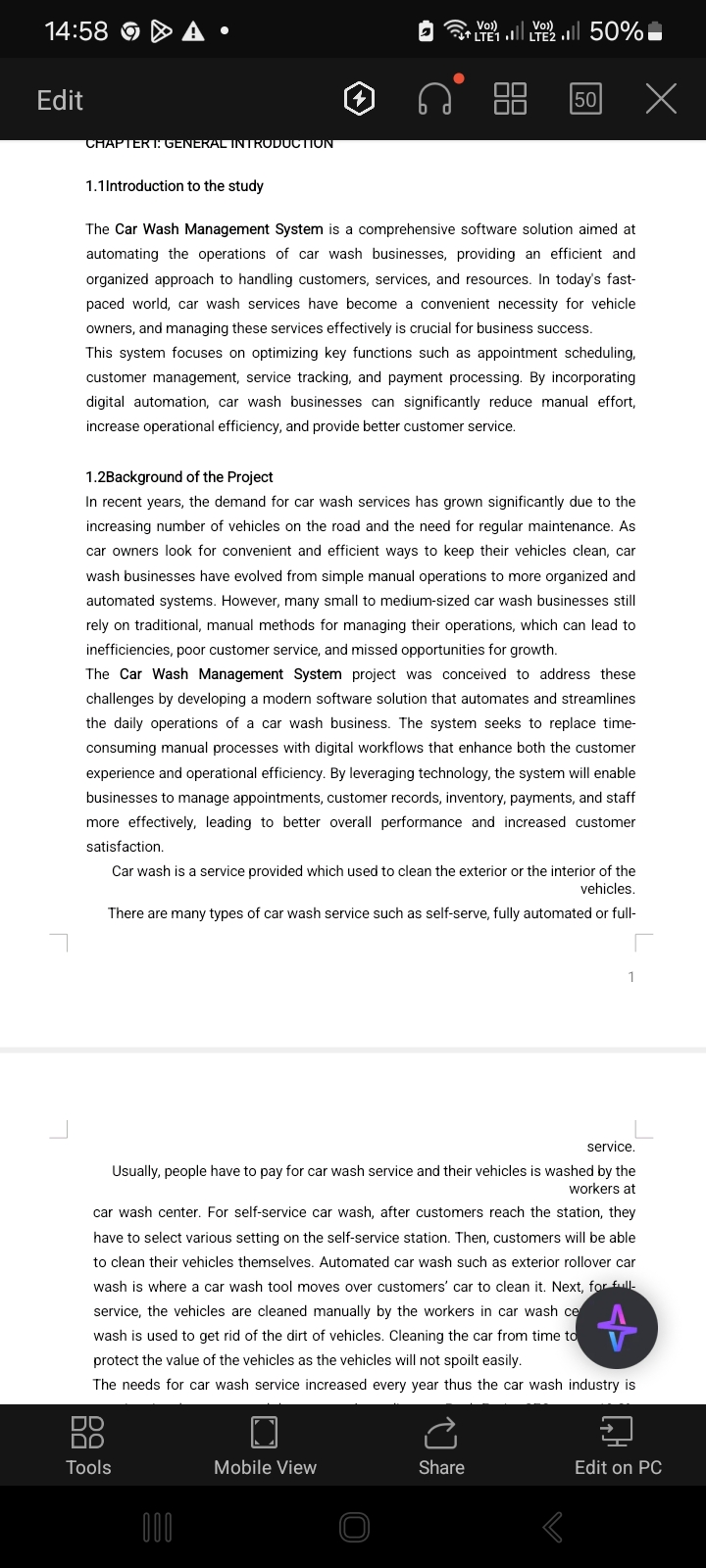
This project is a web application for car wash management system for car wash service. The demand of car wash service nowadays is increasing as most of the people are too busy to wash car themselves. Car wash center has provided various car wash or car detailing services such as foam wash, waxing, polishing which cause convenient to customers. However, there are some limitations found which customers has to queue up for a long time until their turn. During the peak hour, customers might have to wait for a few hours which actually waste customers’ time.
Car wash management system A case study of kinamba car wash
Next, customers who are not familiar to the area are difficult to get a car wash service. They do not know which is the nearest car wash center from their own location. Another problem faced is the attendance of car wash appointment which people think that booking an appointment is troublesome as they have to go to the car wash center to book appointment or they have to make calls to discuss with staff for available time slot. These issues and limitations need to solved to improve the performance of appointment scheduling service. Hence, the proposed solutions in this application are able to solve the problems by integrating appointment scheduling system in car wash service mobile application. Customers are able to make appointment by using the application. Besides, GPS location tracking is used in order to solve the problem that users wanted to get car wash service at car wash center nearby them. The location of the car wash center is stored in the database and it will be retrieve and display at Google Map when it is nearby user’s current location. In addition, Improved Least Laxity First scheduling algorithm is also used to schedule the appointment on real-time basis. Customers can manage their appointment at anytime and anywhere. These proposed solutions are to improve the performance and customers’ user experience of the application.
Below is the document preview.

Design and implementation of an automatic plant moisture project report- electrical telecommunication option
Trending!
An original way to automate plant disease control and irrigation is the Automatic Plant Moisture Monitoring System. This system monitors and controls the moisture content of the soil using an LCD display, relays, moisture sensors, and an Arduino microcontroller. A water pump is activated to irrigate the plants automatically when the water content falls below a certain threshold, which is monitored by moisture sensors placed in the soil. There is less chance of overwatering or under-watering because to this real-time response that makes sure the plants get the right amount of water. By streamlining irrigation management, the technology relieves users of the requirement for ongoing manual monitoring. The system has a second pump that is especially made to guard against fungal infections in addition to irrigation. The purpose of this pump is to spray the plants with an antifungal solution on a periodical basis. This characteristic keeps the plants healthy and disease-free by preventing fungal infections, which are common in humid areas. Without continual human intervention, the monthly spraying helps to maintain a preventive approach to plant health. Users can track the moisture content of the soil in real time by viewing the data from the moisture sensors on an LCD screen. Users may remain informed about plant conditions and system operation thanks to this easy-to-read display. This technology offers farmers and gardeners an effective, user-friendly way to prevent fungal diseases and automate irrigation. It is a useful tool for contemporary agricultural methods because it conserves time, water, and fosters stronger plants.
3188 Views
0 Downloads
811.27 KB
Design and implementation of an automatic plant watering system project report- electrical telecommunication option
Trending!
The growing needs of man and the increasing population of earth causes the scarcity of water. This greatly affects the plants, and the requirement water management is high. Water use has been growing globally at more than twice the rate of population increases in the last century, and an increasing number of regions are reaching the limit at which water services can be sustainably delivered, especially in arid regions. In the present scenario the conventional methods of watering, like flood mode and sprinkler, is not that much effective and is responsible for water wastage. Improper watering systems create breeding areas for disease spreading organisms. Hence, the way watering pants must be smart, and this is achieved by watering plants depending on the necessity of plants and the moisture level of water. This project deals with an automated plant watering system that senses the moisture content of the soil thus determining the necessity of pumping water with the collected data. Also determines the minimum amount of water required to maintain the balance between the soil defensible water and environment parameters.
3492 Views
0 Downloads
427.64 KB
Design and implementation of an energy efficient system project report -electrical telecommunication option
Trending!
The project entitled “Design and Implementation of an Energy-Efficient System for Disabled Individuals’ Homes” aims to develop a comprehensive solution that improves energy efficiency and accessibility of residential environments for people with disabilities. The system integrates smart home technologies with assistive devices, a CD4017 microcontroller, automated controls, and energy management algorithms to optimize energy consumption while maintaining home comfort and safety for the user. Key features include adaptive lighting, temperature control, and automated device management, all tailored to residents’ specific needs and preferences. The implementation involves both hardware and software components, ensuring seamless interaction between the user and the system through intuitive interfaces. The result is expected to demonstrate significant energy savings, improved quality of life for people with disabilities, and a scalable model for wider application.
3751 Views
0 Downloads
547.57 KB
Design and implementation of automatic railway gate control system project report- electrical telecommunication option
Trending!
The "Design and Implementation of an Automatic Railway Gate Control System" focuses on developing a safety system for managing railway level crossings to prevent accidents between cars and trains. In many regions, unguarded railway crossings pose a significant risk, leading to accidents when vehicles attempt to cross the tracks as a train approaches. This study addresses this challenge by designing a prototype system using Arduino Uno, servo motors, obstacle sensors, LCD screens, and a buzzer to automatically control the gates at railway crossings.
The primary objective of this project is to enhance safety by automatically closing the gate when a train is detected, ensuring that vehicles are kept off the tracks during the train's passage. Two obstacle sensors are employed to detect trains approaching from the north and south, triggering the closure of the gates through servo motors. LCD screens display train detection information, and a buzzer sounds an alert when the train is nearby. This prototype serves as a demonstration of how such technology can be implemented to improve safety at real-world railway crossings.
The significance of the study lies in its potential to reduce the number of accidents and fatalities at railway crossings, particularly in areas where manual gate control is impractical or unavailable. By automating the process, the system ensures timely gate closures, minimizing human error and reaction delays.
The methodology used in the study involved software-based development and testing of the system components. Arduino programming was employed to control the sensors, motors, and displays, simulating the real-time operation of the system. No questionnaires were used, as the project focused on technical implementation.
The findings indicate that the automatic gate control system successfully closes the gates when a train is detected, provides real-time alerts via the LCD screens, and triggers the buzzer to warn approaching vehicles. This system, though a prototype, demonstrates the feasibility of using automated systems for railway gate management.
In conclusion, the project demonstrates the potential for implementing automatic railway gate control systems to improve safety at crossings. With further development, such systems can be applied in real-world scenarios, helping to prevent accidents and save lives.
4324 Views
0 Downloads
837.19 KB
Design and implement automatic changeover switch project report- electrical telecommunication option
Trending!
This project develops an automatic changeover switch utilizing a contactor and a multifunction timer relay to ensure an uninterrupted power supply. The design facilitates seamless switching between multiple power sources, enhancing reliability and efficiency. Detailed implementation steps and testing results are provided, demonstrating the system's effectiveness in maintaining power continuity.
3235 Views
0 Downloads
889.51 KB
Design and implementation of dual-axis solar tracker project report- electrical telecommunication option
Trending!
This research aims at determining the effectiveness of tracking system, which has two axes in enhancing the solar energy collection in the part of Kisii . As the world becomes conscious of pollution and the usage of fossil fuels becomes deemed unsustainable, there is hope in other forms of energy such as solar energy. However, the effectiveness of solar panel depends on the fact of their capacity to follow the movement of the sun during the day. For the sake of improvement of the orientation of the solar panels, this research links a dual axis tracking technique to it. A number of simulations and empirical data collecting are provided to estimate the effectiveness of dual-axis tracking system in comparison with the fixed-mount solar panels. This study shows that great advances were made in terms of energy production and efficiency where the tracking system has been installed especially during the times of low sun position and in the fluctuations of season. In addition, economic and environmental consequences are analyzed and current economic opportunities and potential impacts of this technology on energy security and carbon neutrality goals of Kisii are also described. To policymakers, energy planners as well as investors who intend to support renewable energy systems in Kisii and other regions with high solar irradiation, this study holds a lot of potentials.
3282 Views
0 Downloads
987.92 KB
DESIGN AND IMPLEMENTATION OF INDUSTRIAL POWER CONTROL BY INTEGRAL CYCLE SWITCHING WITHOUT GENERATING HARMONIC PROJECT REPORT- ELECTRICAL TELECOMMUNICATION OPTION
Trending!
The project is aimed at achieving integral cycle switching, a process of removing portions of cycles of an AC signal. The controlling of AC power is very important. Generally phase angle control is used for controlling AC power but due to that a sustainable amount of harmonics are generated in the system. This is found in linear loads for example heaters used in furnaces. This technique introduces lesser amount of harmonics. However the concept of achieving the integral cycle control by use of microcontroller can be very accurate as per the program written in assembly / C language so that the actual average voltage or current obtained at the load is comparatively lower than the whole signal if applied to the load. In place of a linear load to be used in the output, a series motor, fan or lamp can be used to verify the output. The disadvantage of using this scheme is unstable input current or voltage waveform as the cycles are switched on and off. In this technique we are using comparator for zero crossing detection which is fed as an interrupt to Atmega 328p microcontroller. Here the microcontroller delivers the output based on the interrupt given as input as the reference for generating triggering pulses. Using these pulses, we drive the opto-isolators for triggering the TRIAC to achieve integral cycle control as per the input switches interfaced to the microcontroller. A lamp or a fan is provided in this project in place of a motor for demonstration purpose. This project can be improved in feature by using a feedback mechanism so that everything becomes automatic to maintain the required output to the load.
3245 Views
0 Downloads
720.56 KB
Design and implementation of lightning protection system project report- electrical telecommunication option
Trending!
Lightning is a natural atmospheric phenomenon that occurs during thunderstorms, resulting from the discharge of electricity between clouds or between a cloud and the ground. It can produce immense energy, generating voltages of up to 100 million volts, which can cause catastrophic damage to structures, electrical systems, and pose severe risks to human safety. In regions like Rwanda, where thunderstorms are established, the potential for lightning strikes is a pressing concern for educational, particularly those with growing infrastructures such as Kigali Independent University (KNP). The increasing frequency of these storms underscores the need for effective lightning protection systems (LPS) to safeguard both facilities and occupants. Many buildings at KNP lacked suitable protection against lightning, which led to disruptions in electrical systems, damage to equipment, and potential hazards for students and staff. To address these challenges, a comprehensive design and implementation plan for a lightning protection system was developed. This solution involved installing air terminals on significant structures to intercept lightning strikes, connecting them to down conductors that safely direct lightning energy into a well-designed grounding system. Surge protection devices (SPDs) were also integrated to protect sensitive electronic equipment within classrooms and administrative offices. The implementation process included thorough risk assessments to identify vulnerable areas, strategically positioning air terminals throughout the campus, and ensuring that all terminals were connected to down conductors for low-resistance grounding. Regular maintenance and inspections were planned to guarantee the system's ongoing functionality. The successful implementation of the lightning protection system at KNP has resulted in substantial benefits for the university community, enhancing safety and reducing the risk of lightning-related incidents, while also raising awareness about the importance of lightning safety and disaster preparedness in educational settings. This initiative serves as a valuable model for other schools and universities and beyond.
3267 Views
0 Downloads
295.42 KB
Design and implementation of phase fault detector in distribution three phase power system based on embedded system project report- electrical telecommunication option
Trending!
In modern society, we cannot imagine the life without electricity. Most of the equipment requires a continuous supply of electricity. Not only industry, but also in the household. Power failure may be caused by several of factors such as overload on the power plant, a thunderstorm, and cable breakage during excavations. There are many sections to the Electric Power System Power, is transmitted from generating stations and substations to consumers via distribution system line lines, one of which is the distribution system line system.
It is possible for both methods to encounter various types of malfunctions, also known as faults. When the insulation of a power system fails at any point, a number of undesirable but unavoidable incidents are able to temporarily disrupt the stable operation of the power system.
A smart GSM-based fault detection system accurately and appropriately detects and locates the fault; As a result technical crews will respond more quickly to rectify these faults, reducing the chances of transformer damage and disasters. A voltage transformer and a GSM modem are used in the system.
The fault information is then transmitted to the control room. We have R, Y, and B as three phases, when there is a failure in one among the three phases this system alerts the authorized person through an SMS, This system indicates the power failure by displaying the value of voltage on the LCD display.
This type of loss is referred as a ‘single phasing’ and it is caused by a lightning strike, broken power line, or mechanical failure in switching equipment. This advanced system monitors the failure,In conclusion, the time required to locate a fault is greatly reduced, since the system automatically and accurately provides fault information. With this project, it is possible to detect the faults of three phase distribution system line lines, as well as monitor voltage current and frequency error by using a GSM modem. When one among the three-phases of a system gets lost, it may cause a phase loss.
Then this system alerts the authorized person by informing about the disconnected phase through an SMS. This is the way by which the authorized person gets notified about the power failure and he can take the necessary steps to solve the issue.
3424 Views
0 Downloads
371.89 KB
DESIGN AND IMPLEMENTATION OF SMART DIGITAL THERMOMETER PROJECT REPORT- ELECTRICAL TELECOMMUNICATION OPTION
Trending!
This project entitled “Design and Implementation of a Smart Digital Thermometer System” aims to explore the effectiveness and benefits of using smart digital thermometers to maintain safety standards. The main objective is to evaluate how a smart digital thermometer can help prevent dangerous temperature through an email alert. This project aims to address these challenges by creating a smart thermometer with wireless connectivity for remote monitoring, making it suitable for use in environmental safety.
The methodology employed in this research involves a mixed-methods approach, combining a review of existing literature on smart digital thermometer security technologies in various environments.
The study results revealed that smart digital thermometers provide more accurate and reliable temperature measurements, are easy to use, and can be integrated into broader preventive safety management systems. Additionally, their ability to provide real-time alerts via mobile apps or connected systems has been shown to significantly improve response times during critical temperature fluctuations.
Based on these findings, it is recommended that general industry, especially small businesses and households, adopt smart digital thermometers as part of their standard preventive security protocols. Further research should focus on the cost-benefit analysis of widespread implementation and potential integration with other preventive security technologies.
3297 Views
0 Downloads
940.98 KB