Pharmacy sales and inventory system project report
| Institution | Kisii National Polytechnic |
| Course | ICT/COMPUTER SCIENCE |
| Year | 3rd Year |
| Semester | Unknown |
| Posted By | MAKORI KERECHA |
| File Type | docx |
| Pages | |
| File Size | 2.71 MB |
| Views | 3761 |
| Downloads | 0 |
| Price: |
Buy Now
 Buy via
whatsapp Buy via
whatsapp
|


Description
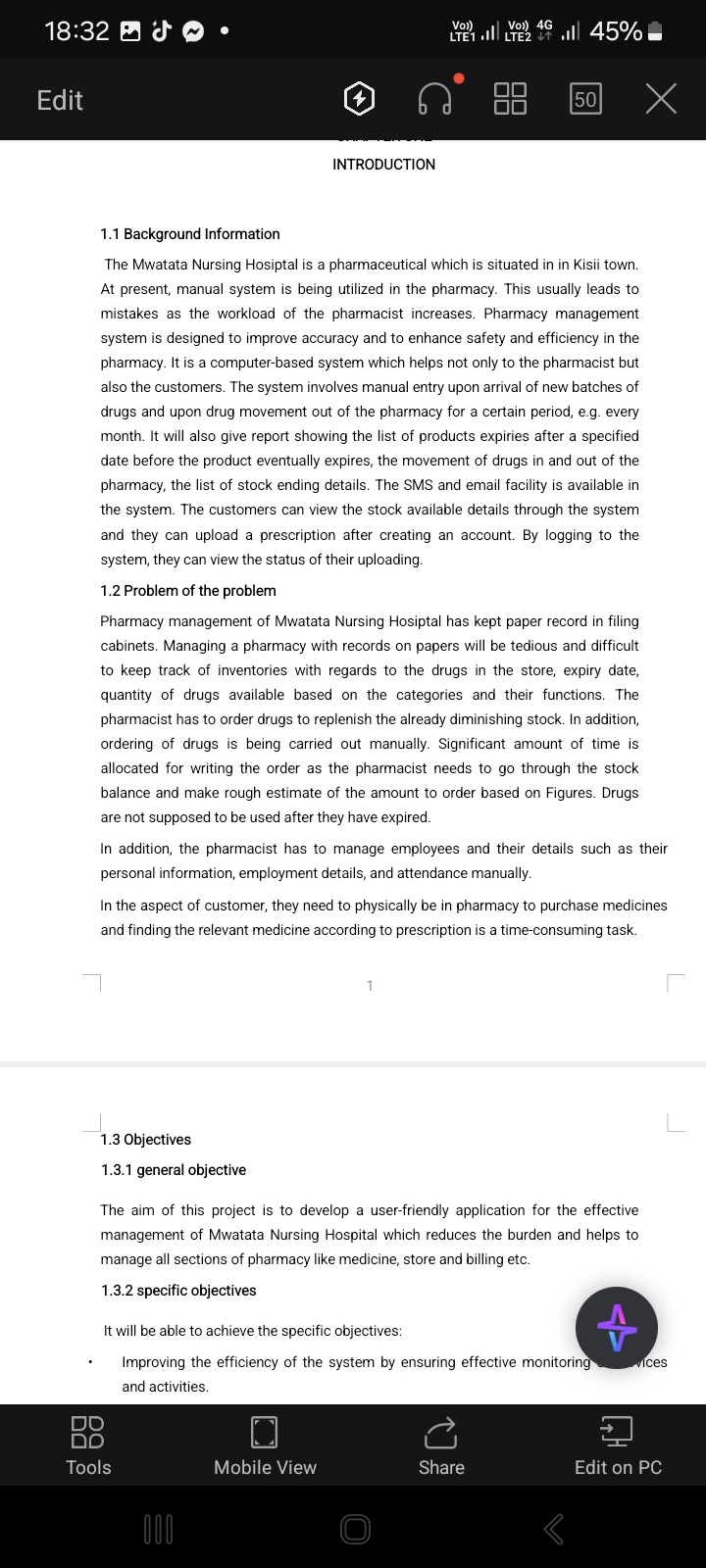
This project illustrates the designing and implementation of a web based Pharmacy Sales and Inventory system for the. The primary aim of is to improve accuracy and enhance safety and efficiency in the pharmaceutical store by minimizing issues occur in day to day operations.
Currently they are using a manual system which is very hard in handling. Managing the stock with paper records based on the expiry dates and the quantity available in the stock are some major problems identified in the problem domain. The system intends to minimize the workload of the staff and increase the value of the business to gain the competitive advantages in the pharmaceutical industry.
The system allows different tasks for different users. They are administrator who can logging the system as different user roles to perform their functions separately. Administrator has all privileges of the system. Create users, generate reports for managerial decisions, manage employee attendance are some administrator tasks. In addition, the system will show a notification about expiry dates of drugs and stock ending details. It is easy to handle stock management through the software rather than working with paper records.
Customers are the main asset of the business. So, the system will help to reduce waiting time of the customers. They can check the availability of the items before they come to the pharmacy by using the search facility provided in the pharmacy web site.
Below is the document preview.

The Effect of Training and Development on Employee’s Performance at Bank of Abyssinia- hrm research project
Trending!
Nothing gets done in an organization without workers, including the most valuable assets such as machines, supplies, and cash. Because of the dynamic nature of humans, it is critical that employees receive continual training and development in order to compete in today's marketplace. Employee performance is the most important factor in improving an organization's overall performance. This study will look at how training and development affect employee performance, specifically at the Bank of Abyssinia. As a result, the research design was a descriptive and correlational study. To achieve the purpose of this study, 100 questionnaires were issued, and 92 of them were successfully gathered and analyzed using descriptive statistical analysis (mean and standard deviation), correlation, and regression analysis using SPSS 26. Version. Both primary and secondary source of data were used for this Study. The method of data collection was questionnaire in the form of both open ended and closed ended questions. Through the selection of four branches (one from each), as well as district and head office staffs, this study was carried out throughout all four grade branches of BOA, ranging from Grade 1-3 and the corporate branch. according to the fact that branches with the same grade are uniform in every respect according to the standards of the bank, and because they all have the same organizational structure, behavior, and culture, as well as the same working environment, branches will be chosen at random. Finally, after the study, the researcher found that the training design and employee performance were positively correlated and had strong correlation between them. Then, the recommendations were based on the findings which affects employees’ performance in the case of Bank of Abyssinia.
2561 Views
0 Downloads
199.87 KB
the factors affecting professional employee intention and turnover in the American international corporation (AIC), Kisii Town, Kenya- hrm research project
Trending!
The purpose of this dissertation is to analyse the factors affecting professional employee intention and turnover in the American international corporation (AIC), Kisii Town, Kenya. The research design is explanatory in nature, and both qualitative and quantitative data were collected via interview and questionnaire, respectively. Questionnaires were used to gather quantitative data from professional employees, while qualitative data were gathered via interview (with senior Administration and HR staff) and review of secondary sources. Out of the 75 questionnaire distributed 72 responses were received and then transferred to excel sheet and then proceed through SPSS 20 Statistical tool. Qualitative data gathered through interview and secondary sources were analyzed via the systematic analysis, while quantitative data gathered via questionnaire were analyzed via correlation and regression analyses. The major factors affecting the employee’s intention turnover in AIC organization fall into three groups, namely personal, pull and push factors. According to this study pull factor was the significant factor which influence employee's to leave the organisation. Employee intention is one of the major challenges faced by the AIC organization due to which the turnover rate of employee increases. The researcher also examined the turnover intention of professional employees with regard to gender, age and length of service. Based on the research findings, participants gave a mixed response for staying and leaving the organisation. However, from their response it is clear that, as part of the retention strategy, they want the AIC organization to improve salary, transparent and fair management system, work and life balance and offering family package like children's education as part of the benefit. This research can be considered by the employers, management and Human resource staff of AIC organisation to improve their internal working environment and take some experience from other similar organisation to reduce employee turnover.
2871 Views
0 Downloads
221.1 KB
assessing Credit risk management of Nib international Bank S.C
Trending!
This study is about assessing Credit risk management of Nib international Bank S.C to achieve the intended objective of the study, Descriptive research was employed. Purposive sampling techniques were used to focus on limited number of informants who have deep insight about the issue. Accordingly, the size of the sample ware 143 which include all city Branch Managers and loan officers, credit analysts, Follow-up officer Customer Relationship Manager and Controllers of the bank. Questionnaires and interview were used as a primary data gathering instrument while annual reports and information from book of account were used as an instrument to gather secondary data relevant for the study. Descriptive statistics was used to analyze the data. Accordingly, the research found out that, credit risk policy and strategy of the bank is not renewed timely, the bank has no procedure to detect borrows associated with crime, internal risk rating system is not utilized to total portfolio and value and existence of collateral is not checked periodically Based on the findings the research suggest that, the bank should review its credit risk management strategy and policy periodically, develop policy enable to identify borrowers associated with crime and adjust its Management Information system in a manner it provide adequate information for decision makers.
4356 Views
0 Downloads
120.01 KB
Assess factors influencing adoption of digital transformation among manufacturing sector firms in Nairobi region- business research project
Trending!
The rapid changes in technological advancement implications are for companies to keep up with the trends and exploit them to their advantage. The manufacturing sector has been signaled as one of the industries that have been slow in its digital transformation. Kenya’s manufacturing sector has not been able to leverage digital transformation to enhance its performance and is behind in meeting its Vision 2030 goals. Therefore, this study assessed the influence of technological, organisational, and environmental factors on DT in Kenya’s manufacturing firms in the Nairobi region. The study was anchored on the technology organisation and environment (TOE) Framework and Diffusion of Innovation (DOI) theory. A positivist research philosophy fits with the study’s objective and is thus adopted. A descriptive correlational design is used as the study aims to describe the association between factors that may influence digital transformation. The target population was 725 firms from which a sample size of 176 was selected as the units of analysis. In each of the 176 firms, a senior manager involved in strategy implementation was purposively and conveniently sampled. The data was gathered using a Likert scale-based questionnaire that waschecked for validity and reliability in a pilot study from which the internal consistency of items was assessed. The output indicated that technology, organisation, and environment factors together explained 47.5 % of the change in DT adoption in manufacturing firms and was significant at the 95 % confidence level. Independently, technological factors had a .577 positive and statistically significant effect on DT adoption. The study therefore concludes that increasing technological factors in manufacturing firms will contribute to an increase in DT adoption while organizational and environmental factors do not have any effects on DT adoption. the study recommends that manufacturing firms focus on using technology that has affords them a relative advantage over the existing technology.
2558 Views
0 Downloads
614.75 KB
Assessing service quality and Customer Satisfaction (A case of Co-operative Bank of Kenya- business research project
Trending!
COOP is struggling to improve and keep its service quality towards increase customers positive perceptions by providing and implementing like modern banking systems (core banking system, e-banking, mobile banking, and internet banking), technological instruments (ATM, POS) and other many banking services tools. However, there are some problems and difficulties observed on its service quality, handling of customers compliant, reliability, responsiveness and other services to apply effectively and efficiently as expected. (Co-operative bank of Kenya reviewed 2015/16 first quarter performance). In this regard, a research should be carried out on the service quality of COOP to fill the gap and give possible recommendation to make the customers more satisfied and the service delivery quality better.
In light of the above discussion, it is deemed essential for COOP to be fully aware of its customer satisfaction in relation with the service offered to them. If COOP does not asses the magnitude of its customer actual perceptions of the service and make appropriate measure the result may have a direct impact on customer defection. COOP in the banking industry of the country should pay more attention for service quality to meet their customer’s expectation.
2782 Views
0 Downloads
188.48 KB
ASSESSING THE BARRIERS TO EFFECTIVE STRATEGIC LEADERSHIP ON CORPORATE STRATEGY IMPLEMENTATION IN KENYAN- BUSINESS RESEARCH PROJECT
Trending!
This research aimed to examine the barriers emerging from organisational structure, communication strategies and management commitment to corporate strategy implementation. The independent variables within the framework were organisational structure, communication strategies and management commitment, and the dependent variable was corporate strategy implementation. The research used a case study design with a quantitative approach. A nonprobability sampling technique with a total population sampling procedure was used guided by the three specific objectives (i) To assess the influence of organisational structure on strategic leadership in managing corporate strategy implementation (ii) To determine the influence of communication strategies on strategic leadership in managing corporate strategy implementation at Safina Media Group and (iii) To identify the contributing factors to management commitment in facilitating corporate strategy implementation at Safina Media Group. The main data collection instrument was a questionnaire distributed to 55 workers in total, and all 55 usable responses were received and analysed through SPSS 25. The objectives of the study were achieved through descriptive analysis. The analysis revealed that the highest rated barriers to effective strategic leadership are the information management system, poor communication, innovativeness and technology (M = 2.31, DS = 0.99 and M = 3.3304, SD = 1.27 and M = 2.26, SD = 1.04 and 2.28, SD = 1.99) respectively. This could be interpreted that a poor information management system, poor communication, poor innovativeness and low technology form barriers to effective strategic leadership in corporate strategy implementation at Safina Media Group. The findings and conclusion give recommendations that Management needs to understand the importance of managing information, communication, and technological innovations in a long-term perspective. Staff should be given information to carry out their human resource activities as well as make individual holders of management positions aware of the consequences of weak relationships with any employee on corporate strategic implementation. Last but not least, this similar study should be carried out with other entities of similar characteristics for comparison of the findings obtained and the validity of outcomes.
3387 Views
0 Downloads
250.7 KB
challenges of obstetric fistula with the aim of assessing the lived experiences, challenges and solutions of women survived from obstetric fistula - social work and community health research project
Trending!
This research paper explores challenges of obstetric fistula with the aim of assessing the lived experiences, challenges and solutions of women survived from obstetric fistula at Hamelin Hospital. The study was undertaken utilizing an in-depth interview and eight participants were purposely selected and 5 participants were interviewed as data saturation reached on the 5th participant. Methodologically the research study is used Qualitative research method and case study. In-depth interview used as a main tool to capture qualitative data. Open-code categorization and content analysis is used for analyzing data. The key findings of the research indicate that first; the participant’s sexuality and sexual experiences before marriage in that they denied having any intimate relationship or sexual interaction before marriage and stated that their parents or caretakers forced into marriage without their consent at early age. Second; Life, challenges and cope-up mechanism after developing fistula they faced many challenges medical and psychosocial. Their coping mechanisms was staying at home and isolating self. Third, perspectives about the future life and how do they shape it they were optimistic about their future after their repair. Fourth, predictions on fistula treatment and rehabilitation services participants were very satisfied by the treatment and very happy about the rehabilitation program. The interventions designed and implemented to understand effects of obstetric fistula and what impact it has in their psychosocial and economic situations, identifying areas of potential concern for supporting and the intervention activities. It helps to develop mechanisms that enable to explore and build up the strength of individuals and communities, which would ultimately help to prevent and manage obstetric fistula
2645 Views
0 Downloads
76.07 KB
Effect of Compensation schemes on Empolyee Turnover intention- business research project
Trending!
The main purpose of this research is to examine the Effect of Compensation on Turnover intention in the case of Kenya wildlife conservation authority. In conducting the study both quantitative and qualitative methods of data analysis were used. The quantitative data were gathered through a questionnaire, and the qualitative data were collected through the administration of the interview. The researcher used a random sampling technique to select the sample respondents for the study. Accordingly, 297 employees were selected from the Head Office of EWCA to participate in this study. Questionnaires were distributed to sample respondents and all questionnaires were returned. Explanatory or causal types and descriptive research designs have been used. Descriptive and inferential statistics were employed to analyze the quantitative data collected. On the other hand, the qualitative data collected through interviews were analyzed qualitatively. Findings showed that both financial and Non-Financial compensations had a positive effect on employee turnover intention. It was recommended that the compensation Schemes should be revised periodically, taking into account the market conditions, the nature of the job, and the employees’ desires and needs. Adequate compensation has to be provided and offered to employees based on their performance.
3508 Views
0 Downloads
111 KB
Effect of Sexual Abuse on school performance among Secondary School Students In Mavoko Sub County, Machakos County, Kenya- Social work and community health research project
Trending!
Globally true magnitude of child sexual abuse is hidden because of its sensitive and illegal nature. Most children and families do not report cases of abuse and exploitation because of stigma, fear and lack of trust in the authorities. This study aims at establishing the effect of child sexual abuse on school performance among secondary school students in Mavoko Sub County, Machakos County. The objectives of this study were to examine the forms of CSA, the effect of CSA on school performance, social behaviour of CSA and school retention rate of CSA. The study was based on the descriptive-survey design. The target population was 3486 form three students divided into 14 strata that is corresponding to each of the 14 public secondary schools. Only 10% of students in form three (3) per school were targeted and to make a sample size be 84. The data was collected using semi structured questionnaires and interviews to school’s principals which were analysed using the Statistical Package for the Social Sciences (SPSS) version 24. Descriptive statistics such as: frequencies, percentages and means were calculated. Inferential statistics such as (Multiple Regression Analysis) were used to test the relationships between the independent (academic performance, social behaviour performance and school retention) and the dependent variables (forms of sexual abuse). The findings of the study show that there was a statistically significant relationship between the level of sexual abuse and the practice of various forms of sexual abuse (r=0.872, p<0.05). The most common forms of sexual abuse were verbal sexual abuse, involuntary kissing, or being sexually touched. There were also cases of attempted oral, anal or vaginal penetration. Further, some students were forced to watch pornographic pictures, drawings, films, videotapes, or magazines The findings also show that there was a significant relationship between sexual abuse and school social behaviour performance (r=0.909, p<0.05). Sexual abuse led to various negative school social behaviours. It meant that some of the students did not trust other people, felt lonely, and experienced stressful inner tension. It also led to mood rapidly changing in terms of anxiety, anger, and depression. There was a significant relationship between sexual abuse and academic performance (r=0.920, p<0.05). Due to sexual abuse, some of the students did not feel interested in classwork and, did not concentrate on class activities. Most of them were also not happy with academic performance and were always absent-minded in class. Pearson correlation analysis also showed a significant relationship between sexual abuse and school retention (r=0.933, p<0.05). Sexual abuse made some students feel that nobody cared about them in school and some decided to drop out. Some felt vulnerable and felt out of place in school. They never felt at ease in school and often decided to drop out. There were instances of students dropping out of school after being sexually abused due to pregnancy, stigma, early marriages, and stigma among others. The study recommends the need to put in place measures aimed at educating students on some of the disregarded forms of sexual abuse. The school administration should promptly identify and curb the tolerance of some of these forms of abuse among students. Counselling measures should be enhanced to check the negative psychological effects of child sexual abuse such as negative school social behaviour. Students who were victims of sexual abuse should be encouraged to remain in school.
3039 Views
0 Downloads
129.93 KB
EFFECTS OF ALCOHOLISM AMONG THE YOUTHS- SOCIAL WORK AND COMMUNITY HEALTH RESEARCH PROJECT
Trending!
The aim of this study was to investigate the effects of alcoholism on the youths of Roka location, in Kilifi County. The study was guided by the research objectives which were; to identify the causes of alcoholism among the youths, to analyze the effects of alcoholism among the youths, to find out the measures that can be initiated to deal with the problem of alcoholism among the youths. The study will be of great significance as the effort to address alcoholism is the key for the community development. The study will cover all youths of Roka location and the information that will be acquired will facilitate the understanding of the causes of alcoholism. The study involved the literature review that showed the patterns of alcoholism in the World, in Africa and in Kenya. The theories that spearheaded the issue of alcoholism like; the Deviant and SocialDisorganization perspectives were also used. The study site was Roka location in Kilifi County and the adopted research design was the descriptive survey. Forty (40) respondents and ten (10) key informants were used for the study. The provision of information was through the Questionnaire and Interview methods. The research found that the factors leading to excessive alcohol consumption among the youths in the study area included; peer influence, unemployment, desire to reduce stress, and media influence. The effects of alcohol consumption to the youths according to the study findings were; school dropout, increased thefts, loss of jobs, committing suicide, wastage of money, increased stress, poor coordination, slurred speech, destruction of reproductive system, damage of; the brain, liver, kidney, and breast, contraction of HIV, and death. In relation to the measures used to address the problems of alcoholism, the research established that, both the Community and the Government measures were employed. In conclusion, the research pointed out that, excessive alcohol consumption has more negative effects as compared to the positive effects. Due to this therefore, the research spearheaded on the issue of exerting more efforts by the Community members and the Government. Apart from the efforts made by the community members and the Government, the research recommended that the County Government of Kilifi and the National Government should come up with policies to establish more Agricultural projects that could employ youths, train the village elders and the chiefs on the best ways of dealing with alcoholism, and also to come up with more rehabilitation centers. The roles of rehabilitation centers in dealing with excessive alcohol consumption are to be considered for further attitudes.
2631 Views
0 Downloads
128.28 KB