HDR 103: DEVELOPMENT CONCEPTS AND ITS APPLICATION NOTES
| Institution | University |
| Course | HISTORY |
| Year | 1st Year |
| Semester | Unknown |
| Posted By | Brian Mike |
| File Type | |
| Pages | 61 Pages |
| File Size | 601.64 KB |
| Views | 3972 |
| Downloads | 1 |
| Price: |
Buy Now
 Buy via
whatsapp Buy via
whatsapp
|


Description
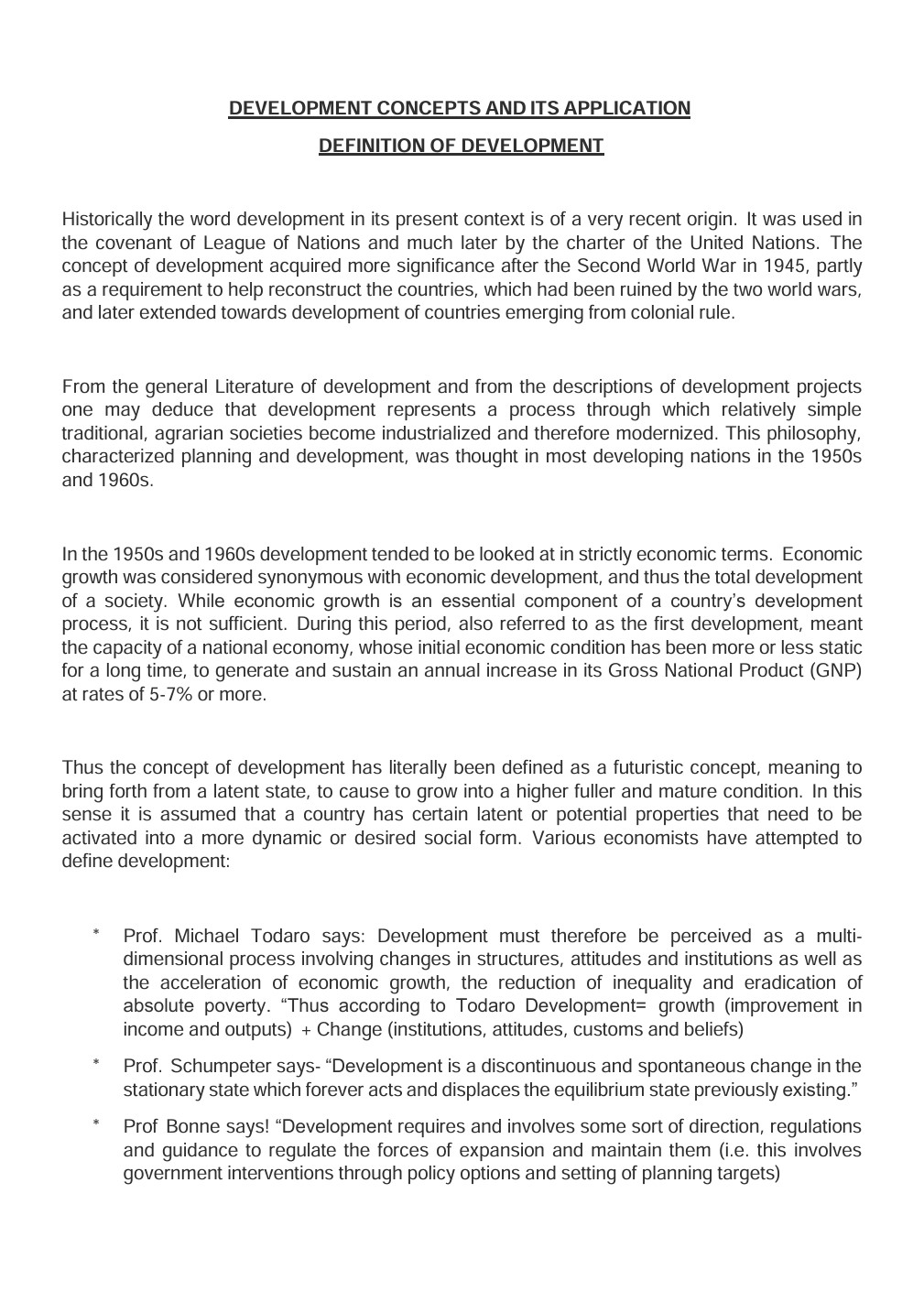
Historically the word development in its present context is of a very recent origin. It was used in the covenant of League of Nations and much later by the charter of the United Nations. The concept of development acquired more significance after the Second World War in 1945, partly as a requirement to help reconstruct the countries, which had been ruined by the two world wars, and later extended towards development of countries emerging from colonial rule.
Below is the document preview.

ESSENTIAL NEW BORN CARE
Trending!
Essential Newborn Care(ENC) is care that every newborn baby needs regardless of where it is born or its size. ENC should be applied immediately after the baby is born and continued for at least the first 7 days after birth.
55 Pages
4781 Views
0 Downloads
363.34 KB
ANATOMY & PHYSIOLOGY OF NON-EXCITABLE TISSUES
Trending!
FUNCTIONS OF EPITHELIUM
1.Protective functions
2.Absorptive functions
3.Secretory functions
4.Sensory functions
88 Pages
4652 Views
0 Downloads
7.33 MB
Cholangiocarcinoma
Trending!
The terms cholangiocarcinoma and bile duct cancer are often used interchangeably. Primary biliary tract malignancies affect one in every 100,000 people per year in the United States. More than 95% of these malignancies are cholangiocarcinomas (epithelial adenocarcinomas ) frequently found in the extrahepatic biliary tree. This form of cancer is slightly more prevalent in males than females (1.3:1.0) and usually affects patients in the fifth to seventh decade of life
12 Pages
4570 Views
0 Downloads
1.13 MB
INTEGUMENT SYSTEM ANATOMY AND PHYSIOLOGY
Trending!
The integumentary system is the body's outer layer, made up of skin, hair, nails, and glands and nerves. It protects the body from injury, infection, bacteria, and sunlight, and helps regulate body temperature. The integumentary system also allows you to feel sensations like hot and cold.
42 Pages
4586 Views
0 Downloads
2.21 MB
THE ENDOCRINE SYSTEM
The endocrine system is a network of glands that produce and release hormones into the bloodstream to regulate and target organs throughout the body. The hypothalamus is the neural control center for the endocrine system in vertebrates.
56 Pages
591 Views
0 Downloads
6.79 MB
Precipitate Labor
Trending!
Precipitate Labor
• Refers to a delivery which results after an unusually rapid labour (less than three hours) and culminates in the rapid, spontaneous expulsion of the foetus. Delivery often occurs without the benefit of asepsis.
Predisposing factors
• A multipara with relaxed pelvic or perineal floor muscles may have anextremely short period of expulsion.
• A multipara with unusually strong, forceful contractions. Two to three powerful contractions may cause the baby to appear with considerable rapidity.
• Inadequate warning of imminent birth due to absence of painful sensations during labor.
8 Pages
4607 Views
0 Downloads
783.61 KB
ABDOMINAL WALLS ABDOMINAL REGIONS
Trending!
The abdominal wall is made up of multiple layers of muscles and fascia that protect the body's organs and provide stability to the trunk. Some abdominal regions and muscles include:
Rectus abdominis
A muscle surrounded by the rectus sheath, which is made up of fibers from the three lateral abdominal wall muscles.
13 Pages
4949 Views
0 Downloads
545.73 KB
ANATOMY & PHYSIOLOGY OF THE DIGESTIVE SYSTEM
Trending!
FUNCTIONS OF THE DIGESTIVE SYSTEM
1. Delivery of water and
nutrients to the body
2. Endocrine functions
3. Excretion of waste (via the
biliary system)
4. Immunologic functions
101 Pages
4589 Views
0 Downloads
7.49 MB
Postpartum Hemorrhage (PPH)
Trending!
PPH Refers to excessive bleeding from the genital
tract after birth of the baby, up to 6(six) weeks or 42 days postpartum.
Description
• Excessive bleeding from the birth canal after 2ndstage of labour and within the puerperium period.
• It amounts to 500 ml or more, or any volume that causes deterioration of maternal condition.
14 Pages
4995 Views
0 Downloads
597.96 KB
URINARY SYSTEM ANATOMY AND PHYSIOLOGY
Trending!
COMPONENTS OF THE URINARY SYSTEM
A: Anatomical
1. Kidneys
2. Ureters
3. Urinary bladder
4. Urethra
COMPONENTS OF THE URINARY SYSTEM
A: Functional
1. Secretory units the
nephrons
2. Urine collecting units
•Kidneys have both*
61 Pages
4539 Views
0 Downloads
15.63 MB