Question Bank On Research Methodology
| Institution | University |
| Course | Research Methodology |
| Year | 1st Year |
| Semester | Unknown |
| Posted By | Rose Oloo |
| File Type | |
| Pages | 16 Pages |
| File Size | 54.66 KB |
| Views | 2653 |
| Downloads | 0 |
| Price: |
Buy Now
 Buy via
whatsapp Buy via
whatsapp
|


Description
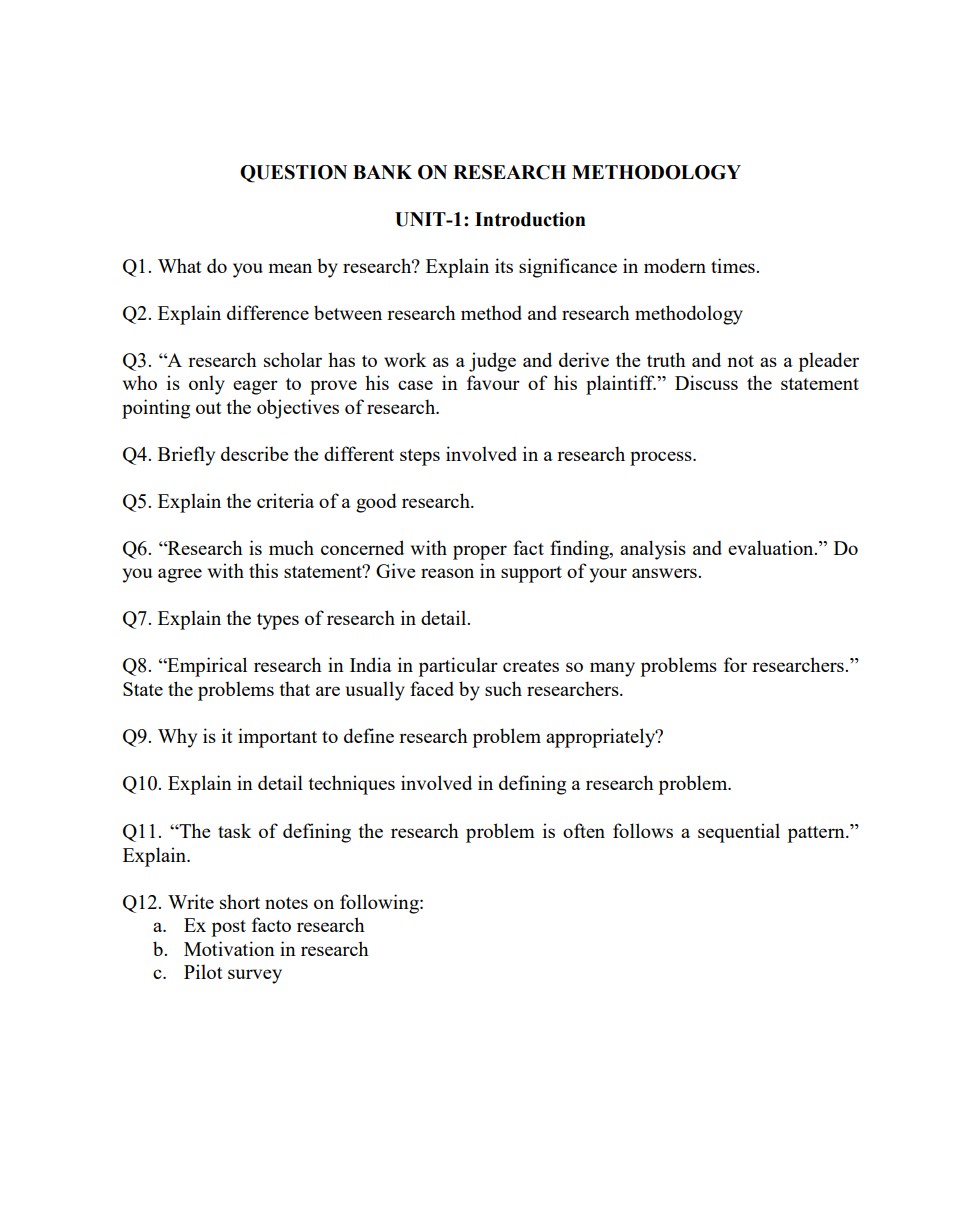
This document contains a question bank on research methodology covering 6 units: 1. Introduction to research - defining research, differences between methods and methodology, objectives of research, research process, criteria for good research. 2. Research design - meaning and significance, differences from problem approach, exploratory vs descriptive design, research hypotheses, experimental designs. 3. Sampling methods - sample design, probability vs non-probability sampling, random sampling, stratified sampling, sampling bias, sample size. 4. Data collection methods - primary vs secondary data, surveys, questionnaires, interviews, observation, case studies, attitudes measurement techniques. 5. Attitude measurement and scaling - types of scales, sources of error,
Below is the document preview.

PRINCIPLES OF TEACHING SHORT NOTES
Trending!
This document discusses principles of teaching and learning styles. It defines effective teaching as demonstrating competency across seven domains: social regard for learning, learning environment, diversity of learners, curriculum, planning and assessment, community linkages, and personal growth.
24 Pages
3787 Views
0 Downloads
211.34 KB
PLANT SYSTEMATICS LECTURE NOTES
Trending!
This exploration of taxonomy, nomenclature, herbarium curation, botanical gardens, and
selected angiosperm families provides a detailed understanding of plant diversity, classification,
33 Pages
4080 Views
0 Downloads
960.25 KB
PLANT TAXONOMY LECTURE NOTES
Trending!
Taxonomy may be defined as the study and description of the variation of organisms, the investigation of the causes and consequences of this variation, and the manipulation of the data obtained to produce a system of classification.
45 Pages
4583 Views
0 Downloads
375.56 KB
BCE 206: ENGINEERING SURVEYING LECTURE NOTES
Trending!
Surveying is defined as “taking a general view of, by observation and measurement determining the boundaries, size, position, quantity, condition, value etc. of land, estates, building, farms mines etc. and finally presenting the survey data in a suitable form”. This covers the work of the valuation surveyor, the quantity surveyor, the building surveyor, the mining surveyor and so forth, as well as the land surveyor.
78 Pages
4366 Views
0 Downloads
2.07 MB
BBY 3108: INVERTEBRATE ZOOLOGY SHORT NOTES
Trending!
An invertebrate is any animal without an internal backbone which includes animals such as insects, crustaceans, worms, jellyfish and sponges. The diversity of invertebrate species far outnumbers that of the vertebrate animals. One group of invertebrates called Arthropods, which includes insects, spiders and crustaceans, contains almost 80% of all animal species. The remaining invertebrates constitute between 12-15% of all animal species.
99 Pages
4137 Views
0 Downloads
1.11 MB
BUSINESS MANAGEMENT EXAMS SHORT REVISION NOTES
Trending!
The document provides an introduction to management, discussing its definition, characteristics, levels, and key functions including planning, organizing, staffing, directing and controlling. It defines management as getting things done through others and outlines that it is a universal, purposeful, integrative and continuous process.
12 Pages
4095 Views
0 Downloads
297.32 KB
HISTOLOGY OF FIBROUS CONNECTIVE TISSUE
Trending!
Definition and classification
Cells
Tissue responsible for support, connects or separates different types of tissues and organs
Composition
Extracellular matrix (abundant)
Protein fibres
Amorphous ground substance
Tissue fluid (constant)
23 Pages
3686 Views
0 Downloads
6.41 MB
Development of Chorion and placenta
Trending!
Fetal membranes are membranous/auxiliary
structures that surround or associated with vertebrate
embryo but do NOT take part in final embryo
formation.
Include:
1-Amnion.
2-Yolk sac.
3-Allantois.
4-Connecting stalk and umbilical cord.
5-Chorion
38 Pages
4431 Views
0 Downloads
10.11 MB
PLACENTA, FETAL MEMBRANES AND MULTIPLE GESTATION
Trending!
DEVELOPMENT OF THE CHORIONIC SAC
• Trophoblast layer of the blastocyst
• Differentiation into: – Cytotrophoblast – inner layer – Syncytiotrophoblast – outer layer
• Development of extraembryonic mesoderm
• Formation of isolated lacunae spaces which later coalesce to form one big extraembryonic cavity – renamed chorionic sac
• Chorionic sac surrounds the amniotic cavity and primary umbilical vesicle
• Expansion of chorionic sac reduces the size of umbilical vesicle
130 Pages
3792 Views
0 Downloads
3.06 MB
DEVELOPMENT OF SKIN AND ASSOCIATED STRUCTURES
Trending!
INTRODUCTION
• The integumentary system consists of: – the skin – and its appendages:
• sweat glands,
• nails,
• hairs,
• sebaceous glands,
• arrector muscles of hairs (arrector pili muscles),
• mammary glands,
• teeth
92 Pages
3885 Views
0 Downloads
1.84 MB